
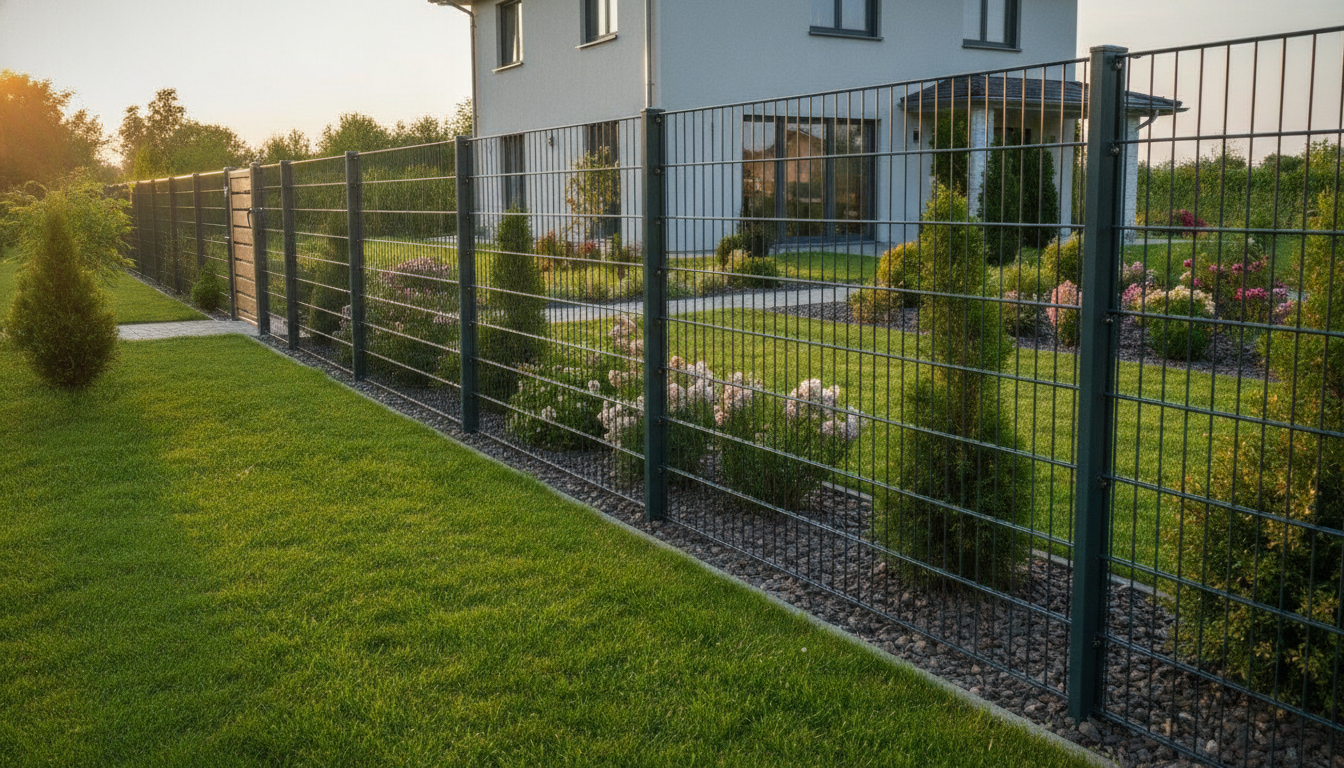
Choosing rigid mesh fencing for your garden is often a long-term decision: you want to secure your property without having to redo the work in five years. So what is the actual lifespan of these panels? Here are the factors that determine their longevity, along with our advice for making the right choice for your land.
An average lifespan of 15 to 30 years
On average, a rigid mesh fence lasts between 15 and 30 years. This range mainly depends on the quality of the steel, the anti-corrosion treatments, and your region’s climate.
Unlike chain-link fencing, which eventually loosens and sags, a rigid panel retains its original structure and rigidity if installed correctly. This is what makes it one of the most cost-effective choices for marking out land over the long term.
Galvanizing and coating: the core of durability
Steel’s main enemy is rust. To prevent it, the panels must undergo two essential treatments: hot-dip galvanizing (a bath of molten zinc to create a barrier against corrosion) and plastic coating (a protective polyester coating baked in an oven).
Entry-level mesh fencing, often less well protected, tends to rust quickly at the welds. Conversely, panels treated with high-quality coatings will withstand UV rays and moisture for several decades before the first corrosion spots appear.
The impact of climate and environment
The immediate environment has a major impact on fence wear. By the sea, salt and sand accelerate the deterioration of protective coatings. In these areas, standard mesh fencing will deteriorate much faster if it is not specifically designed for marine environments.
Similarly, pollution near major roads or industrial areas attacks the coating. In the countryside or in a typical urban area, the fence will age much more slowly, without requiring any particular attention.
Installation quality and the privacy-screen trap
Longevity depends not only on the product, but also on its installation. Posts set in concrete will always be more stable than base plates fixed to a fragile low wall. If the fence moves with every gust of wind, the fixings wear out and the entire structure weakens.
The risk is even greater if you add privacy slats or a privacy screen. By blocking the wind, these accessories act like sails. Without posts that are sufficiently sized or set to withstand this force, a storm can bend the structure or crack your low walls, ruining your investment.
A few steps to extend the lifespan of your mesh fence
Even though rigid mesh fencing requires very little maintenance, a few simple habits can help extend its durability:
- Clean the mesh once a year with clean water or slightly soapy water to remove salt, pollution, or plant moss.
- Avoid hitting the base of the posts with the lawn mower or string trimmer, as these impacts chip the protective coating and allow rust to take hold.
- Regularly trim shrubs or climbing plants growing against the fence to prevent them from applying continuous pressure on the panels.

Experte clôture, portail et aménagement extérieur depuis 2019.
Diplômée en Master de Marketing digital – SEO, UX/UI
Voir le profil sur LinkedIn


