
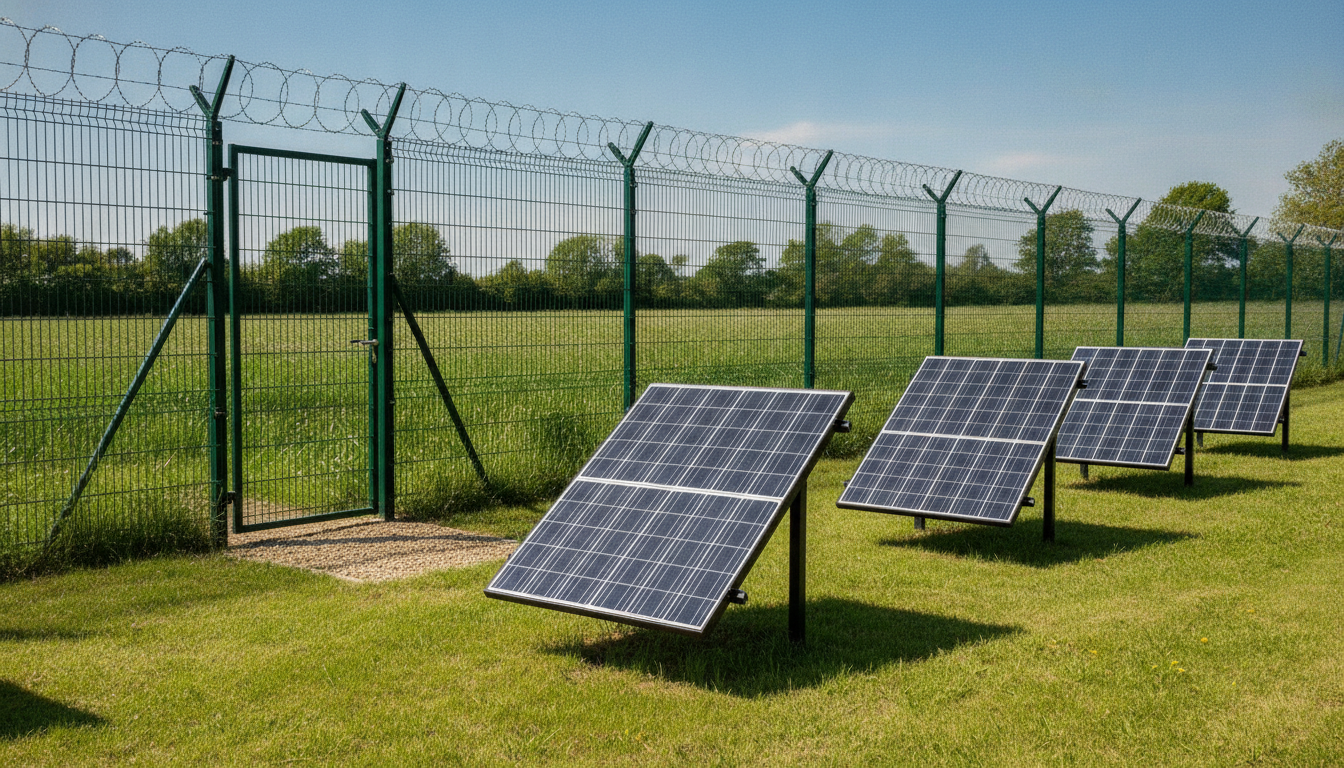
If your roof is poorly oriented or cluttered, installing your photovoltaic panels on the ground is an excellent alternative for generating your own electricity. However, placing modules in your garden requires compliance with certain planning and safety regulations. Between protecting the equipment from theft and preventing accidents, the question of installing a fence arises quickly. Here is what you need to know before getting started.
Planning Regulations for Ground-Mounted Installations
Before choosing your fencing, you need to check the urban planning code. If your panels have a capacity of less than 3 kW and do not exceed 1.80 meters in height, you normally do not need to complete any formalities (unless you live near a historic monument or in a protected area). Beyond these thresholds (height greater than 1.80 m or capacity over 3 kW), a prior works declaration (DP) with the town hall is mandatory.
Also remember to review your municipality’s Local Urban Development Plan (PLU): some town halls impose minimum distances from the street or prohibit certain visual elements to preserve the landscape.
Is It Mandatory to Enclose Access to Your Panels?
From a purely legal standpoint, nothing requires you to surround your panels with fencing. In practice, however, it is strongly recommended. Panels installed at human height remain accessible to children, pets, or passersby. A damaged cable or faulty inverter can quickly become dangerous.
There is also an insurance consideration: most insurers require that your property be fully enclosed to cover theft or vandalism. Without solid fencing and a locked gate, you risk receiving no compensation in the event of damage.
Installing a Fence: What Limits Must Be Observed?
If you decide to enclose the area, be aware that installing a barrier is also subject to regulations. While the Civil Code (Article 647) guarantees the right to enclose one’s property, many municipalities require a prior declaration with the town hall before installing fencing or a low wall.
Here again, the local PLU sets the rules. It generally establishes the maximum authorized height (often limited to 2 meters), as well as the permitted materials and colors to ensure the installation integrates well into the neighborhood.
Which Model Should You Choose to Secure Your Installation?
The choice of fencing depends primarily on the risks you want to prevent. Rigid mesh fencing mounted on a concrete base is often the best option: the concrete slab prevents rodents or pests from burrowing under the fence and gnawing on electrical cables.
If your panels are visible from the street and you prefer to conceal them, you can add privacy slats or screening. Be careful with orientation, however: these screens must never cast shadow on your solar collectors, or your electricity production will drop. Brands such as Districlos offer rigid panels and screening kits suited to this type of installation.
Safety Distances to Plan For
The placement of your fence should not be done randomly. If you install it at the property boundary, it must be positioned strictly on your side to avoid any neighborhood disputes. If you opt for a shared boundary fence, written agreement from your neighbor is essential.
Technically, always leave a space of at least 1.50 to 2 meters between the panels and the fence. This distance allows easy circulation for maintenance and cleaning, and above all prevents the shadow of the fence (or a neighboring hedge) from blocking the sun during the day.

Experte clôture, portail et aménagement extérieur depuis 2019.
Diplômée en Master de Marketing digital – SEO, UX/UI
Voir le profil sur LinkedIn


