
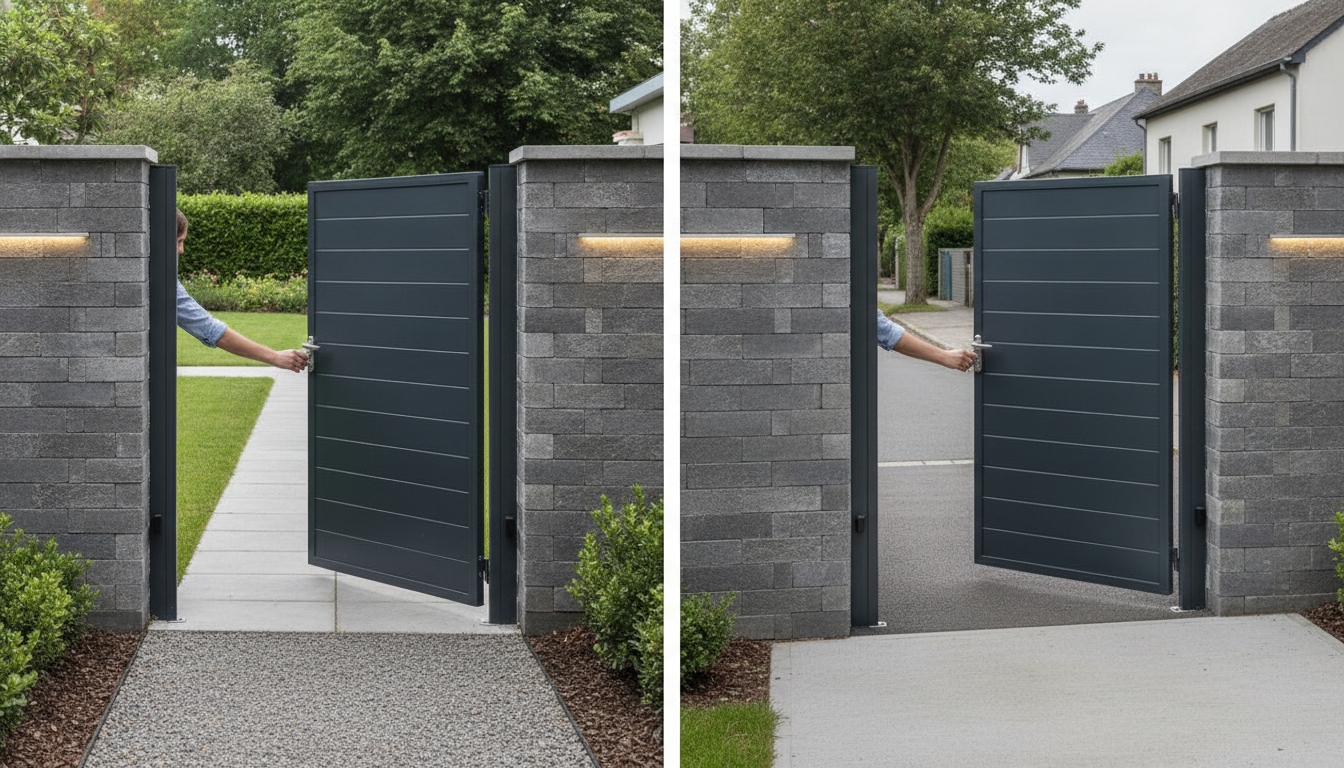
When installing a wicket gate, the question of the opening direction comes up very quickly: should it open inward (push) or outward (pull)? This detail changes many things in day-to-day use, whether in terms of practicality, safety, or simply legal compliance. Here is what you need to know before setting your posts.
What the law says
Before deciding, you should first check the regulations. In France, the Civil Code and local planning rules are clear: your wicket gate must never encroach on the public highway. If your fence opens directly onto a pavement or a street, outward opening is therefore prohibited.
The aim is simple: to avoid obstructing or injuring pedestrians. The only exception concerns wicket gates installed set back from the property line, leaving enough space for the gate leaf to open without extending into the street. If your gate is directly on the property line, inward opening is mandatory.
Inward opening: the classic, safer option
This is the most common option. Known as a push-opening gate, it opens towards your garden. It is a natural choice that prevents visitors from having to step back onto the pavement to let you open it.
In terms of safety, it is also reassuring if you have children or pets. If the gate is not properly closed, the leaf opens towards the garden rather than towards the street, which limits the risk of a direct escape onto the roadway.
Outward opening: to save space
Less common, outward opening (or pull-opening) is useful for narrow entrances. If you do not have enough clearance in your courtyard, or if a parked car blocks the way, opening inward quickly becomes frustrating.
By choosing an outward-opening wicket gate, you keep the entire surface of your courtyard available. It is an excellent solution for small spaces, provided you have sufficient setback from the street to remain compliant with the law.
The trap of sloping ground
Sometimes, the ground itself makes the decision. If your driveway slopes up towards the house, inward opening will be difficult, or even impossible: the bottom of the gate will scrape the ground as soon as you try to open it.
You then have two options: outward opening (if the law allows it where you live) or using rising hinges. These accessories lift the gate slightly as it opens, preventing it from catching on the slope.
Left-hand or right-hand inward-opening: how to choose?
Once you have chosen the opening direction (inward or outward), you still need to decide which side to install the handle and lock. To avoid making a mistake when ordering, stand on the street side, facing your gate:
- If the lock is on the right and you push the gate inward, it is a right-hand inward-opening.
- If the lock is on the left and you push inward, it is a left-hand inward-opening.
For outward opening (pull-opening), the logic is reversed because you pull the gate leaf towards you.
Also consider everyday obstacles: the presence of a letterbox, a water meter, or a tree may force you to choose one side rather than the other. If you are unsure, the Districlos teams can help you choose the aluminium or steel model best suited to your project.

Experte clôture, portail et aménagement extérieur depuis 2019.
Diplômée en Master de Marketing digital – SEO, UX/UI
Voir le profil sur LinkedIn


