
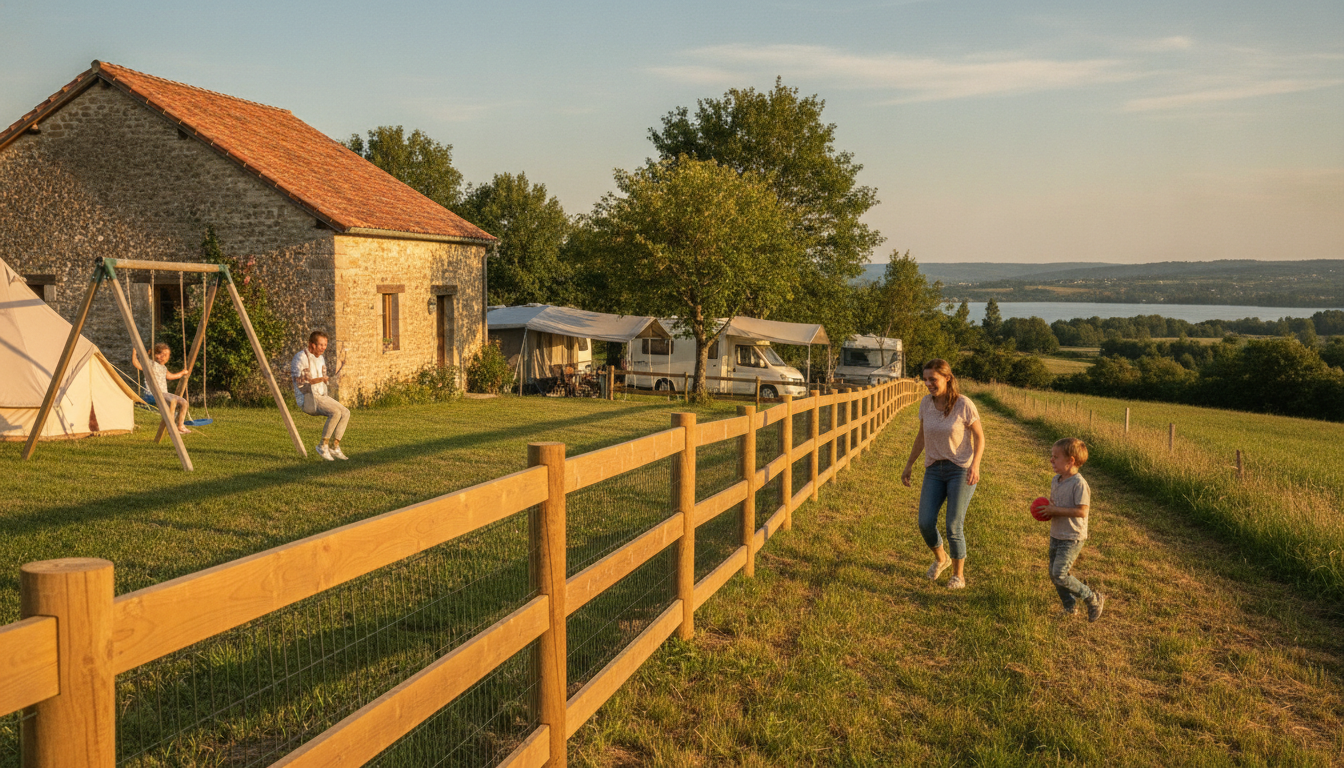
When you run a campsite or a holiday rental, fencing isn’t just about marking property lines. It reassures parents, protects against intrusions and, above all, preserves guests’ privacy without turning the place into a prison. Between local rules and real on-the-ground needs, here’s how to sort it out.
Safety and regulations: what you need to know
If you welcome the public, safety isn’t optional. For example, if your property has a shared swimming pool, the law requires a compliant access fence (NF P90-306) to prevent any risk of drowning.
Before buying your rolls or panels, always check with the town hall to consult the Local Urban Plan (PLU). In many tourist or protected areas, municipalities impose maximum heights, colours (often green or grey) or specific materials so as not to spoil the landscape.
Rigid panels: the strong, long-lasting option
To mark out pitches or secure the perimeter of a holiday rental, rigid panels (or rigid mesh fencing) are still the safe bet. It’s neat, almost impossible to vandalise or climb, and it lasts over time.
If you go through specialist suppliers like Districlos, choose galvanised and powder-coated models. They resist rust far better, especially if your land is damp or near the sea. Aesthetically, dark shades (anthracite grey, moss green) blend easily into the vegetation.
Protecting guests’ privacy (overlooking)
No one likes having breakfast on the mobile home terrace under the neighbours’ gaze. To block overlooking without building big walls, you can dress up your rigid panels:
- Privacy slats (wood or PVC): They slide directly into the mesh. It’s neat and modern, and PVC requires no maintenance.
- Artificial hedges: A great way to get greenery straight away, with no trimming or watering chores.
- Fabric privacy screens: Less attractive in the long run, but very cost-effective for quickly screening long stretches.
Roll fencing for large areas
If your property covers several hectares or borders a forest, installing rigid panels everywhere will quickly blow your budget.
For these outer areas, flexible roll fencing (single-twist chain-link or welded mesh) is much more economical. It easily adapts to sloping or uneven ground. Installed on sturdy posts, it’s more than enough to keep wild or stray animals out.
Don’t overlook access points
A good fence is useless if the entrances are poorly planned. For a campsite, plan a sliding gate wide enough for motorhomes and caravans to manoeuvre without stress. For a holiday rental, a nice matching pedestrian gate makes a great first impression as soon as guests arrive. In all cases, choose sturdy hardware: in peak season, this equipment is used dozens of times a day.

Experte clôture, portail et aménagement extérieur depuis 2019.
Diplômée en Master de Marketing digital – SEO, UX/UI
Voir le profil sur LinkedIn


