
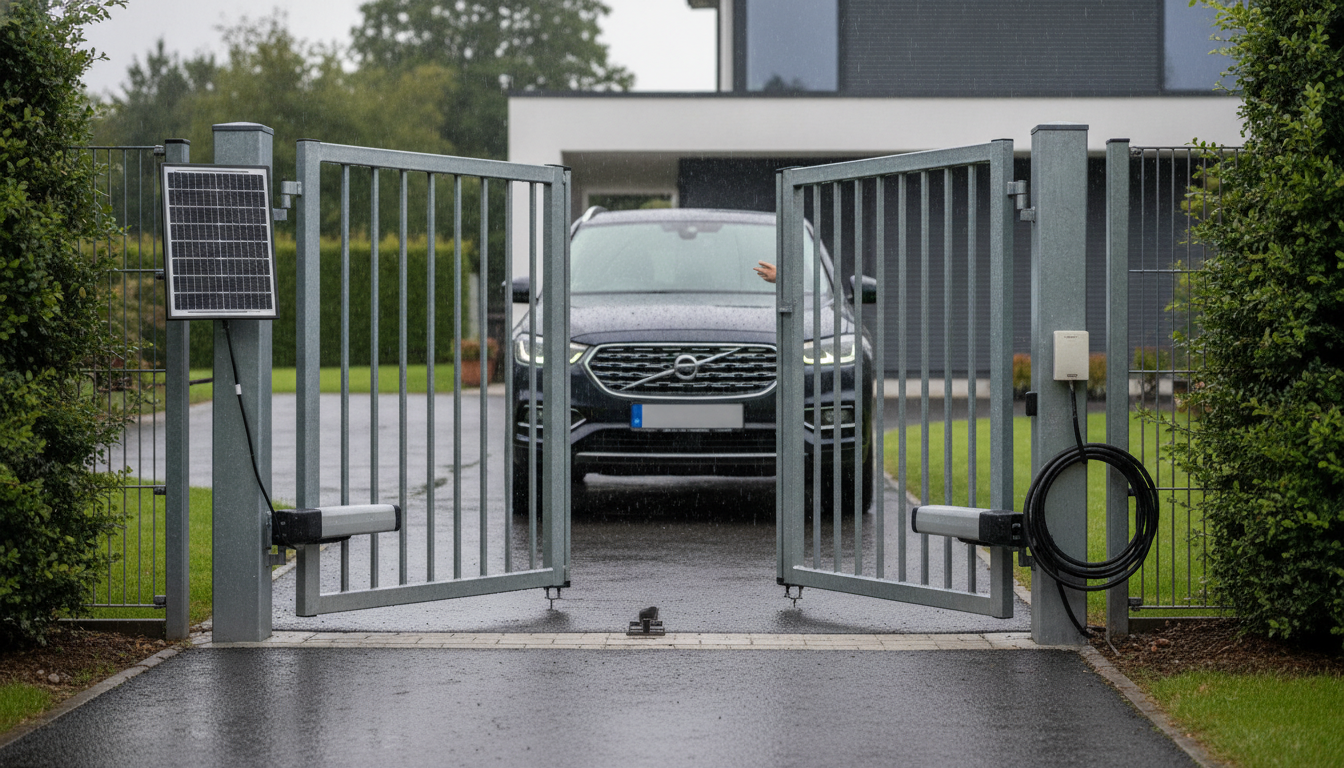
Installing a motorized gate changes daily life: no more getting out of your car in the rain to open the leaves. But when it comes to equipping your gate, a technical question quickly arises: is it better to opt for a classic wired connection or turn to solar?
At Districlos, we help you gain clarity to make the right choice based on your property and habits.
How a Classic Wired Motorization System Works
The wired system is the traditional solution. It requires a direct connection to the home’s electrical grid (230 V). To bring electricity to the gate posts, a trench must be dug in the garden to lay waterproof conduits and power cables.
This installation continuously powers the motor as well as all safety accessories, such as photoelectric cells, the flashing light, and the receiver. It is a robust option that ensures constant power, regardless of how often the gate is opened.
Advantages and Limitations of Wired Electric Gates
The main strength of the wired system is its reliability. The system does not depend on the weather and can handle frequent openings without strain. It is ideal for large families or co-owned property entrances where the gate opens dozens of times a day.
However, the work can quickly become extensive if you do not have other earthworks planned. Digging under a paved or asphalt driveway requires time and a certain budget. Another detail to keep in mind: in the event of a power outage, the gate remains blocked, unless you have installed a backup battery or use the manual release.
How Does a Solar Gate Automation System Work?
Contrary to common belief, a solar gate does not operate directly from real-time sunlight. The system uses three elements: a photovoltaic panel, a backup battery (placed in a waterproof casing), and a low-consumption motor (12V or 24V).
The panel captures daylight (even on cloudy days) and continuously recharges the battery. When you activate the remote control, the motor draws accumulated energy from this battery. This closed-circuit operation makes your installation autonomous from the electrical grid.
Strengths and Constraints of Solar Power
The primary advantage of solar remains its ease of installation. With no trench to dig or cable to run from the house, installation takes only a few hours, significantly reducing labor costs. Furthermore, you do not consume electricity on your overall bill.
But be aware of the limitations: the system’s efficiency directly depends on sunlight. If your entrance is heavily shaded or if you live in a region frequently subject to fog, the battery will struggle to recharge properly. Also note that the number of daily openings is limited, and the battery will need to be replaced every 5 to 7 years.
Comparison: Which System to Choose?
To help you choose the right kit, here are the three essential criteria to consider:
- Overall budget: While the solar kit is more expensive to purchase, it saves you from paying for extensive earthworks. The wired system is cheaper initially, but the cost of connection can quickly reverse that trend.
- Your property’s configuration: If the gate is more than 20 meters from your house, solar is often the simplest solution to avoid an interminable trench.
- Frequency of use: For very regular use, prioritize the wired system. For typical residential use (fewer than 10 openings per day), solar works perfectly.
Also consider the visual aspect: the solar model requires installing a small panel on a post or nearby wall, which requires some integration to remain discreet.
Installation and Maintenance: What You Need to Know
Regardless of the chosen option, do not neglect safety. A motorization system must comply with European standards to avoid any risk of accident. At Districlos, we advise you to always pair your installation with obstacle detection cells and an orange flashing light to signal gate movements.
In terms of maintenance, the wired system requires almost nothing, apart from regular lubrication of mechanical parts. For solar, you will simply need to wipe the photovoltaic panel occasionally to remove leaves, dust, or snow that could hinder its charging.

Experte clôture, portail et aménagement extérieur depuis 2019.
Diplômée en Master de Marketing digital – SEO, UX/UI
Voir le profil sur LinkedIn


