
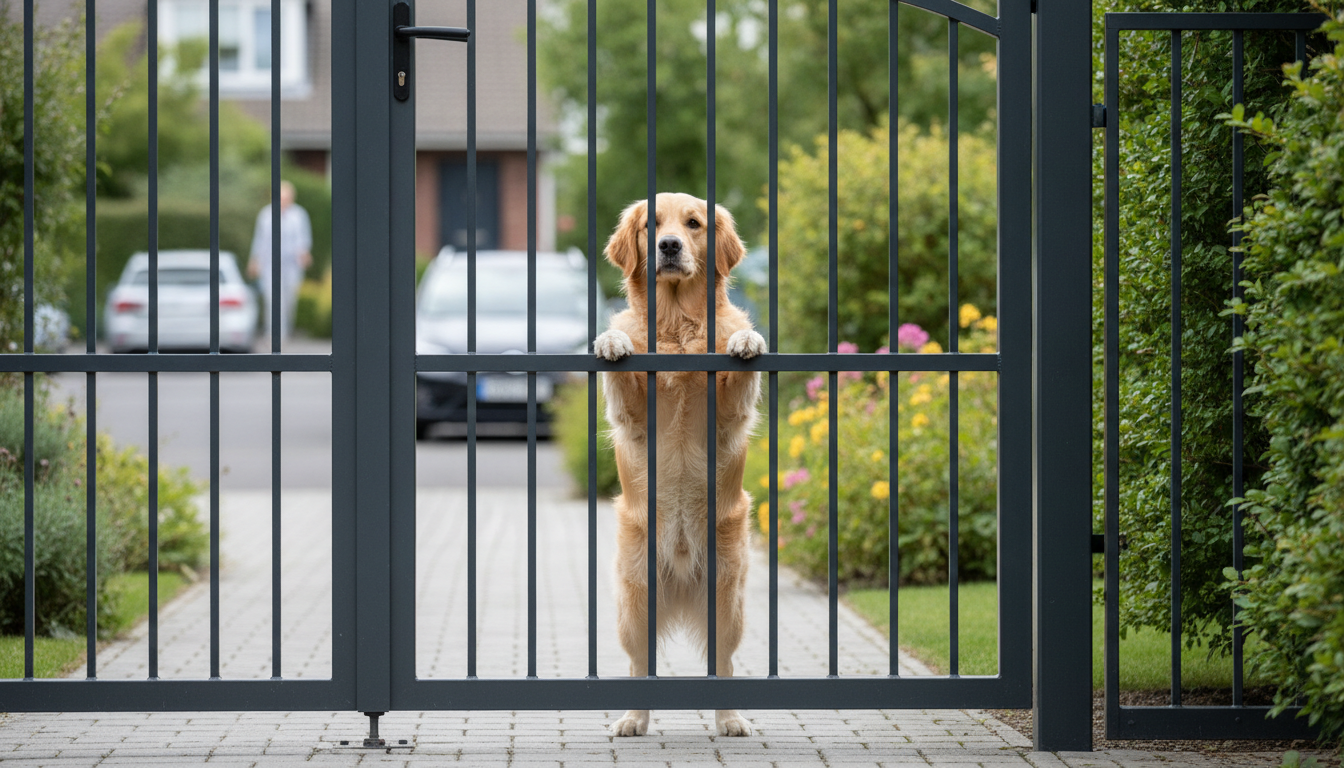
Seeing your dog escape into the street is every owner’s nightmare. Between the fear of cars and the anxiety of not finding it, securing the garden quickly becomes an obsession. The gate is obviously your first line of defense. But between models of 1.20 m and those of 2 meters, how do you choose the right height to protect your pet?
To make the right decision, simply measuring your dog’s size is not enough. You also need to observe its agility, temperament, and the specific characteristics of your entrance.
Knowing your dog’s limits (and talents)
Not all dogs handle obstacles in the same way. A chihuahua doesn’t have the jumping ability of a Border Collie, but it has other resources. Before getting out the tape measure, observe your pet: is it a jumper, a digger, or a climber?
Some very athletic breeds clear improbable heights without even a running start. Other dogs, heavier or short-legged, will never attempt to jump, but will instead try to dig underneath or squeeze through bars.
Height guidelines according to size/build
To help you see more clearly, here are the heights generally recommended by professionals:
- Less than 1.20 m: sufficient for calm or elderly small dogs (dachshunds, French bulldogs, miniature poodles). Be careful, however, if your small dog is particularly lively.
- Between 1.50 m and 1.60 m: this is the standard average. It suits most medium to large dogs (Golden Retrievers, spaniels, boxers) that do not have a jumping temperament.
- From 1.80 m to 2.00 m: essential for active, guard, or working large dogs (Malinois, Huskies, Dobermans). A determined large dog can clear 1.50 m without much effort if it has a running start.
Temperament: the real key factor
The physical size of the animal is not everything; its temperament plays a huge role. A calm, home-loving dog will respect a simple visual barrier. However, an anxious, hyperactive dog or one that guards at the slightest noise will constantly look for a way to get out.
If your dog tends to jump against the gate whenever someone passes in the street, aim directly for 1.80 m. This will prevent it from accidentally falling to the other side. Also, consider the structure: if the gate has horizontal crossbars, some dogs will use them as a ladder. If you have a climber, opt for a completely smooth and vertical model.
Solid or openwork: which design to prevent escapes?
Height isn’t everything; visuals matter greatly. A solid gate blocks the view of the street. Fewer stimuli (passers-by, other dogs, cars) generally mean less barking and less desire to escape.
If you prefer an openwork or semi-openwork model, the space between the bars must be narrow enough so that the dog cannot get its head through, which also prevents the risk of getting stuck. Finally, monitor the space under the gate: leave a maximum gap of 5 cm with the ground to prevent a small dog from slipping underneath.
Find the right model for your garden
To secure your entrance without turning your home into a prison, Districlos offers a whole range of aluminum and PVC gates up to 2 meters high.
Whether you need a sliding model to optimize space or a large solid swing gate to block the view of the street, you can configure your project online or visit a store to discuss it with an advisor and find the right solution for your companion.

Experte clôture, portail et aménagement extérieur depuis 2019.
Diplômée en Master de Marketing digital – SEO, UX/UI
Voir le profil sur LinkedIn


