
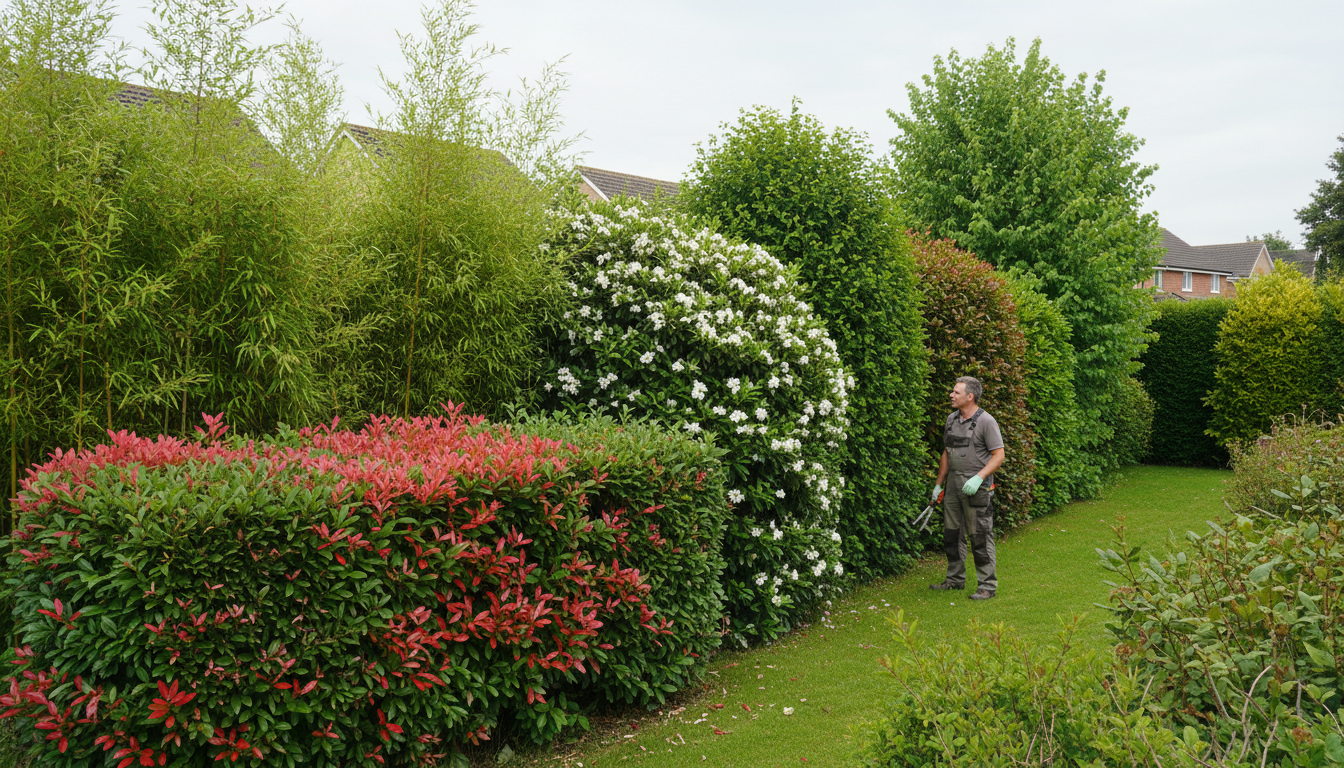
With its recognizable red leaves, Photinia is the go-to choice for screening hedges. However, between the devastating effects of entomosporium, the requirement for at least two prunings per year, and the “copy-paste” look found in housing estates everywhere, many gardeners are looking for something else. Fortunately, there are alternatives, both plant-based and otherwise. Here are the options worth considering.
Why look for an alternative to Photinia?
Photinia Red Robin is a victim of its own success. Mass-planted for twenty years, it has made housing estate hedges perfectly interchangeable. But the real problem lies elsewhere: this species is increasingly susceptible to fungal diseases, particularly entomosporium, which causes black spots on the leaves and can seriously weaken the plant. In heavy, damp soils, this often leads to disaster by the second or third winter.
There is also its rapid but untidy growth, which requires at least two prunings a year, and foliage that thins out at the base over time. As a result, after a few years, the hedge provides poor screening at the bottom, exactly where it is needed most. Turning to other solutions, whether plant-based or artificial, therefore makes sense.
Evergreen shrubs that truly provide screening
Several species do the job just as well as Photinia (if not better), without the drawbacks:
- Eleagnus ebbingei: dense grey-green foliage, highly resistant to wind and salt, fast-growing, and few diseases. Probably the most direct replacement.
- Portuguese Laurel (Prunus lusitanica): more elegant than the classic cherry laurel, it offers evergreen dark green foliage and good opacity without becoming invasive.
- Osmanthus burkwoodii: compact, evergreen, and fragrant in spring. Well-suited for a 1.5 m to 2 m hedge with minimal effort.
- Ebbing’s Silverberry: drought-resistant, grows quickly, and remains dense from base to top.
- Japanese Privet: semi-evergreen to evergreen depending on the region, it tolerates almost any soil type and is easy to prune.
These shrubs maintain their density throughout their height, including at the base, which is often the weak point of aging Photinia hedges.
Privacy screening: immediate privacy without waiting for growth
This is the main argument compared to any plant hedge: privacy screening installed on a fence or mesh works from day one. There is no need to wait three or four years for the plants to grow together. The screening is total, uniform, and does not depend on the season or the weather.
At Districlos, you will find a range of privacy screens adapted to different contexts: PVC, composite, aluminium, or woven fabric. These solutions are fixed directly onto rigid mesh or an existing fence and are available in stock (in-store or for fast delivery). This allows you to set up a screening project in a few days, rather than a few seasons.
Combining a hedge and privacy fencing: the best option?
Rather than choosing between plants and artificial solutions, the most effective approach is often to combine both. A fence with aluminium or composite privacy slats ensures immediate and durable screening, while shrubs planted in front provide a natural and aesthetic touch over time.
This approach solves a common problem: gaps in the hedge caused by a diseased, dead, or poorly developed shrub. With a screening structure in the background, your privacy is not compromised even if a plant needs to be replaced. It is also the ideal configuration when overlooking is very close, typically at the property boundary.
Privacy panels: durability without maintenance
Rigid privacy panels are in a category of their own. Made of aluminium, composite, or treated wood, they integrate directly into a fencing system and offer 100% screening without any maintenance. No pruning, no watering, and no diseases to monitor.
Districlos notably offers aluminium slat fences and composite panels that are resistant to UV rays, moisture, and temperature fluctuations. Their lifespan far exceeds that of a plant hedge, and their appearance adapts to various garden styles, from contemporary to classic. For those who want to resolve the issue once and for all, this is the most pragmatic option.
How to choose based on your situation
The right choice depends on three factors: your budget, your patience, and your terrain. If you have the time and suitable soil, an Eleagnus or Portuguese Laurel hedge will do the job perfectly for just a few euros per plant. If you need quick, uncompromising screening, Districlos privacy screens and panels will be more suitable.
In any case, the mistake to avoid is replanting Photinia by default, simply because it is what you know. Take the time to compare, and if you are unsure, Districlos customer service can assist you, either online or in one of their stores.

Expert in fencing, gates, and outdoor landscaping since 2019.
Holds a Master’s degree in Digital Marketing – SEO, UX/UI.
View LinkedIn profile


