
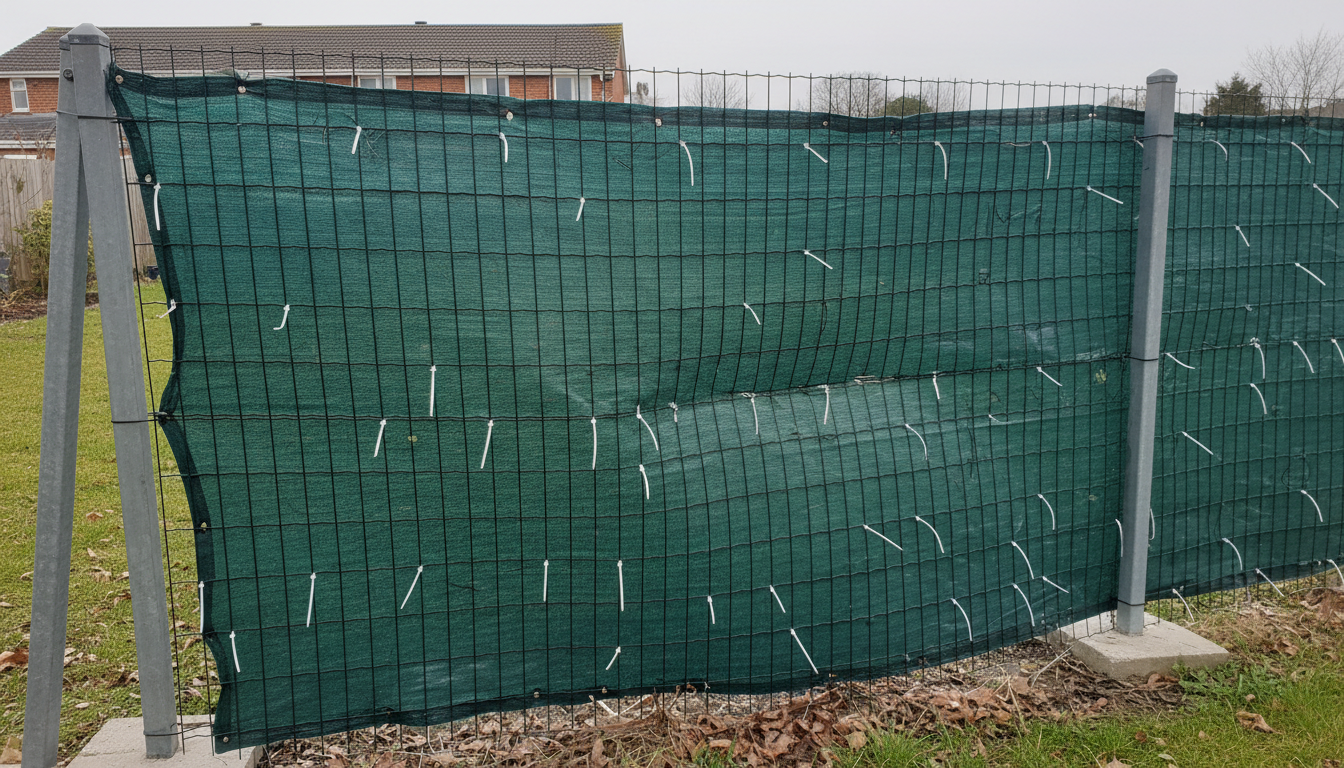
You’ve just purchased a brand-new privacy screen, you’re motivated, and you start attaching it directly to your fence with plastic ties every 50 cm. Logical, right? Except six months later, your fence is warped, buckled, sometimes even torn from the posts. The culprit isn’t the wind. It’s the installation method. This mistake appears in the vast majority of residential installations, yet it’s simple to avoid.
Privacy Screening Turns Your Fence Into a Sail
Chain-link fencing is designed to let air pass through. This is what allows it to withstand wind without moving. As soon as you install privacy screening on it, you eliminate this permeability. Your fence becomes a solid surface exposed to gusts, exactly like a boat sail. And your fence is not at all dimensioned to withstand this pressure.
The higher the opacity rating, the greater the wind load. An 80% opacity privacy screen does not behave at all like a 50% model. Many people overlook this parameter at the time of purchase, even though it radically changes the structural demands.
Mistake #1: Fastening Too Tightly Without Reinforcing the Structure
The typical reflex: attach the privacy screen as tightly as possible against the fence, multiplying rigid attachment points. The intention is good—you want it to hold. But this is precisely what causes the damage. By fastening too tightly, each gust transmits all the force directly to the fence and posts, with no margin for absorption.
The mesh deforms, the posts tilt, the ground fixings work loose and eventually fail. On standard chain-link fencing with posts set 2 meters apart, a single storm is sometimes enough to cause irreversible damage.
What to Check Before Even Unrolling the Privacy Screen
Before touching the privacy screen, ask yourself the right question: is your fence capable of supporting screening? Chain-link fencing mounted on thin stakes with a simple tension wire is not designed for this. At minimum, you need:
- Reinforced posts (48 mm diameter or larger), properly set in concrete or mounted on base plates, with bracing struts at ends and corners
- A tension wire at top and bottom, or even a third in the middle, to distribute forces across the full height of the fence
- Post spacing reduced to 2 meters maximum, ideally 1.5 m in windy areas
If your installation does not meet these conditions, reinforce it first. Installing privacy screening on a fragile fence guarantees its destruction.
The Correct Installation Method
The attachment must allow the privacy screen to work slightly with the wind, without transmitting the entire load to the fence. Use suitable fixing clips or fasteners, positioned every 30 to 40 cm along the tension wires and posts, not on the fence mesh itself.
Attach the privacy screen first to the posts, then to the horizontal tension wires. The fence should serve only as an intermediate support, not as a load-bearing structure. And do not tension the privacy screen like a drum: leave very slight play. This flexibility is what will prevent the wind from tearing everything away.
Chain-Link or Welded Mesh: The Choice Makes All the Difference
If you know from the outset that you want to install privacy screening, welded mesh panel fencing is a far better choice than chain-link. Welded panels in 4 or 5 mm steel wire, fixed to slotted posts, offer far superior structural resistance. Screening clips directly into the mesh without creating excessive stress.
At Districlos, welded mesh panels are available in stock with compatible screening systems—PVC slats, woven willow, artificial hedges. You can collect your order in-store or have it delivered directly to your site. If you are unsure between several solutions, customer service can help you size the system according to your wind exposure.
When the Damage Is Already Done
Is your fence already deformed? Two options. If the posts are still straight and properly set, you can re-tension the fence by adjusting the tension wires and adding bracing struts. Remove the privacy screen, correct the structure, then reinstall it properly.
If the posts are bent or dislodged, there’s no miracle: the installation must be redone. This is the time to consider switching to welded mesh panel fencing with integrated screening, which will prevent you from experiencing the same problem in the next windstorm. It costs slightly more initially, but the fence truly lasts over time.

Expert in fencing, gates, and outdoor landscaping since 2019.
Holds a Master’s degree in Digital Marketing – SEO, UX/UI.
View LinkedIn profile


