
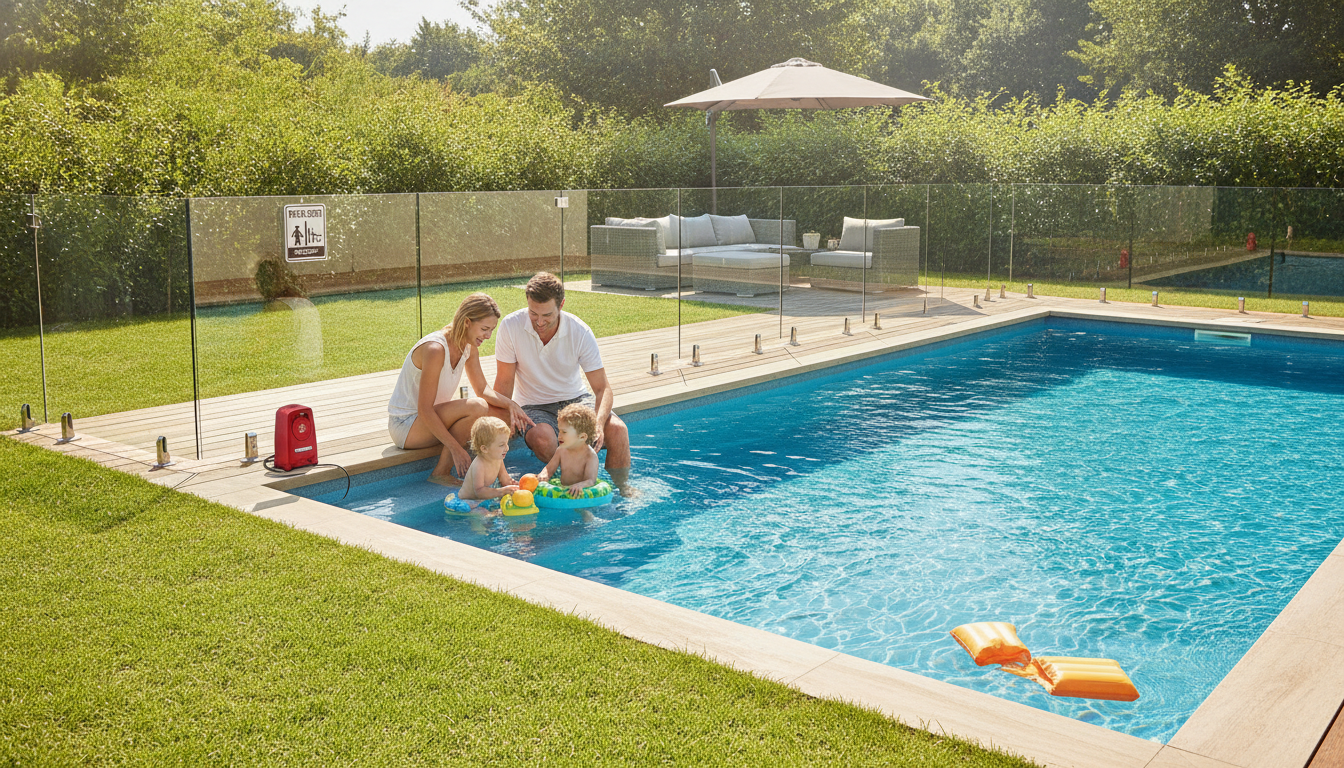
A swimming pool is a guarantee of great family moments during the summer. However, it is also a body of water that requires vigilance, especially when young children are around. Every year, drowning is among the leading causes of accidental death in young children. The good news: most of these tragedies are preventable with the right habits and equipment. Here is what you need to know to enjoy your pool with peace of mind.
What the law says about private pools
Since 2004, every inground or semi-inground private pool must be equipped with a standardized safety device. This obligation applies to both primary residences and seasonal rentals. Failure to comply with this rule can be costly: up to a €45,000 fine.
Regulations recognize four types of devices: protective barriers, alarms, safety covers, and enclosures. You may choose only one, but nothing prevents you from combining several solutions. Note: above-ground and inflatable pools are not covered by this legal obligation, though this does not negate the need for close supervision.
The safety barrier, the most effective rampart
Among all devices, the barrier remains the most deterrent protection for young children. It creates a physical obstacle between them and the pool, unlike an alarm which only signals a problem once it has already occurred. To comply with the NF P90-306 standard, it must measure at least 1.10 meters between two support points and resist opening attempts by a child.
The essential point is the self-closing gate with a locking mechanism out of reach of small children. An opening system that is too easy defeats the entire purpose of the barrier. Regarding materials, you have the choice between aluminum, tempered glass, or transparent models that preserve the view of the pool. The installation must maintain a sufficient distance from the edge so that a child cannot climb it by leaning on furniture.
Choosing the right device for your situation
Not all equipment is equal depending on your land’s configuration and your lifestyle. Here are the main options to compare:
- The barrier: ideal when young children are present, it physically blocks access to the pool.
- The alarm: less expensive, it detects a fall (immersion alarm) or a crossing (perimeter alarm), but does not replace direct supervision.
- The safety cover: roller shutter, bar cover, or movable floor, it also protects against pollution and limits evaporation.
- The enclosure: high or low, it secures the pool while extending the swimming season.
The choice depends on your budget, the desired aesthetics, and above all the actual level of risk. A home with young children or one that frequently hosts guests will benefit from combining a barrier and a cover.
Supervision, irreplaceable despite equipment
No device will ever replace the presence of an attentive adult. Drowning happens silently, in seconds, in very little water. A child can fall in without a sound while someone is checking their phone or chatting with a neighbor. The golden rule: a designated adult keeps their eyes constantly on the children swimming, without doing anything else at the same time.
When several adults are present, it is better to clearly name a responsible person rather than thinking that “someone is watching.” This vague distribution of responsibility is often the cause of accidents. Also, teach your children to swim as early as possible and set simple rules: no swimming without a companion, no running around the pool, and get out of the water as soon as you are tired.
Arranging the surroundings to limit dangers
Safety does not stop at the edge of the pool. The areas surrounding the pool deserve special attention, as this is where slips and falls occur. Opt for a non-slip surface around the pool and avoid leaving toys, towels, or garden hoses lying around that could cause someone to trip.
Also, consider clearly delimiting the pool area from the rest of the garden. A perimeter fence or a well-positioned privacy screen structures access and prevents uncontrolled passage, particularly toward children’s play areas. Store water treatment products out of reach in a locked room: these substances are dangerous if ingested or touched.
The right reflexes in case of an accident
Even with all precautions, it is better to know how to react. Knowing first aid techniques can make the difference between life and death. Immediately remove the person from the water, call 15 or 112, and begin resuscitation maneuvers if necessary. First aid training is a valuable investment for any pool owner.
Keep basic rescue equipment within reach: a pole, a lifebuoy, and a charged phone. Post emergency numbers near the pool, visible to everyone. Shared with the whole family, these simple reflexes turn a panic situation into an effective reaction. Your pool’s safety rests on three pillars: compliant equipment, flawless supervision, and the ability to act quickly.
At Districlos, we support both individuals and professionals in choosing fences, barriers, and privacy screening systems suitable for securing a pool area. Our advisors guide you toward the solutions best suited to your project, available for delivery or pickup in our store network.

Expert in fencing, gates, and outdoor landscaping since 2019.
Holds a Master’s degree in Digital Marketing – SEO, UX/UI.
View LinkedIn profile


