
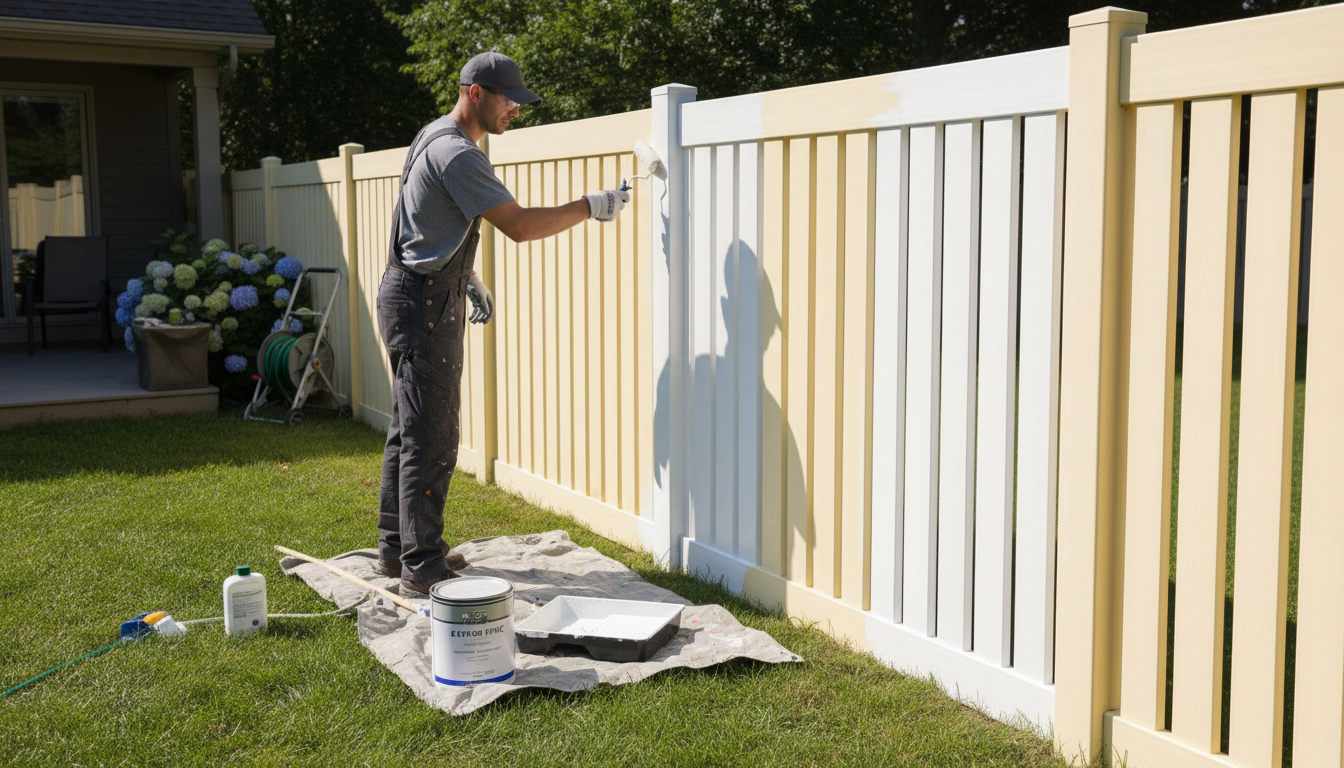
Has your PVC fence turned yellow over the years? This is common for most white fences exposed to sunlight and weather. Before tearing everything out to install new fencing, you should know that it is entirely possible to repaint a yellowed PVC fence to restore its appearance. However, you must use the right products and prepare the surface correctly. Here is how to proceed, step by step.
Why Does PVC Turn Yellow Over Time?
The yellowing of PVC is not abnormal. It is a natural phenomenon caused by prolonged exposure to UV rays. Sunlight gradually degrades the pigments and the surface of the plastic, which takes on this characteristic yellowish tint. Pollution, mould, and atmospheric residues accelerate the process.
Yellowed PVC is not necessarily damaged in depth. In the vast majority of cases, the structure remains sound; only the surface layer has undergone deterioration. This is what makes painting worthwhile: you address an aesthetic problem without affecting the fence’s structural integrity.
Thoroughly Clean Before Painting
There is no point in picking up the brush straight away. If you paint over a dirty surface, the paint will not adhere and will begin to peel within a few months. Cleaning is a non-negotiable step.
Start with a high-pressure washer at a reasonable distance (30–40 cm minimum to avoid marking the PVC). Focus on areas that are green or blackened by mould. Then follow up with a sponge soaked in a mixture of hot water and bicarbonate of soda or black soap. Rinse thoroughly and allow to dry for at least 24 hours before applying any paint.
Degrease and Lightly Sand the Surface
PVC is a smooth, non-porous material. Paint therefore naturally struggles to adhere to it. To overcome this problem, you must prepare the surface in two stages.
First, degrease the entire fence with acetone or a special PVC degreaser applied with a cloth. Then carry out light sanding with fine-grit abrasive paper (180 to 240). The aim is not to gouge the PVC, but to create a micro-roughness that will allow the paint to grip. Dust thoroughly after sanding with a damp cloth.
Choosing the Right Paint for Exterior PVC
This is the most important point. Not all paints are suitable for PVC, and even fewer for outdoor use. You need a product formulated to withstand UV rays, rain, and temperature variations. Two options:
- Special PVC acrylic paint: water-based, easy to apply, low-odour, it dries quickly and holds up well over time. This is the most common choice for fences.
- Gloss paint for plastic surfaces: more resistant but slower to dry, with a strong odour. It is well suited to areas heavily exposed to the elements.
In both cases, check that the label states “special PVC” or “multi-surface plastics.” Standard paint will not adhere to PVC, even with a good primer.
Apply a Bonding Primer
Bonding primer (or undercoat for PVC) makes all the difference between paint that lasts five years and paint that peels after the first winter. It creates an intermediate layer between the PVC and the topcoat, ensuring long-lasting adhesion.
Apply the primer with a foam roller or flat brush, in a thin, even coat. Observe the drying time specified by the manufacturer, generally between 2 and 4 hours, before applying the paint. Do not skip this step, even if some PVC paint manufacturers promise direct application.
Painting the Fence: Method and Practical Advice
Choose a dry, windless day with a temperature between 10 and 25 °C. Apply the paint in two thin coats rather than one thick coat, observing the drying time between each pass. Use a foam roller for flat surfaces and a cutting-in brush for recesses, posts, and joints.
Always work in the same direction, from top to bottom, to avoid drips. If your fence has removable slats or panels, do not hesitate to remove them to paint them flat: the result will be far more uniform.
What If Painting Is Not Enough?
Sometimes the yellowing is too advanced, the PVC has become brittle, or the panels are cracked. In this case, repainting will only temporarily mask the problem. It is then better to consider replacing your fence with a new model, possibly in a colour more resistant to yellowing such as anthracite grey or wood-effect.
At Districlos, you will find a wide range of PVC, composite, and aluminium fences, available in stock at our stores throughout France or delivered directly to your home. Our customer service team will help you choose the solution best suited to your outdoor space and budget.

Expert in fencing, gates, and outdoor landscaping since 2019.
Holds a Master’s degree in Digital Marketing – SEO, UX/UI.
View LinkedIn profile


