
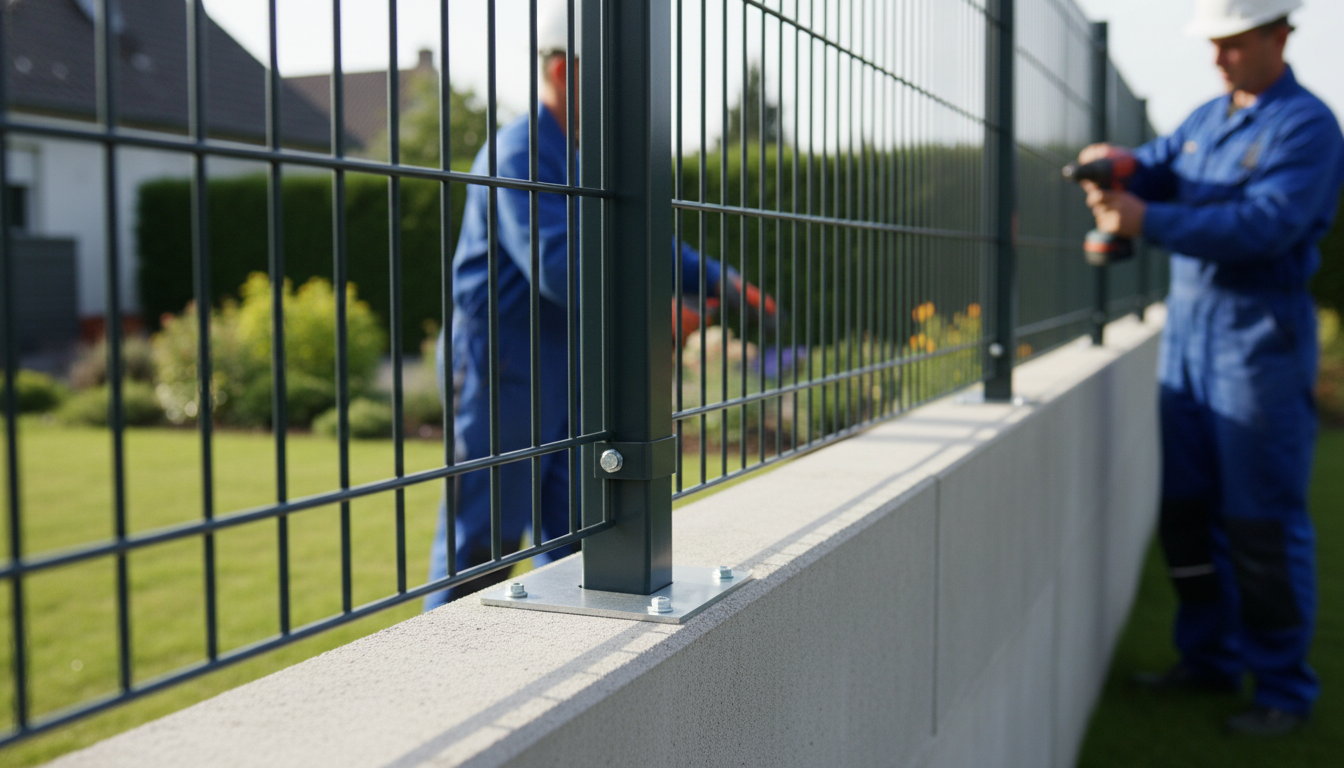
Is your low wall only 10, 15, or 20 cm wide, and do you need to install a fence made of rigid panels on it? This is a very common situation, yet it is rarely explained clearly. A narrow low wall makes fixing more difficult: standard base plates overhang, posts lack stability, and the finish looks uneven. There are practical solutions for fixing rigid mesh fencing on base plates even on a thin low wall—provided you choose the right hardware and install it carefully.
Why a narrow low wall is a problem
A standard post base plate generally measures between 15 and 20 cm per side. When the low wall is barely that wide—or even narrower—there is virtually no room for error. The slightest offset and the base plate overhangs the wall, on the street side or the garden side. The result: you cannot tighten the anchors properly, there is a risk of cracking the wall, and the fixing will not last over time.
The other difficulty is wind resistance. A rigid mesh panel—especially if fitted with privacy slats or a privacy screen—creates considerable wind load. On a narrow low wall, the anchoring must be flawless to prevent the posts from tipping in gusts.
Choosing the right base plate for a narrow low wall
Not all base plates are equal. For a narrow low wall, choose compact base plates or base plates designed for this type of support. Some have a reduced footprint of 10 x 10 cm or 12 x 12 cm, which is well suited to low walls 15 cm wide.
Also check the number of fixing points. A base plate with 4 well-spaced anchor holes will provide better anchoring than a 2-hole model, even on a small surface. At Districlos, base plates are sized to suit different installation configurations, including on low walls.
Which type of post to use with a base plate
A base-plate post differs from a post to be set in concrete: it is bolted directly onto the low wall thanks to its base plate welded at the bottom. This is the right solution when you cannot pour concrete into the wall (too narrow, hollow wall, fragile breeze blocks).
Choose posts with a minimum section of 60 x 40 mm for standard panels from 1.03 m to 1.93 m high. For heights above 1.50 m on a narrow low wall, a reinforced post or bracing may be necessary, especially in windy areas.
Installation steps on a narrow low wall
A successful fixing depends as much on the method as on the hardware. Here are the steps to follow:
- Mark the installation line with a chalk line along the full length of the low wall, centred properly, to keep the posts aligned and avoid any base-plate overhang.
- Pre-drill the low wall to the diameter suited to the mechanical anchors (generally 10 or 12 mm), using a rotary hammer rather than a simple drill, then anchor with steel expansion bolts suited to the low wall material.
- Fix each base plate by tightening the nuts gradually, check the post is plumb with a spirit level, then clip or bolt the rigid mesh panels between the posts.
One point that is often overlooked: anchor quality. On a wall made of hollow breeze blocks, a standard expansion anchor is not enough. Use chemical anchors (resin anchoring), which fill the voids in the block and provide far better holding strength.
Mistakes to avoid
Drilling too close to the edge of the low wall is the most common mistake. Less than 3 cm from the edge, the risk of cracking the breeze block or stone is real. If your low wall is truly too narrow to accommodate the base plate with a sufficient margin, it is better to consider raising the wall or using a side fixing on the inner face.
Another pitfall: neglecting post plumb. On a narrow low wall, the slightest out-of-plumb is immediately visible and makes fitting the panels more difficult. Take the time to shim and check each post before tightening everything permanently.
What height of rigid mesh above a low wall
The total height of your fence (low wall + mesh) is often governed by your municipality’s Local Urban Plan (PLU). As a general rule, the maximum permitted height is between 1.80 m and 2 m at the property line. If your low wall is already 50 cm high, a 1.23 m rigid panel will be enough to reach the regulatory height.
Remember to check local rules before buying your panels. A quick call to the town hall or checking the PLU online can save you from having to dismantle everything a few weeks later.
Finding the right materials for your project
Whether your low wall is 10 or 25 cm wide, base-plate fixing remains the cleanest and fastest way to install rigid mesh fencing without pouring concrete. The key is to start with components that are compatible with each other: base plates suited to the wall width, posts at the right height, and anchors suited to the material. Districlos offers all of these items—base-plate posts, rigid panels, fasteners, and fixing accessories—available online or in stores throughout France. Customer service can also help if you are unsure about sizing or whether your project is feasible.

Expert in fencing, gates, and outdoor landscaping since 2019.
Holds a Master’s degree in Digital Marketing – SEO, UX/UI.
View LinkedIn profile


