
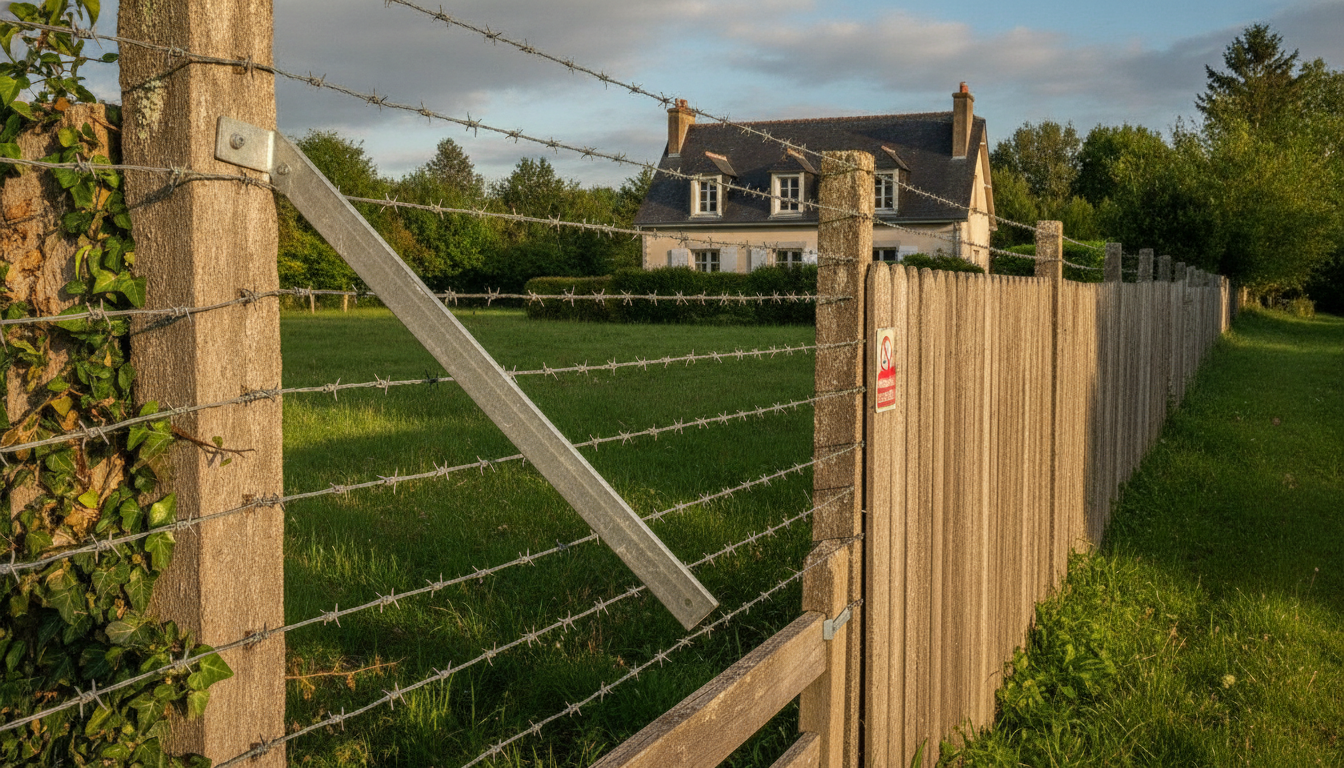
Installing barbed wire or a cranked extension (the angled arm at the top of a fence post) is an effective way to deter intrusions. However, demarcating your property does not grant you absolute rights. In France, the law strictly regulates the use of these devices to prevent accidents and neighborhood disputes.
The right to enclose property and its limits
Article 647 of the Civil Code specifies that every owner may enclose their land. However, this fundamental right has limits: the installation must not harm others. While the use of barbed wire or concertina wire (spiral razor wire) remains authorized, it is only tolerated if it does not pose a disproportionate danger to neighbors, passers-by, or animals.
Furthermore, courts penalize the ‘abuse of right’: installing an aggressive fence for the sole purpose of blocking a neighbor’s view or causing annoyance is systematically judged illegal.
Rules for installing barbed wire
Although no law formally prohibits barbed wire for private individuals, public safety rules apply, particularly if the land borders a street, a communal path, or a busy passage.
To install this type of protection legally, several practical rules apply:
- Setback: The fence should ideally be installed slightly set back from your property line so that the spikes do not protrude onto the public highway or the neighbor’s property.
- Height: It is customary to install barbed wire at a minimum height (generally 2 meters) to prevent a pedestrian or a child from being injured while passing by.
- Joint ownership: If the fence separates two private properties, it is best to obtain written agreement from the neighbor before installing barbed wire.
The orientation of the cranked extension: beware of encroachment
The cranked extension, the angled metal arm fixed to the top of the posts to support the barbed wire, is particularly deterrent. However, be careful with its inclination: from a legal perspective, the airspace above your neighbor’s land belongs to them. Your installation must therefore never protrude onto their side, even by a few centimeters.
The cranked extension must be oriented towards the interior of your property. If it leans outwards or towards the street, it constitutes an encroachment on the property of others. In the event of a dispute, a judge may require its immediate removal at your expense.
Civil liability and risks of injury
Being the owner of the fence also means being its ‘custodian’ in the eyes of the law. According to Article 1242 of the Civil Code, you are responsible for damage caused by the objects you own. If a mail carrier, a walker, or an animal is injured by barbed wire that is too low or poorly positioned, your civil liability may be engaged.
To limit risks, ensure that the installation is clean, visible, and ideally marked with a warning sign to avoid any unpleasant surprises.
Prior procedures at the town hall and the PLU
Before purchasing your equipment, visit the town hall to consult the Local Urban Plan (PLU). Many municipalities prohibit or strictly limit the use of barbed wire in residential areas, for safety reasons as well as landscape aesthetics.
Take the opportunity to check if the installation of your fence requires the filing of a prior declaration of work, which is very common depending on the locality.
Which equipment to choose to secure your land?
To avoid disputes, the quality of installation is essential. The use of sturdy posts and standardized cranked extensions ensures that the installation does not sag over time and remains well within the boundaries of your property.
If you are looking for reliable equipment, specialized brands like Districlos offer complete ranges of fences, cranked extensions, and fixing accessories adapted to security requirements. Do not hesitate to ask for advice in-store or online to choose products that comply with local rules.

Experte clôture, portail et aménagement extérieur depuis 2019.
Diplômée en Master de Marketing digital – SEO, UX/UI
Voir le profil sur LinkedIn


