
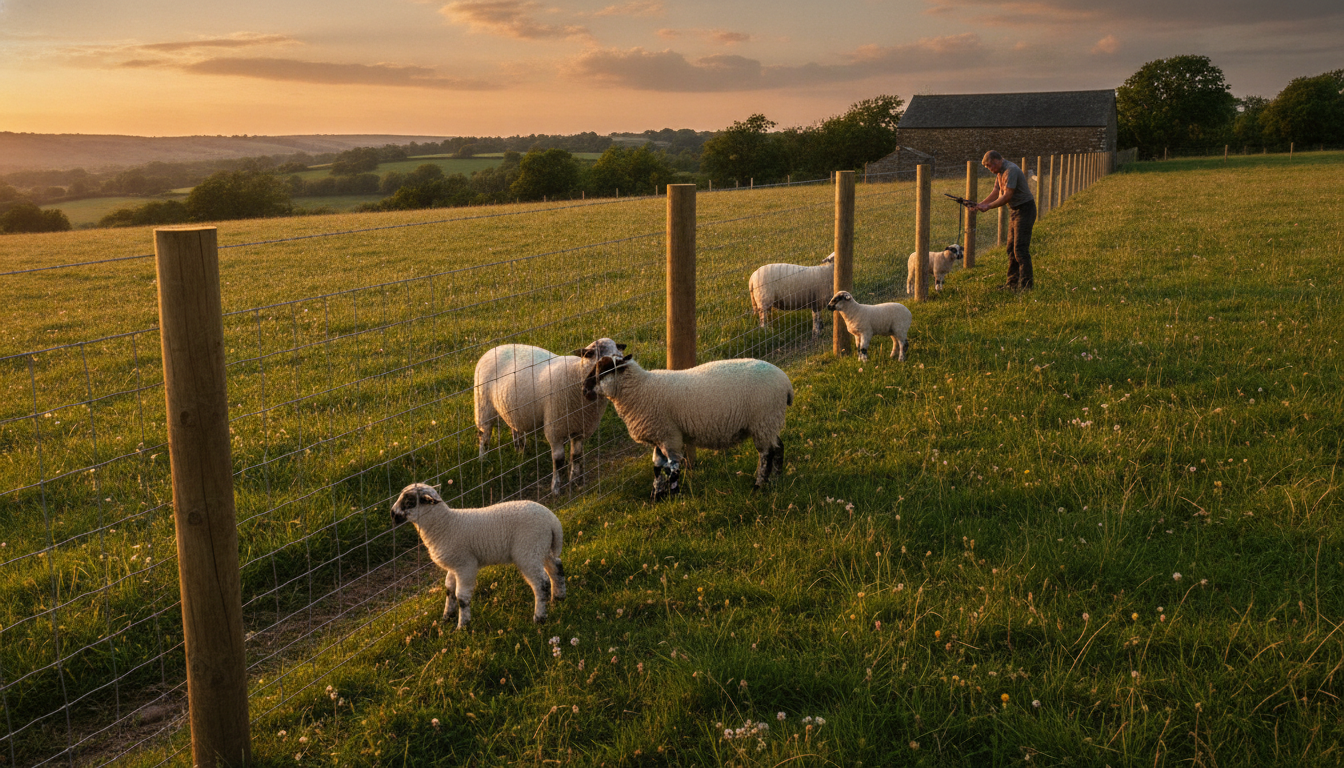
Whether you are starting livestock farming or simply need to enclose a new plot, installing a sheep fence requires careful planning. Given the physical pressure from animals rubbing against it, lambs trying to squeeze through, and the threat of predators, your installation must be robust. To avoid unpleasant surprises, three elements must be closely monitored: the type of mesh, the height of the fence, and the tension of the wires.
Which mesh to choose? Graduated mesh
For sheep and ewes, knotted mesh fence (often called sheep fence or Ursus type) remains the most suitable option. Its strength lies in its graduated mesh: the mesh openings are very tight at the bottom and widen as they go up.
This arrangement meets two specific needs. First, it prevents lambs from sticking their heads through or getting caught in the fence. Second, it blocks small dogs or passing pests. If your animals tend to push against the enclosure limits, opt for large-diameter galvanized steel wires to prevent the entire structure from deforming too quickly.
What fence height should you plan for?
The correct height primarily depends on the breed of your sheep and the local wildlife. Generally, a height of 1 m to 1.20 m is sufficient for most lactating or dairy ewes.
For hardy, light, and agile breeds (such as Ouessant or certain moorland breeds), plan for at least 1.20 m in height to prevent them from jumping over at the slightest stress. Conversely, for heavier and calmer animals, a 90 cm fence may suffice, provided it remains well-tensioned.
Tension Wires: The Key to Preventing Sagging
A flexible fence will always sag if ewes rub against it to scratch themselves or to grab a tuft of grass from the other side. To maintain a rigid structure over time, galvanized steel tension wires must be used.
These horizontal wires are attached to the corner posts (reinforced by brace posts) and support the fence along its entire length.
For a solid installation, plan for:
- Tensioners (or strainers) placed at the start and every 50 meters to adjust the tension.
- Three lines of tension wire (at the top, in the middle, and at ground level).
- Staples to secure the wires to your wooden posts.
Adding an Electric Wire for Reinforcement
Knotted mesh provides a good physical barrier, but combining it with an electric fence makes a significant difference. Be aware, however: the thick wool of sheep insulates them very well from light shocks. You will therefore need a powerful enough energizer for the current to pass through the fleece.
By placing a smooth electrified wire 20 cm from the ground, you prevent animals from digging under the fence or trying to stick their heads through. A second wire placed at the top of the fence deters dogs or predators from jumping over. This dual system protects your animals while preventing the fence from being damaged by the physical pressure of the animals.
Some Installation Tips
To prevent slack, space your intermediate posts a maximum of 2.50 to 3 meters apart. Beyond that, the fence will eventually sag. Pay particular attention to anchoring the corner posts, as they bear the entire mechanical tension.
To equip yourself, you can find this type of professional material (Ursus mesh, tensioners, posts) at specialized distributors like Districlos, which offers these ranges of agricultural equipment in-store or on its website.

Experte clôture, portail et aménagement extérieur depuis 2019.
Diplômée en Master de Marketing digital – SEO, UX/UI
Voir le profil sur LinkedIn


