
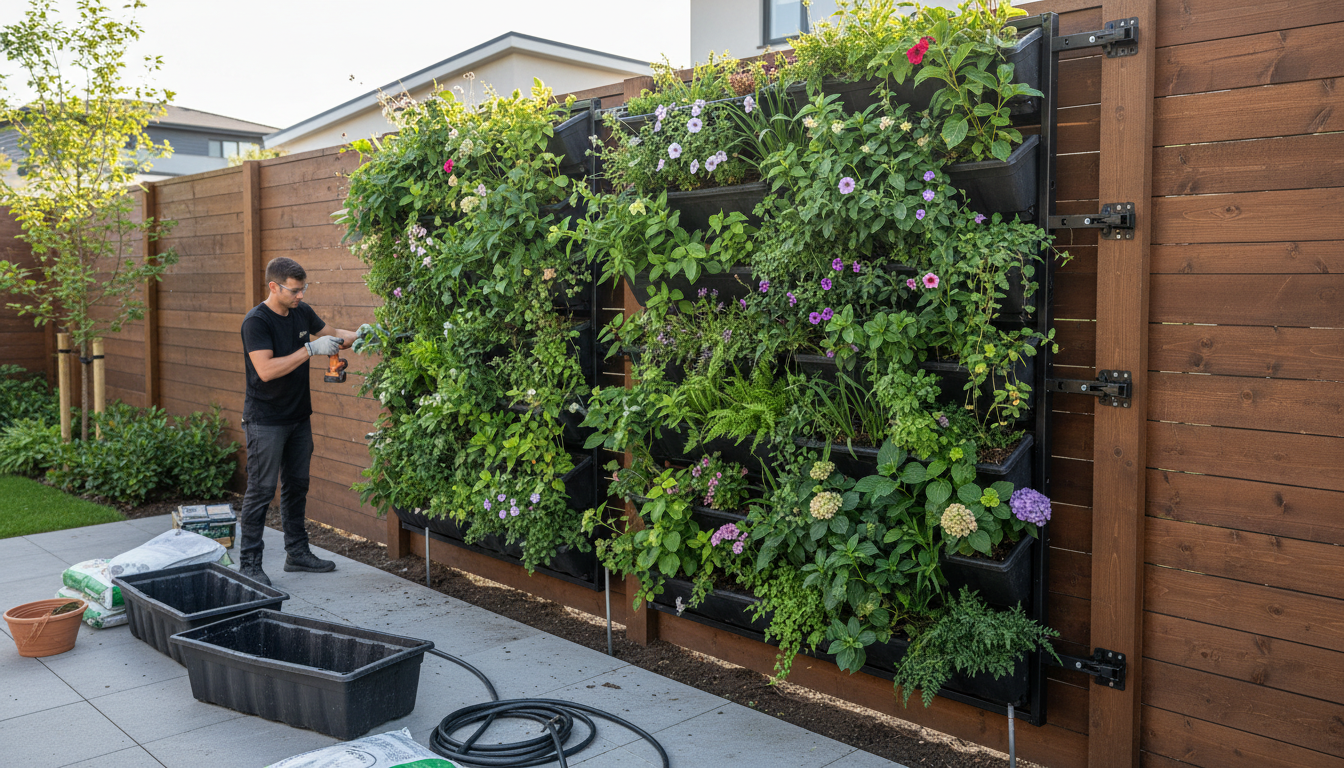
You want to install a green wall along your fence, but the weight worries you? Between the potting-soil planters, waterlogged plants and the support structure, it quickly adds up to several dozen kilos per linear metre. Attaching all of that to a standard fence without preparation is the best way to see it bow within a few weeks.
Here is how to do it properly.
Weight is the real issue
A light trellis with a few climbers is usually fine. A green wall with planting modules, substrate, irrigation and dense plants is another matter: allow 30 to 50 kg/m2 once saturated with water.
A standard fence—rigid mesh, privacy panels—is not designed to take that. The posts are built to withstand wind, not a vertical load. If you hang a heavy wall directly on panels without reinforcement, you risk post deformation, fixings tearing out, or even collapse.
Assess the strength of your fence
Before you start, assess what you have in place.
- Fence type: a rigid galvanised steel panel on concreted-in posts will cope better than flexible mesh on stakes. Aluminium or PVC is generally too light.
- Post anchoring: concreted in, driven into the ground, or base-plated? You need at least a 30 × 30 × 50 cm concrete footing to support the extra weight.
- Post spacing: between 1.5 m and 2 m, the load is distributed well. Beyond 2.5 m, you will need to add intermediate posts.
If your fence is old, rusty or poorly anchored, reinforce it first or replace it. Fixing a heavy green wall to a weak fence is like building on sand.
Create an independent load-bearing structure
The most reliable solution is to separate the green-wall structure from the fence. In practice, you install a self-supporting frame—steel sections or galvanised tubes—anchored to the ground with bolted base plates or feet set in concrete. This frame is positioned against the fence without being attached to it.
The load then goes vertically into the ground via the dedicated structure, not into the fence posts. The fence serves only as a visual backdrop. This is the method landscapers recommend as soon as you exceed 15 kg/m2.
Fixings for a direct installation
If your fence is robust enough—concreted-in steel posts, thick rigid panels—a direct installation is still possible for moderate loads. The choice of fixings then becomes critical.
Use stainless-steel fixing clamps tightened around the posts, not self-drilling screws that weaken the metal. Space the supports every 40 to 50 cm vertically and at every post horizontally. Horizontal aluminium or steel rails, bolted to the posts, allow you to hang the green-wall modules while distributing the load evenly. This avoids localised stress points—the ones that always end up failing.
Choose the right plants to limit overload
If you want to attach the installation to the fence rather than to an independent structure, keep it as light as possible. Horticultural felt modules with a lightweight substrate (sphagnum, perlite) weigh significantly less than PVC planters filled with standard potting soil.
For plants, choose species with limited root growth and light foliage: helichrysum, sedums, small ferns, small-leaved ivy. Avoid vigorous climbers such as wisteria or star jasmine, which quickly gain volume and weight. A green wall that lasts is a compromise between the visual result and what the structure can withstand.
Drainage and maintenance
One point that is often overlooked: water is what makes a green wall heaviest. Poorly adjusted watering or insufficient drainage can double the weight of the installation. Plan a water collection system at the bottom of the wall and check regularly that nothing is stagnating in the modules.
Regular maintenance is also essential: pruning, checking the fixings, and inspecting the condition of the posts. Plants grow, gain weight and create wind load. Inspect your fixings at least twice a year, in spring and autumn, to anticipate structural issues before they become costly.
Do it yourself or call in a professional?
For a small decorative wall of a few square metres with light plants, a capable DIYer can manage it well. But for a heavy installation along the full length of a fence, load calculations, fixing sizing and structure selection require real expertise. A poor installation means rebuilding the fence and losing the plants.
At Districlos, our teams advise private individuals and professionals on choosing fences that can support heavy installations: reinforced rigid panels, high-strength posts, and suitable fixing accessories. Feel free to send us your project.

Expert in fencing, gates, and outdoor landscaping since 2019.
Holds a Master’s degree in Digital Marketing – SEO, UX/UI.
View LinkedIn profile


