
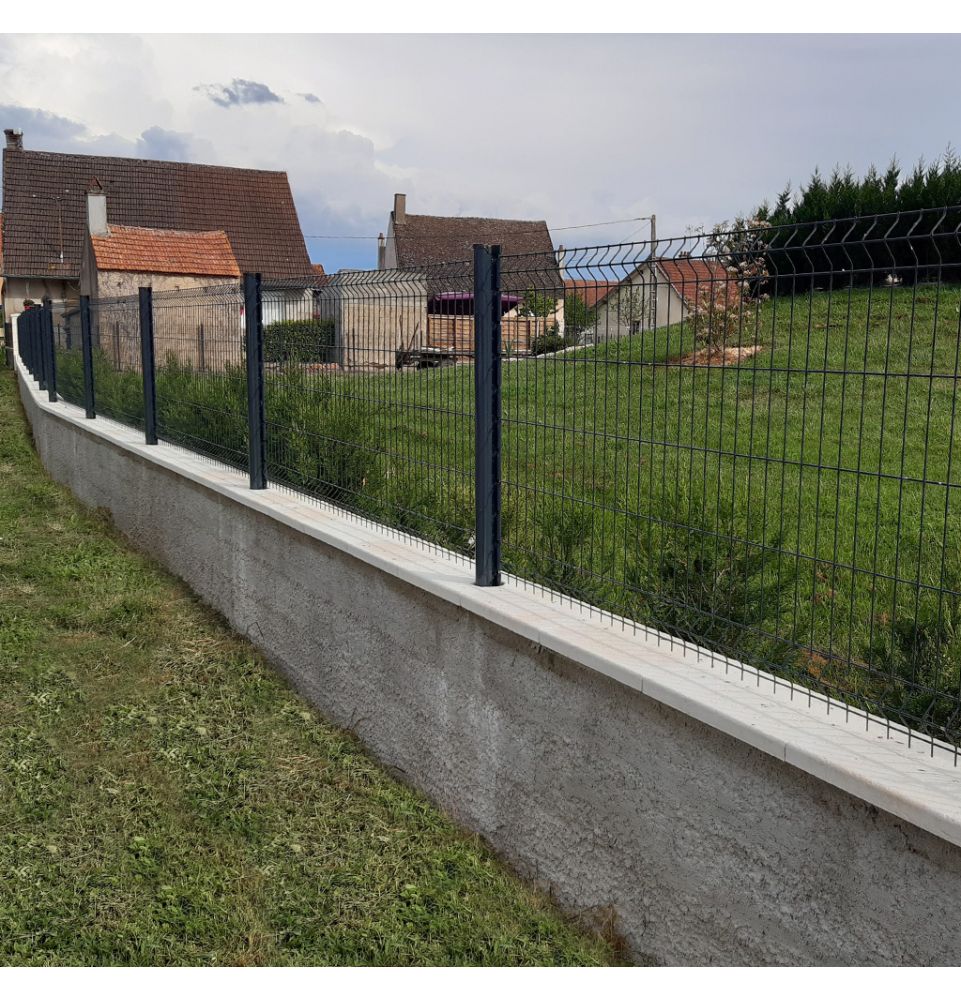
If you have a low wall or a concrete slab and want to install your new rigid fencing, base plate installation seems ideal: it is fast, clean, and requires no digging. However, an essential question arises, especially if you live in a region swept by winds: will this installation be strong enough to withstand gusts? This is a legitimate concern, as the force exerted by wind on a fence is far from negligible. The answer is yes, it is possible to install fencing on base plates in a windy region, but not just any way and, above all, not in all conditions. The durability of your installation will depend on several critical factors that must not be ignored to avoid seeing your fence lean or be torn away during the first storm.
Understanding your fence’s wind resistance
A fence, and more specifically a rigid mesh panel, constitutes an obstacle to the passage of wind. This resistance generates a force, known as wind load, which is exerted across the entire surface of the panels and transmitted directly to the posts, and then to their fixing points. It is a simple physical principle: the larger and more solid the surface, the greater the force. The real challenge appears when you decide to add a screening system. A privacy screen, whether made of PVC slats, wood, or fabric, literally transforms your openwork fence into a solid wall. The wind load is then multiplied, turning your installation into a virtual sail that must withstand considerable pressure during strong gusts. This factor puts the strength of base plate fixings to the greatest test.
Base plate fixing: a practical but demanding solution
Base plate installation involves fixing the base of the posts to a hard, flat surface using anchor bolts or specific wall plugs. Its main advantage is avoiding earthworks and concrete sealing, making it a very popular method for low walls or terraces. However, its weakness lies precisely in this fixing method. Unlike a post sealed into a solid concrete block, the entire force of the wind is concentrated on four anchoring points over a very small surface area. If the support is not perfectly solid, the leverage effect exerted by the wind on the top of the post will eventually weaken, loosen, or even tear out the fixings.
Essential conditions for base plate installation in windy zones
For a base plate installation to be viable in an area exposed to the wind, several conditions must be strictly met. The slightest compromise on any of these points jeopardises the entire structure.
- A support of irreproachable strength: The base plate must be fixed to a solid, reinforced concrete support. Avoid installation on hollow breeze blocks, bricks, or an old, crumbly wall. The pull-out resistance would be far too low. The support must be sound, crack-free, and sufficiently wide (at least 20 cm for a low wall).
- Limited fence height: The higher the fence, the greater the leverage effect. In windy areas, it is strongly discouraged to opt for base plate installation for heights exceeding 1.50 metres, and even less so if you plan to add screening.
- Professional-grade fixings: The choice of wall plugs is paramount. You must use heavy-duty anchor bolts or opt for chemical anchoring, which offers superior resistance by better distributing stresses within the concrete.
Screening and wind: a high-risk duo for base plates
This is the major point of vigilance. Adding a privacy screen to a fence installed on base plates in a windy area is a very high-risk operation. Even with a perfectly solid support and quality fixings, the continuous force and jolts of the wind can overcome the installation. If screening is a necessity for you, it is preferable to look towards openwork solutions that allow some air to pass through, thereby reducing the pressure exerted. However, for total screening, base plate installation is simply not the most secure method.
Sealing, the safest alternative for exposed regions
If your project does not meet all the mentioned conditions or if you are looking for absolute peace of mind, the best solution remains sealing the posts. This technique involves digging holes in the ground and pouring concrete blocks into which the posts are directly inserted. This method offers incomparable resistance. The post is securely held over a significant height within a solid concrete block, which virtually cancels out the leverage effect. In-ground sealing is the only technique recommended by professionals for high fences, installations with total screening, and generally for all installations in regions heavily exposed to wind. It is a slightly higher investment in time and labour, but it guarantees the longevity and safety of your fence for many years.

Expert in fencing, gates, and outdoor landscaping since 2019.
Holds a Master’s degree in Digital Marketing – SEO, UX/UI.
View LinkedIn profile


