
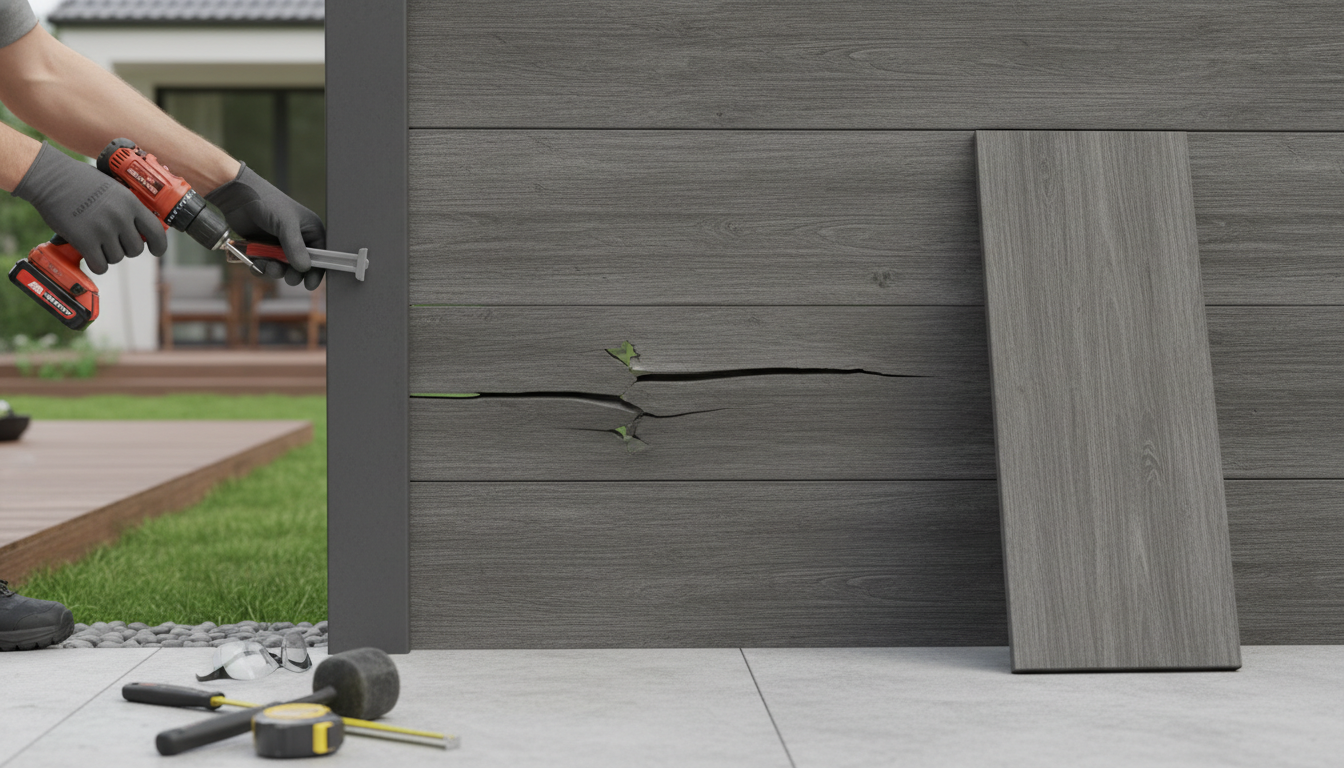
A composite fence slat broken, split, or discolored after an impact? There is no need to dismantle the entire fence. Replacing a single slat remains accessible, provided you proceed correctly. You need to know the fixing system, have the right equipment, and follow a few precise steps. We explain how to proceed, from diagnosis to replacement of the damaged slat.
Why Can a Composite Slat Become Damaged?
Composite is a durable material, designed to last outdoors without particular maintenance. But it is not indestructible. A violent impact—ball, falling heavy object, collision with garden equipment—can crack or break a slat. Hail or a storm can also leave marks.
In some cases, it is a defect in the initial installation that eventually causes warping or dislodgement. The good news: you can generally replace only the affected slat without touching the rest of the fence. The assembly system of composite fences is designed for this.
Identify the Type of Fixing for Your Fence
Before you begin, you need to understand how your fence is assembled. Not all composite slats are fixed in the same way.
The most common system relies on slats fitted vertically into grooved posts. The slats slide from top to bottom in the grooves, held by a finishing profile at the top. Other systems use fixing clips, side screws, or aluminum inserts.
Identify the exact model of your fence—the reference is often indicated on the purchase invoice or delivery note. Without this information, you risk ordering a slat with the wrong dimensions or in a color that does not match.
The Necessary Equipment
No need for professional tools. To replace a slat, you need:
- A screwdriver or power screwdriver (if the top finishing is screwed)
- A rubber mallet to remove and refit the slats without damaging them
- The replacement slat in the correct dimensions
- Possibly a wooden wedge to protect surfaces during disassembly
If your fence is a few years old, check that the color of the new slat matches that of the existing slats. Composite can evolve slightly under the effect of UV, even if this variation remains discreet on good-quality products.
Remove the Damaged Slat
Start by removing the finishing profile located at the top of the fence, between the two posts that frame the slat to be replaced. Depending on the model, this profile is clipped, fitted, or screwed. Remove it carefully.
Then slide the slats upward one by one, starting from the top one. Stack them in order to facilitate reassembly. When you reach the damaged slat, remove it and set it aside.
On some models, it is sufficient to remove the slats located above the broken one, which limits handling. Work carefully to avoid scratching or forcing the intact slats.
Install the New Slat and Reassemble
Slide the new slat into the grooves of the posts, at the exact location of the old one. Check that it fits correctly and rests flat on the lower slat. A tap with a rubber mallet can help adjust the position without forcing.
Then replace the upper slats in the reverse order of disassembly, then reattach the finishing profile at the top. Check that the assembly is stable, aligned, and that nothing moves. Allow less than an hour for a standard panel.
Where to Find a Compatible Replacement Slat?
This is often the sticking point: finding the exact slat for your fence. Large DIY stores do not always stock specific references. It is better to turn to a specialist distributor who keeps permanent stock on common references.
At Districlos, the composite slats from our ranges are available individually, in-store and online. Our customer service can help you identify the correct reference if you have any doubt. Collection in-store or delivery to site—no need to wait weeks.
A Few Precautions to Avoid Returning
To extend the lifespan of your composite fence, avoid storing heavy or unstable objects against the slats. Keep lawnmowers and brush cutters that throw stones away. If you live in an area exposed to wind, regularly check the tightening of the finishing profiles.
An annual cleaning with soapy water is sufficient to maintain the appearance of the composite. And if one day another slat fails, you will know how to replace it.

Expert in fencing, gates, and outdoor landscaping since 2019.
Holds a Master’s degree in Digital Marketing – SEO, UX/UI.
View LinkedIn profile


