
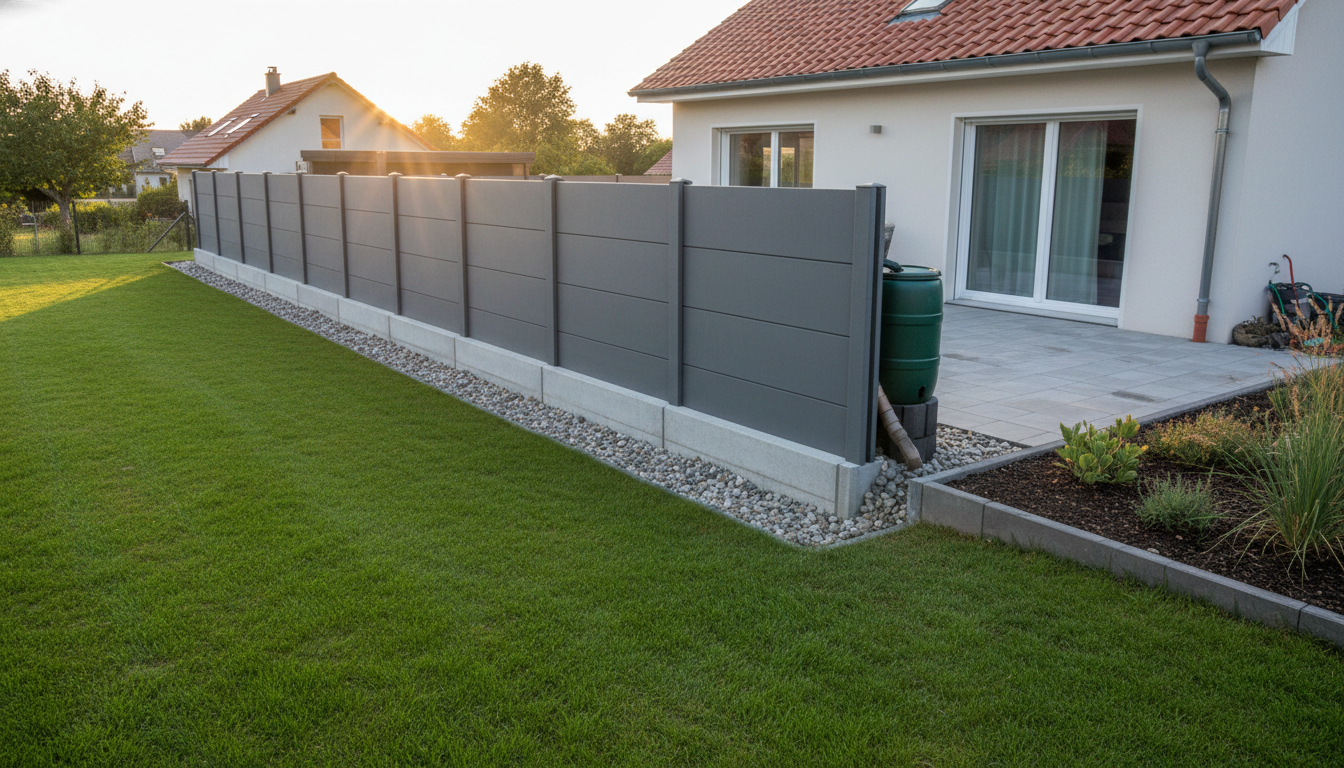
Have you installed (or are you planning to install) a fence with a concrete base? It is a good way to mark out your property, gain privacy, and strengthen the overall structure. However, there is one point many homeowners overlook: managing runoff water. A poorly designed base can block the natural flow of rainwater, cause pooling, and even flood your land or your neighbour’s. Here is how to anticipate this issue and choose the right solutions.
Why the base can cause drainage problems
A base panel forms a continuous barrier at ground level. Unlike simple chain-link fencing or openwork panels installed on posts, it prevents water from passing freely across the property line. As a result, during heavy rain, water builds up on one side of the fence—often yours if the ground slopes down towards it.
The phenomenon is more pronounced on clay soils or low-permeability ground, where water runs off on the surface instead of soaking in. Without a suitable system, you risk persistent puddles, soil erosion at the foot of the base, and, over time, the undermining of your fence foundations.
Assess the slope and direction of flow before installation
Before you even set the first post, take the time to observe how water moves across your land after a good downpour. Where does it come from? Where does it pool? Does the natural slope direct runoff towards the planned fence line?
This step is often overlooked—wrongly so. If your land slopes down towards the fence, you will need to plan a drainage system. If the slope runs parallel to the fence, the issue will be less significant, but not non-existent. In all cases, it is better to plan ahead than to have to break up an already installed base to put things right.
Solutions for draining water at the foot of the base
Several systems make it possible to combine a concrete base with effective drainage:
- Weep holes: small openings (50 to 80 mm PVC tubes) integrated into the base panel or the concrete footing. They let water through without compromising the overall strength. This is the most common and simplest solution to implement during construction.
- A perimeter drain: a perforated drainage pipe laid in a gravel bed along the base on the uphill side captures water before it builds up. It redirects it to a discharge point (inspection chamber, ditch, stormwater network).
- A swale or channel: a simple shallow depression dug parallel to the fence, guiding water towards a natural discharge area.
On sloping ground, the drain + weep holes combination is often the most effective.
What base height should you choose?
The height of the base has a direct impact on runoff. The higher the panel, the more it obstructs flow. A 25 to 30 cm panel is generally enough to protect the bottom of the fence from impacts and vegetation, while limiting the dam effect.
Beyond 40 or 50 cm, the base behaves like a true retaining wall and requires serious thought about drainage. If you want a significant height for privacy or aesthetic reasons, it is feasible, but the drainage system must be sized accordingly.
Common mistakes to avoid
The first is installing the base without any provision for water. You pour a continuous footing, install the panels, and discover the problem at the first storm. Modifying an existing base to drill weep holes is possible, but clearly more restrictive.
Another common mistake: neglecting drain maintenance. A drainage pipe that clogs with soil or roots becomes useless. Plan an inspection chamber at each end so you can clean the system.
Finally, be careful not to divert runoff water onto the neighbouring property: this is prohibited by the French Civil Code (Article 640) and is a frequent source of neighbour disputes.
Choosing the right fence with a concrete base
The type of fence also affects water management. A rigid panel fence on a concrete base with correctly positioned weep holes remains the most versatile configuration. It combines strength, appearance, and compatibility with effective drainage.
At Districlos, you will find fences with concrete bases suited to different site conditions. Our teams, available in-store or by phone, can advise you on base sizing and installation accessories based on your plot’s topography. Whether you are a private individual or a professional, it is best to ask the right questions before setting the first posts.

Expert in fencing, gates, and outdoor landscaping since 2019.
Holds a Master’s degree in Digital Marketing – SEO, UX/UI.
View LinkedIn profile


