
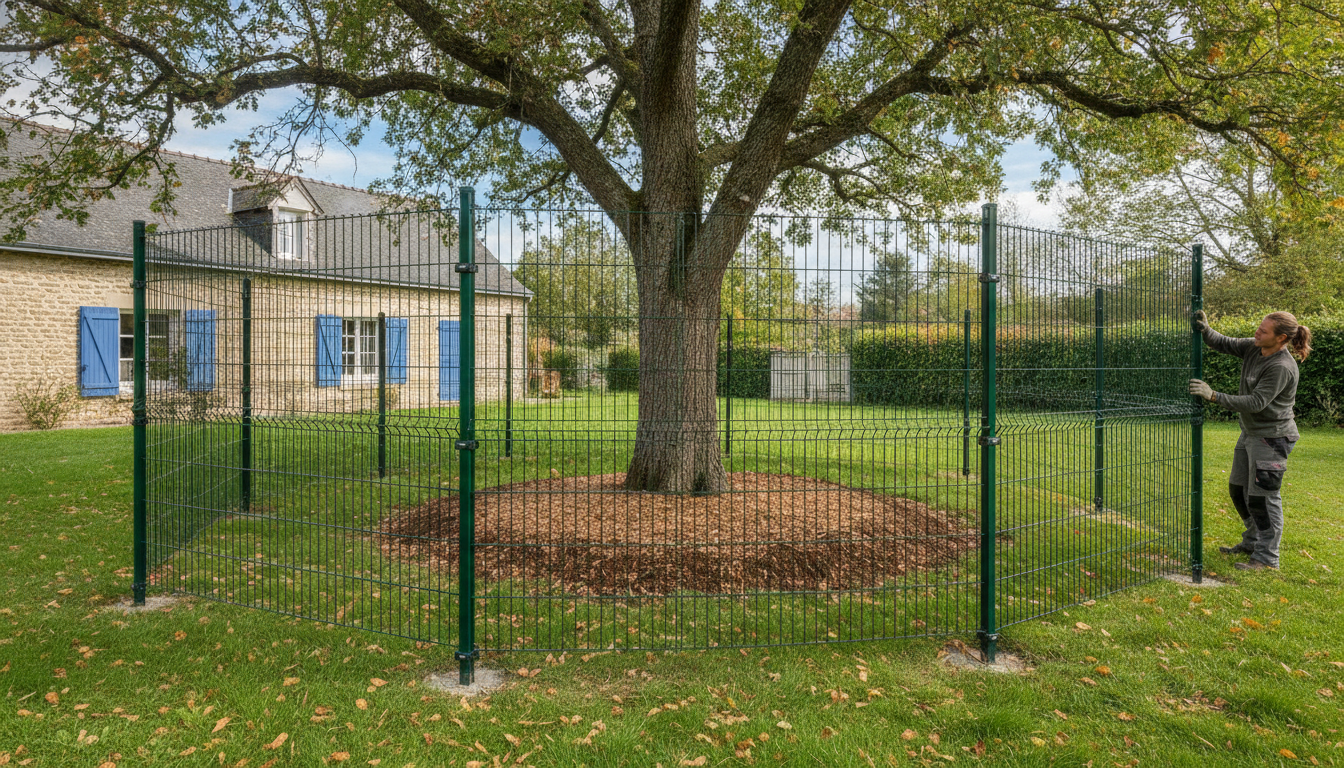
Installing a fence allows you to define your property and gain peace of mind. However, things get complicated when a tree is located right on the path. There is no question of cutting it down: it is entirely possible to install rigid panels without harming its health. Here is how to adapt your installation to work around the problem.
Anticipating tree growth and protecting its roots
Before digging, observe the tree closely. Remember that it will grow and its trunk will widen. Allow at least 50 cm of clearance between the trunk and your mesh panel (more if it is a fast-growing young tree). Without this margin, the pressure from the wood will eventually bend or break your fence within a few years.
Also consider the invisible roots. Generally, they spread across the ground over an area equivalent to the canopy (the foliage). Digging too close to the trunk risks severing main roots, which could weaken the tree or make it unstable in the wind.
Bypassing the obstacle: the deviation technique
The simplest solution is to bypass the trunk by creating an offset. Instead of aiming for an absolute straight line, create a “U” shape or a wide angle around the tree using corner posts and shorter panel sections.
To achieve this bypass, you can use adjustable mounting collars or notched posts, which allow the panels to extend in different directions. The goal is to follow the shape of the tree without the mesh ever touching the bark.
Integrating the tree into the fence line
If a lack of space or property boundaries requires you to stay aligned, you will need to have the panels meet on each side of the trunk.
For this option, here is the procedure to follow:
- Install your posts at a reasonable distance from the main roots to avoid pouring concrete directly onto them.
- Cut the rigid panel with a grinder to fit it as closely as possible to the trunk or low branches.
- Always apply a protective paint or a cold galvanizing spray to the cut wires to prevent rust from setting in.
Installing posts without damaging the root system
Digging to set the posts requires vigilance. Use a spade or a manual auger rather than a mini-excavator: this will allow you to feel the ground and avoid disasters. If you hit a root more than 3 or 4 cm thick, do not cut it.
Instead, shift the post by a few centimeters. You will then simply need to trim the width of the rigid panel using a grinder to fit this new center-to-center distance. This is the advantage of welded steel mesh: it can be easily cut without losing its rigidity.
Choosing the right equipment from a specialist
For this type of custom installation, you will need sturdy equipment that is easy to adapt. At Districlos, we offer ranges of rigid panels and posts designed to adapt to difficult terrain configurations. You can find all our products directly in-store or have them delivered to your site.
If you are unsure about the choice of corner fixings or the best way to cut your fencing, come see us in-store or contact our teams for practical advice tailored to your project.

Experte clôture, portail et aménagement extérieur depuis 2019.
Diplômée en Master de Marketing digital – SEO, UX/UI
Voir le profil sur LinkedIn


