
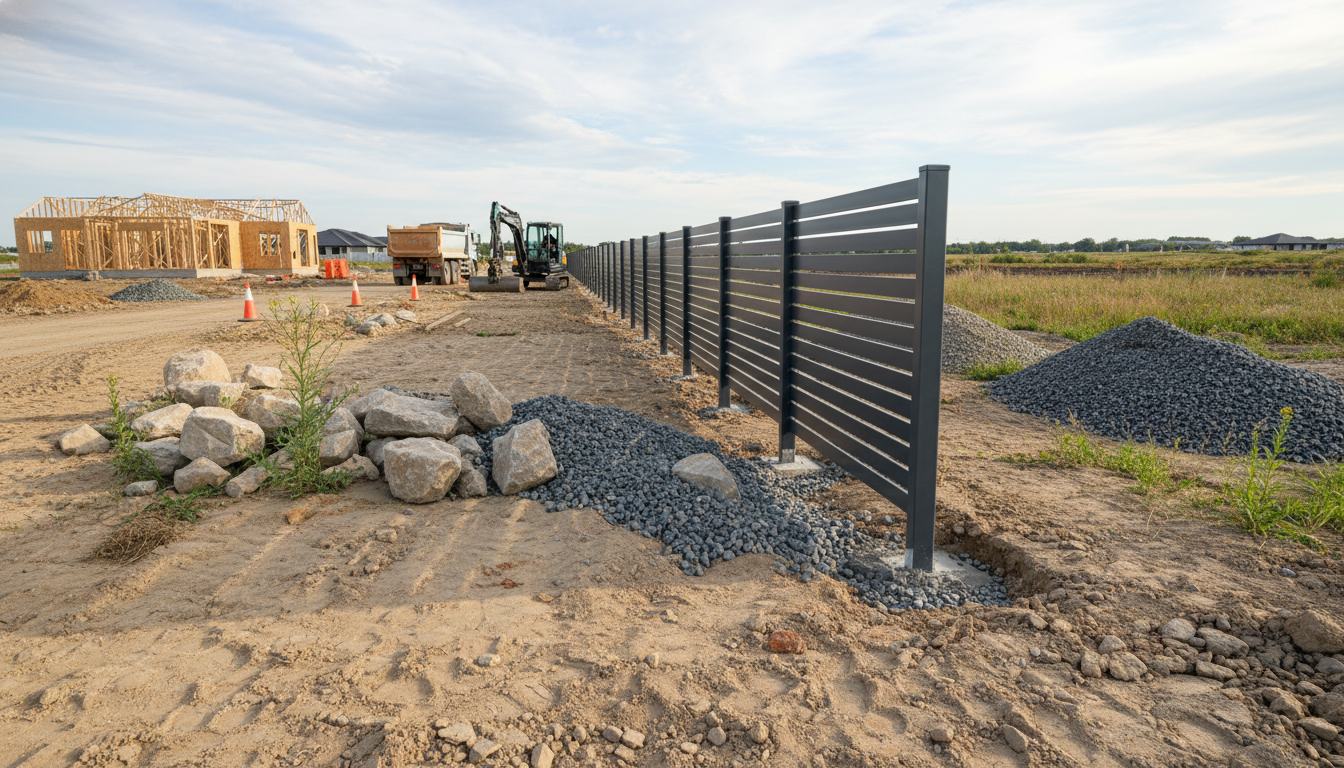
Have you recently had your land backfilled and would like to install a fence quickly? This is a common situation, especially on new plots or after earthworks. The problem is that recently backfilled ground is nothing like natural ground that has been stable for years. It shifts, settles, and compacts. Installing posts without proper precautions risks your fence leaning after just a few months. Here’s how to proceed to achieve a solid and durable result.
Why Recently Backfilled Ground Poses a Problem for Fences
Backfill is an addition of soil, rubble, or various materials intended to raise or level ground. When it’s recent, this soil hasn’t yet had time to compact naturally. Depending on the nature of the materials and the thickness of the backfill, settlement can last from 6 months to several years. During this period, anything anchored in it is likely to shift.
A fence post sealed in unstable backfill can sink, tilt, or become dislodged due to differential settlement. The ground does not settle uniformly: some areas compact faster than others. Your mesh fence will deform, your rigid panels will become misaligned, and the entire structure will lose both solidity and aesthetic appeal.
Assess the Condition of the Backfill Before Starting
Before getting out the auger, take the time to analyze your soil. How long ago was the backfill put in place? With what materials? Backfill consisting of topsoil will settle much more than backfill made of compacted gravel or all-in material properly laid in successive layers.
If the backfill is less than three months old and has not been mechanically compacted, it is frankly better to wait or plan for appropriate foundations. A simple test: push a metal stake into the ground by hand. If it sinks easily by 30 or 40 cm, the soil is still very loose and will not provide sufficient anchoring for standard fence posts.
Compacting the Ground Before Installation
If you cannot wait for natural settlement to do its work, the solution involves mechanical compaction of the backfill, at least along the installation line. A vibrating plate or a roller compactor is used for this, depending on the surface to be treated.
The ideal approach is to compact in layers of 20 to 30 cm, watering lightly between each pass. This work reduces voids in the soil and accelerates stabilization. Many individuals skip this step, but it is what makes the difference in the fence’s long-term stability.
Choosing the Right Type of Anchoring
On backfilled ground, classic anchoring—a simple hole with concrete—is not always sufficient. Two approaches depending on the depth of the backfill:
- Deep anchoring with concrete sealing: dig beyond the backfill to reach the natural ground in place, then pour a concrete block of at least 30 × 30 cm. This is the most reliable method if the backfill does not exceed 50 to 80 cm in thickness.
- Continuous concrete footing or beam: for thick or unstable backfills, pour a continuous foundation that distributes loads over a larger surface. This solution is well-suited for rigid panel fences or low walls with fencing.
In all cases, the depth of the sealing must be calculated based on the actual thickness of the backfill. A post anchored only in the added layer will eventually shift, even with concrete.
Adapting the Fence Choice to the Terrain
Not all fences react the same way to ground movements. A flexible mesh fence on posts will be more tolerant than a rigid panel fence, which tolerates no misalignment. If your backfill is still new and you have doubts about its stability, opt for a system that absorbs slight movements.
Clip-on posts for rigid panels remain an option, provided the anchoring is correctly sized. At Districlos, our posts are designed to adapt to various terrain configurations, including difficult soils. Do not hesitate to contact our customer service to find the most suitable solution for your project.
Mistakes to Avoid on Backfill
The first and most common mistake is treating recent backfill like regular soil. You dig 40 cm, pour the concrete, and hope it holds. Six months later, the fence looks like a line of falling dominoes.
Another pitfall: neglecting drainage. Backfill often retains more water than natural soil, especially if it contains clay or topsoil. Stagnant water around the sealing blocks accelerates ground movements and weakens the anchors. Providing a gravel bed at the bottom of each sealing hole helps drain water and limit this phenomenon.
When to Call a Professional
If your backfill exceeds one meter in thickness or if it was made with heterogeneous materials (soil mixed with rubble, construction debris, etc.), enlist a professional earthworks contractor or an experienced installer. The risk of ground movement is too significant to improvise.
Districlos supports individuals and professionals with this type of project. Our team can advise you on the choice of posts, the type of fence, and the most suitable installation method for your land. In-store or by phone, we will study your specific situation before guiding you. It’s best to lay the right foundations from the start.

Expert in fencing, gates, and outdoor landscaping since 2019.
Holds a Master’s degree in Digital Marketing – SEO, UX/UI.
View LinkedIn profile


