
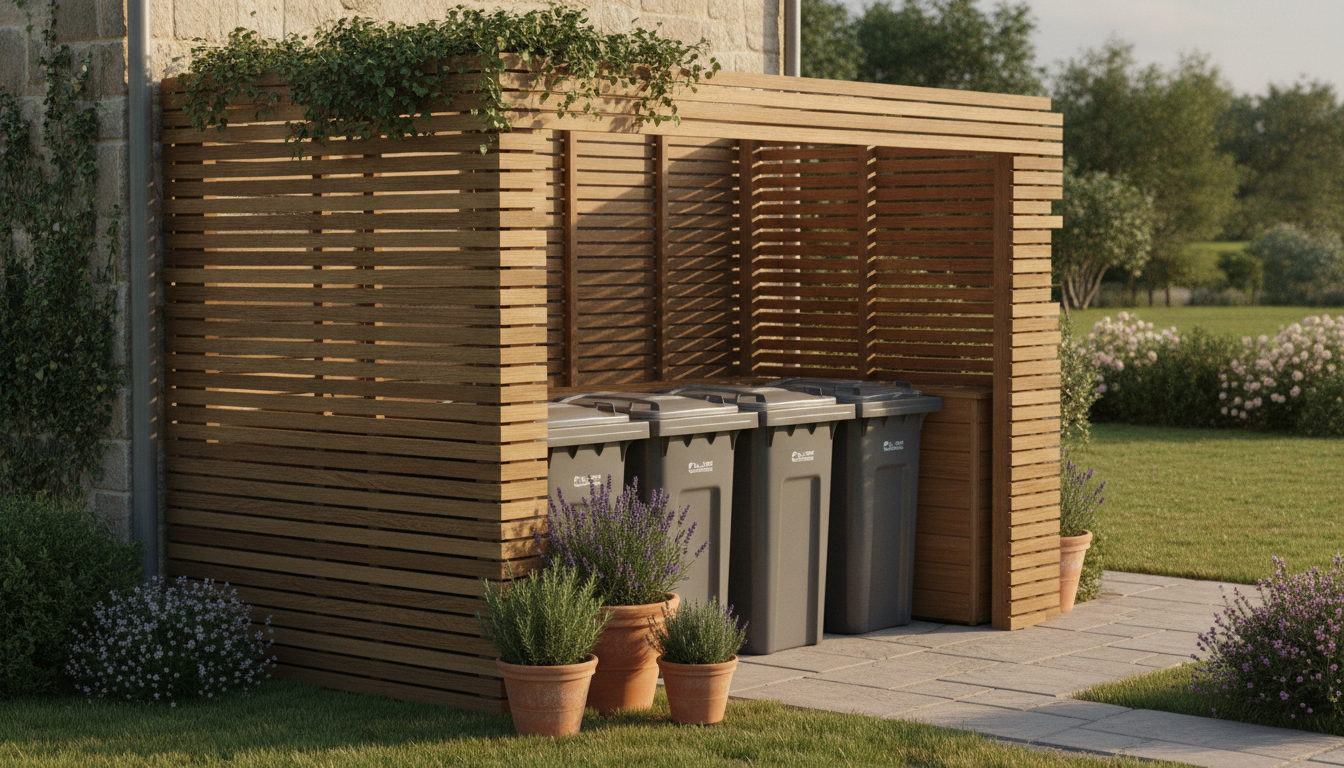
Essential but frankly unsightly, recycling bins and composters always end up spoiling the entrance to the house or a corner of the garden. To conceal them without complicating daily life, a screen is an excellent option. Here’s how to create a bin enclosure that is clean, sturdy, and discreet.
Why a screen is the ideal solution for your bins
Why choose a screen rather than a closed shelter? Simply to avoid odors. A totally enclosed space tends to turn into a hothouse in summer. The privacy screen or slatted screen conceals the view while allowing air to circulate freely.
Furthermore, its slim design means you don’t lose valuable square meters, which is ideal for small courtyards or front yards. It’s a simple tip to enhance your home’s curb appeal as soon as you pass through the gate and add value to your exterior at a lower cost.
Which material to choose for your bin enclosure?
The choice of material mainly depends on the time you want to spend maintaining it and the style of your house.
Composite and aluminum for zero maintenance
If you are looking for a durable solution that will not change over time, opt for aluminum or composite. These materials are perfectly resistant to UV rays, humidity, and especially splashes (a trash bag accident can happen quickly during handling). A simple spray with a hose from time to time is enough to clean them. These modern screens integrate very well along an existing fence or near a contemporary garage.
Wood for natural integration
For a composter at the back of the garden or near the vegetable patch, natural wood remains the most logical choice. It blends into the decor, and you can easily grow climbing plants (ivy, star jasmine, or clematis) on it to make it almost invisible.
However, be careful: to prevent the wood from rotting due to soil or compost moisture, use class 4 pressure-treated wood or fix the posts on metal plates above ground.
How to install your screen around the bins
Regarding installation, there’s no need for major masonry work. The simplest way is to assemble an L-shaped or U-shaped structure to surround the bins on two or three sides, while leaving free access to easily remove them on collection day.
- Plate mounting: ideal if you already have a concrete slab or paved ground in front of your garage.
- Direct embedding: recommended on soft ground (lawn, soil) to ensure good stability against wind.
Dimensions and access: pitfalls to avoid
A few practical details to keep in mind before fixing your posts:
- Allow space: allow about 80 cm wide per bin. If you’re too tight, you’ll constantly rub against the sides when handling the bins.
- Choose the right height: a screen of 1.20 m to 1.50 m is largely sufficient to hide standard bins (120 to 240 liters) without obstructing the view of the rest of the garden.
- Anticipate opening: make sure to leave enough clearance to fully open the bin lids or to stir your compost without being hindered by the panel.
If you lack space or if your land is sloped, Districlos offers modular privacy solutions that adapt precisely to your space constraints.

Experte clôture, portail et aménagement extérieur depuis 2019.
Diplômée en Master de Marketing digital – SEO, UX/UI
Voir le profil sur LinkedIn


