
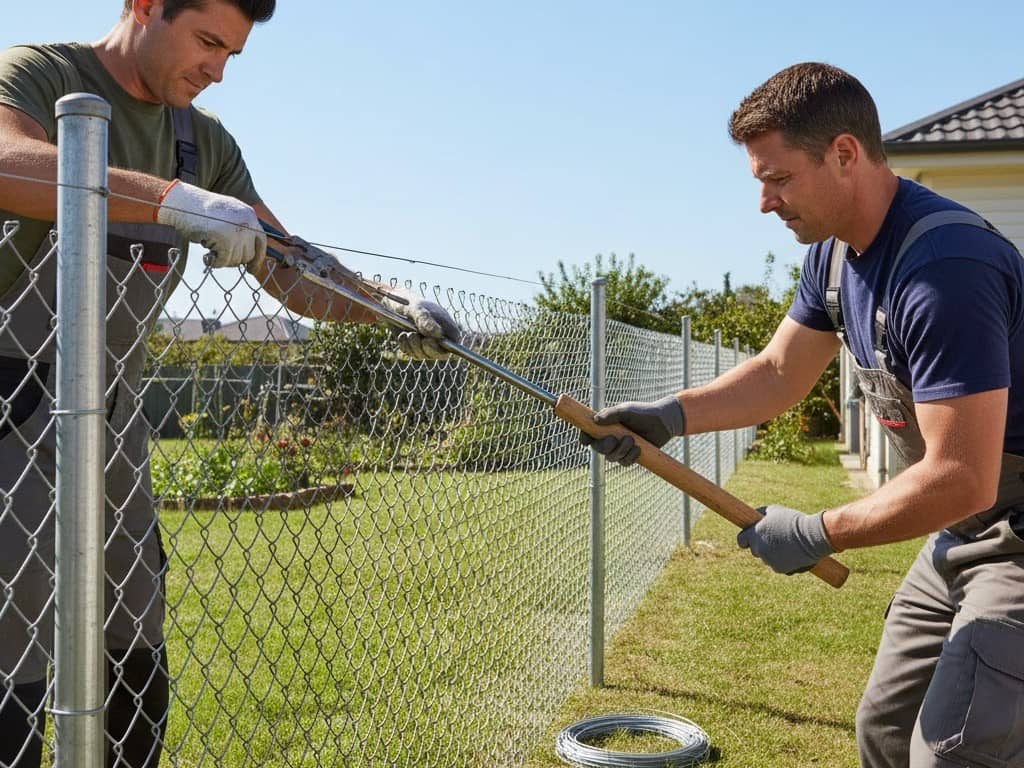
You are in the middle of installing your flexible mesh fencing, the posts are set, the roll is ready… but you are missing an essential tool: the tensioner. Do you have to stop everything and run to the store? Not necessarily. While it is true that tensioners, also known as strainers, are the professional solution par excellence, there are tricks to achieve correct tension for your wires without this accessory.
Whether for a small repair, a fence of a few meters, or simply because you are a fan of DIY resourcefulness, discover our methods for tensioning a wire manually. The goal remains the same: a solid and durable fence that will not sag at the first opportunity.
Why is properly tensioning your wire essential?
Before getting to work, let’s remember why this step is so crucial. The tension wires (usually one at the bottom, one in the middle, and one at the top) form the skeleton of your fence. The mesh rests on them. A loose wire ensures a mesh that ripples, gaps at the bottom, and loses all its effectiveness, whether for containing an animal or simply marking out your land.
Proper tension distributes the forces across all posts and struts. It guarantees the flatness and rigidity of the installation over the long term. It is therefore a step that should not be neglected for the longevity of your fence.
Equipment needed for manual tensioning
The good news is that you won’t need complex equipment. To tension your wire without a tensioner, you will simply need tools found in most toolboxes:
- Thick protective gloves, essential for handling the wire without injuring yourself.
- End-cutting pliers or robust wire cutters to cut and twist the wire.
- A piece of rebar, an iron bar, or even a very sturdy piece of wood long enough to serve as a lever.
The tourniquet technique: simple and effective
This is the most well-known and reliable trick to replace a tensioner. The principle is simple: create a twist in the wire to shorten it and therefore tension it. This is known as the “tourniquet” or “garrot” technique. It allows you to apply significant force without exhausting yourself.
To implement it, securely fix your wire to the starting post. Unroll it to the next post, go around it, and bring the wire back on itself for a distance of about 40 to 50 cm. You will work on this double wire to create the tension.
Steps to tension your wire with a tourniquet
Once your wire is doubled, insert your iron bar or piece of wood between the two strands, roughly in the middle of the length. Then, simply turn it as you would a crank. Each turn will wrap the wires around each other, reducing their length and gradually increasing the tension across the entire line.
Continue turning until you reach the desired tension. Be careful not to go too far at the risk of breaking the wire! The wire should be as tight as a guitar string but maintain a very slight elasticity. Once the tension is reached, block your lever against the post or securely tie the wire to maintain the twist.
Tensioning the wire with pliers for short lengths
For very short distances (less than 5 meters) or to slightly retighten an existing wire, a good pair of end-cutting pliers may suffice. The method is more physical and less precise. It involves wrapping the wire around the pliers to get a good grip, then pulling with all your strength to tension it before stapling it or wrapping it around the end post.
This technique is truly a temporary fix. It does not achieve the level of tension obtained with a tourniquet or a real tensioner, and it is not recommended for installing a complete fence.
When is using a tensioner still indispensable?
Even if these tricks are effective, we must remain realistic: they do not replace a genuine No. 2 strainer. For long distances (over 20 meters), on sloping ground, or for a truly professional and durable result, investing in tensioners is highly recommended.
The tensioner allows for much finer adjustment, more uniform tension, and above all, it offers you the possibility to easily retension the wire after a few years when it will inevitably have loosened a little. This is a guarantee of peace of mind and performance for your fence.

Expert in fencing, gates, and outdoor landscaping since 2019.
Holds a Master’s degree in Digital Marketing – SEO, UX/UI.
View LinkedIn profile


