
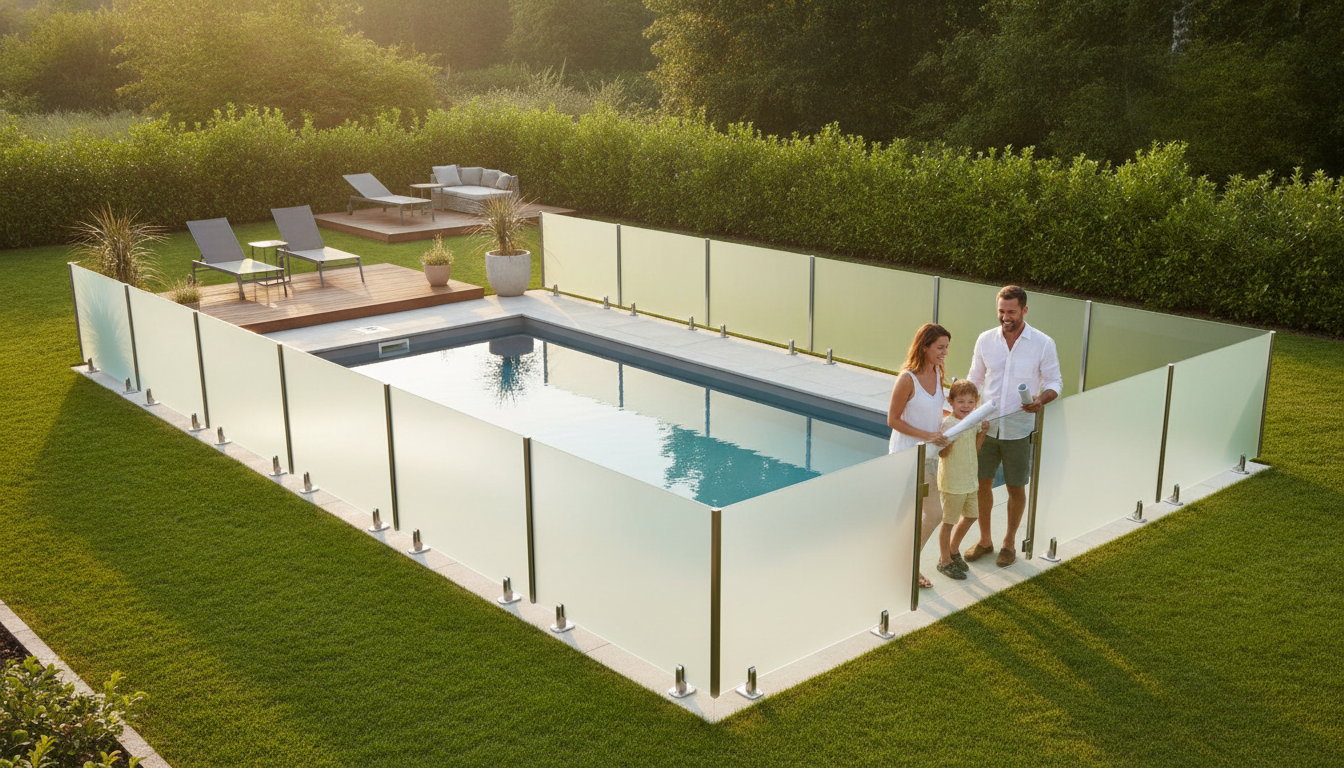
Are you installing an above-ground pool in your garden this summer? Before you dive in, there’s an important question to address: that of safety and the rules to follow. Contrary to popular belief, an above-ground pool is not always exempt from obligations. Fencing, declaration to the local council, anti-drowning device… we take stock of what truly awaits you in 2026.
Is the above-ground pool covered by safety law?
This is THE major confusion. The famous law of January 3, 2003 imposes a safety device to prevent drowning, but it only applies to in-ground or semi-in-ground pools for private use. Above-ground pools simply placed on the ground, such as self-supporting or tubular models, are not covered by this legal obligation.
In other words, the law does not oblige you to install a barrier around your inflatable or tubular pool. But be careful: absence of obligation does not mean absence of risk. A child can drown in very little water, and the owner’s responsibility remains fully engaged in the event of an accident. Prudence, however, is not optional.
When does an above-ground pool become “in-ground” in the eyes of the law?
The trap lies in the installation details. If you excavate the ground to partially embed your pool, or if you surround it with a deck that conceals its height, the administration may reclassify it as a semi-in-ground pool. In this case, you fall within the scope of the 2003 law, and a safety device becomes mandatory.
The rule is simple to remember: the closer your pool is to ground level, the more likely it is to be subject to the same constraints as a traditional pool. In case of doubt, it is better to contact your local council before starting work rather than discovering the problem afterwards.
Is a declaration or permit required for an above-ground pool?
Here again, everything depends on the size and duration of installation of your pool. Administrative procedures follow precise thresholds:
- Less than 10 m2 of surface area: no formalities, regardless of duration.
- Between 10 and 100 m2: a prior declaration of works is necessary if the pool remains installed for more than 3 months per year (or 15 days if you are in a protected area).
- More than 100 m2: a building permit may be required.
A tubular pool dismantled every winter generally escapes any formalities. However, if you leave your pool in place all year round, remember to check your situation. Your municipality’s Local Urban Plan (PLU) may also impose specific rules, particularly regarding distances to property boundaries.
Pool Fencing: What Remains Highly Recommended
Even without a legal obligation, fencing off access to your above-ground pool is one of the best decisions you can make, especially with young children or animals. A protective barrier prevents unsupervised access to the pool and significantly reduces the risk of accidents.
Several solutions exist depending on your budget and the configuration of your garden. A rigid fence or a mesh panel installed around the swimming area works perfectly. You can also opt for a self-locking gate to control entries. The idea is not to turn your garden into a fortress, but to create a reliable physical separation between the living space and the water feature.
What height and characteristics for an effective fence?
If you choose to install a barrier, it should be genuinely deterrent. Even outside the strict legal framework, it is relevant to draw inspiration from the NF P90-306 standard which governs pool barriers. It recommends a minimum height of 1.10 meters between two support points and a sufficiently small bar spacing so that a child cannot pass through or climb over.
A good device must resist attempts to open it by a child under 5 years old and close automatically thanks to a self-locking system. The choice of materials also matters: aluminum, galvanized steel, or rigid panels offer durable resistance to bad weather and the permanent humidity around a pool. At Districlos, our team will guide you towards the solution adapted to your terrain and your pool.
Owner’s Responsibility: The Real Issue
Beyond the texts, what you must keep in mind is your civil and criminal liability. In the event of drowning, especially of a child, the absence of protective measures can be held against you, even if the law did not impose anything for your above-ground pool. Courts assess the notion of negligence on a case-by-case basis.
Installing a fence is therefore as much a matter of compliance as of common sense. A secured pool protects those around you and shields you from the legal consequences of an accident. In 2026, regulations have not fundamentally changed for above-ground pools, but the attention paid to safety continues to strengthen. Anticipate, secure, and enjoy your summer with peace of mind.

Expert in fencing, gates, and outdoor landscaping since 2019.
Holds a Master’s degree in Digital Marketing – SEO, UX/UI.
View LinkedIn profile


