
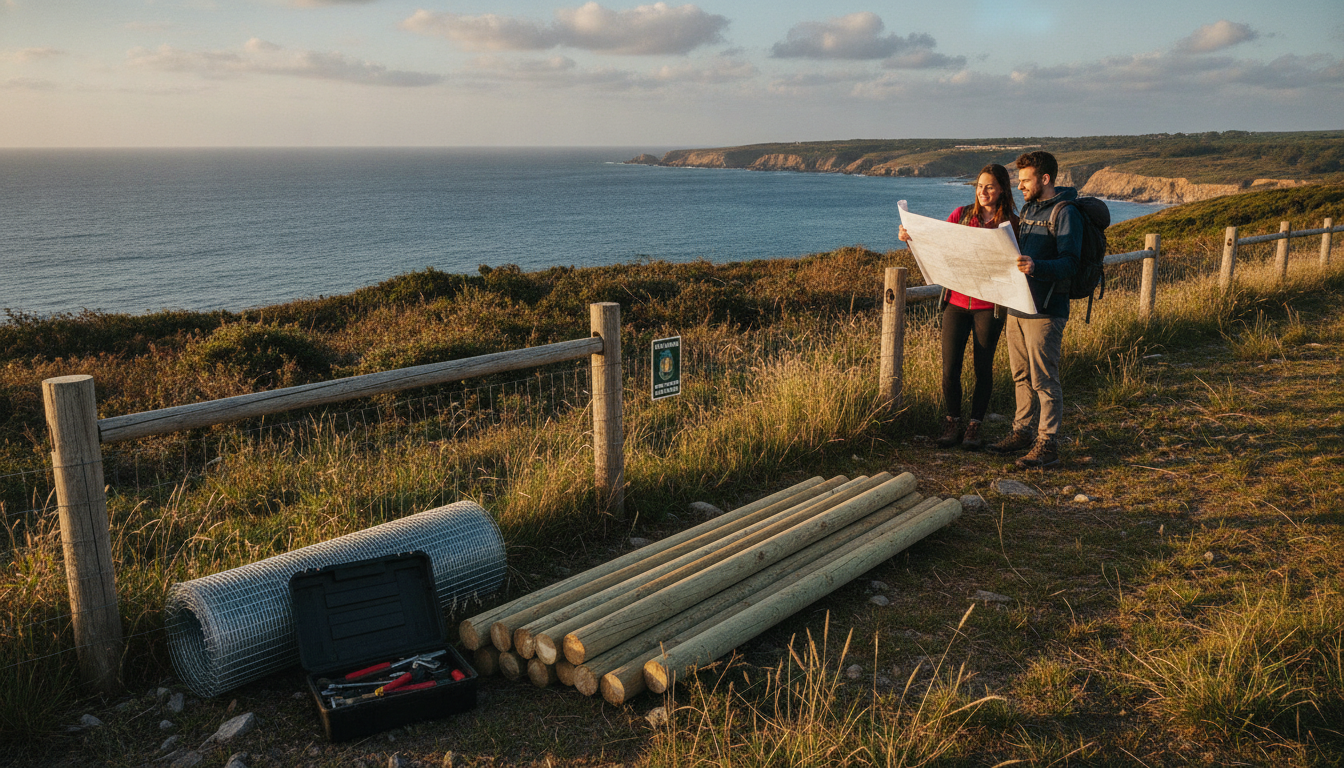
Do you live near a listed site, a nature park, or a protected coastline? Before you set a single post, it is best to know the rules. Installing a fence along the edge of a protected area is not something to improvise: regulations are strict, and a mistake can cost you dearly—up to being required to remove everything. Here is what you are allowed to do, and above all what you must check before you get started.
Why are these areas so tightly regulated?
A protected area is not just a beautiful landscape. It is a zone where biodiversity, heritage, or ecological balance justify special legal protection. This includes listed and registered sites, nature reserves, national and regional parks, Natura 2000 areas, and areas covered by the Coastal Law.
In all these areas, the aim is to limit human impact on the environment. Even a modest fence can block wildlife movement, spoil a landscape, or fragment a natural habitat. That is why the authorities closely regulate this type of installation, sometimes down to the choice of materials and height.
What permissions should you request before installing a fence?
The first thing to do is to check with your town hall. In most municipalities near a protected area, installing a fence requires a prior works declaration. This document allows the administration to verify that your project complies with local planning rules.
Depending on the area concerned, you may also need approval from the Architect of the Buildings of France (ABF), especially if you are within the perimeter of a listed site or a historic monument. Do not overlook this step: without validation, your fence may be deemed illegal, even if it has already been installed.
- Prior declaration at the town hall for most projects
- ABF opinion in protected perimeters
- Consult the Local Urban Plan (PLU) for local constraints
Height, materials, transparency: what is often required
Along the edge of a protected area, you cannot install just anything. The rules are designed to preserve the visual character of the site and allow small wildlife to move through. In practical terms, you will often be asked to opt for a discreet, permeable fence rather than a solid wall that closes off the landscape.
The most common constraints concern the maximum height, often limited to 1.20 m or 1.50 m, the ban on overly bright colours, and the requirement to use materials that blend into the site. Flexible wide-mesh fencing, a well-chosen rigid panel, or a natural wood fence will generally be more acceptable than a concrete palisade.
Preserving wildlife passage
This is easy to forget, yet it is central in sensitive areas. A fence that is too closed off cuts through the ecological corridors used by animals to move, feed, or reproduce. Hedgehogs, amphibians, small mammals: all need to move freely.
To stay compliant and respectful of the environment, it is recommended to leave openings at ground level or choose fencing whose lower mesh is sufficiently spaced. Avoid solid base panels that turn your fence into an impassable barrier. A simple 15 cm gap under the fence can be enough to preserve wildlife passage.
The special case of the coastline and wetlands
If your land is by the sea or close to a wetland, expect even stricter rules. The Coastal Law protects a coastal strip where development and works are heavily restricted. In the well-known 100-metre strip, installing a fence may be outright prohibited or subject to specific authorisations.
Wetlands are protected for their role in water regulation and biodiversity. Any intervention there is closely monitored. Before considering a fence on this type of land, always check the exact status of your plot with the State services or your intermunicipal authority.
The risks if you do not comply with the rules
Installing a fence without authorisation in a protected area exposes you to real penalties. The administration may require you to restore the site, meaning removal at your expense. Fines may also be added, sometimes substantial, especially in cases of damage to a sensitive natural environment.
Beyond the financial aspect, it is also a matter of respecting nature. A poorly designed fence can cause lasting damage to a fragile ecosystem. It is better to take the time to do things properly: having your project approved in advance saves you months of hassle and ensures an installation that lasts.
Choosing the right fence for a compliant project
Once you have the necessary authorisations, you still need to select the right product. The goal: a fence that complies with local constraints, is durable, and suits your environment. Choose materials that withstand outdoor conditions and blend into the landscape without spoiling it.
At Districlos, we support both private individuals and professionals in choosing fences, mesh fencing, and panels suited to each type of land. Our customer service team can advise you on the most relevant solutions to stay compliant while meeting your needs. Whether you are looking for discreet flexible mesh fencing or a well-integrated rigid panel, you will find the right product for your project along the edge of a protected area.

Expert in fencing, gates, and outdoor landscaping since 2019.
Holds a Master’s degree in Digital Marketing – SEO, UX/UI.
View LinkedIn profile


