
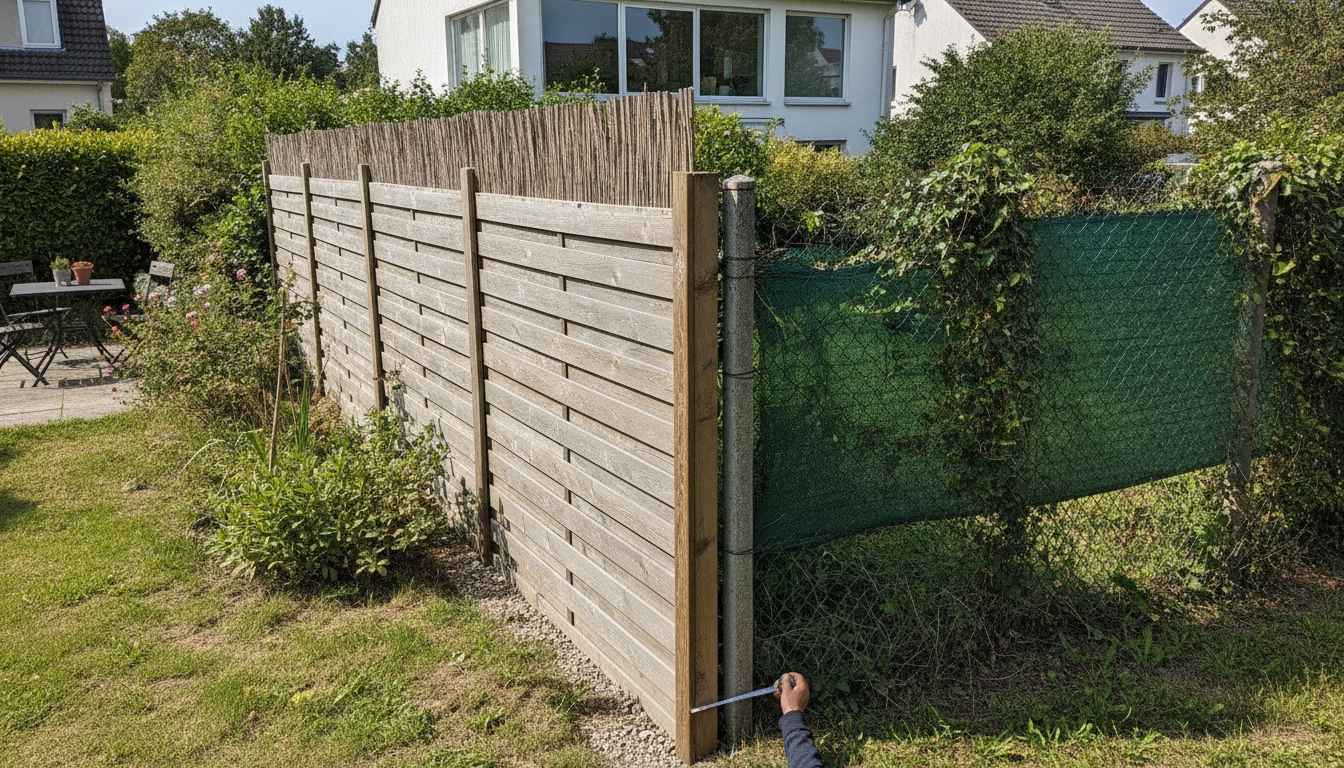
To shield oneself from neighbors, installing a privacy screen or a reed fence seems to be the simplest solution. But beware: before planting a single post, you must consider neighborhood rules, and especially the concept of a right to light/view easement. If you do not comply with the law, your neighbor can force you to dismantle everything at your own expense.
What is a Right to Light/View Easement?
A right to light/view easement is a rule in the Civil Code that regulates overlooking. It imposes a minimum distance between an opening on your neighbor’s property (window, balcony, terrace) and your land.
The law distinguishes two cases:
- Direct view (you see into your neighbor’s property by looking straight ahead): the opening must be located at least 1.90 meters from the property line.
- Oblique view (you have to turn your head or lean to see into your neighbor’s property): the minimum required distance is 0.60 meters.
If your neighbor’s window complies with these distances (or if it has been installed for more than 30 years), it is perfectly legal. You cannot block their view or daylight by installing an opaque screen directly in front of their window, under penalty of being sued for abnormal neighborhood disturbance.
Installing a privacy screen on a party or private fence?
It all depends on the nature of the fence:
- The fence is a party fence (it separates your two properties and belongs to both owners): you must obtain your neighbor’s written agreement before attaching anything to it (reed fence, artificial hedge, PVC slats). A privacy screen has significant wind resistance and can damage or knock down a shared wire mesh fence.
- The fence is private (it is built entirely on your land): you are free to install the screening of your choice. Be careful, however: your installation must not extend a single millimeter onto your neighbor’s property, and you must respect the maximum authorized heights.
What are the maximum authorized heights?
Before purchasing your materials, inquire at your town hall to consult the Local Urban Plan (PLU). Municipalities often impose height limits, as well as choices of colors or materials to preserve neighborhood harmony.
If your municipality has no specific rules, the Civil Code applies. The maximum authorized heights (including fence and privacy screen) are:
- 3.20 meters in cities with more than 50,000 inhabitants.
- 2.60 meters in municipalities with fewer than 50,000 inhabitants.
The special case of “non-opening obscured windows”
A non-opening obscured window (or tolerance window) is not a conventional window. It is a fixed opening that does not open, equipped with frosted glass or a glass block. It lets light pass through but prevents you from seeing into your property.
Here, the law is much more flexible. If your neighbor’s window is a simple non-opening obscured window, you have every right to install an opaque privacy screen directly in front of it, even if it blocks their light. This type of opening does not give them any right of view over your property.
What type of privacy screen to choose?
To shield yourself without incurring the wrath of the neighborhood, several options are available to you. Fence specialists like Districlos offer equipment suitable for all terrain configurations:
- Rigid panels with screening slats (in PVC, wood, or composite): these slide directly into the mesh of the fence. It’s a clean, durable, and aesthetic solution.
- Screening fabric or artificial hedge: installed on a single-twist mesh fence, this is the quickest and most economical option to regain some privacy.

Experte clôture, portail et aménagement extérieur depuis 2019.
Diplômée en Master de Marketing digital – SEO, UX/UI
Voir le profil sur LinkedIn


