
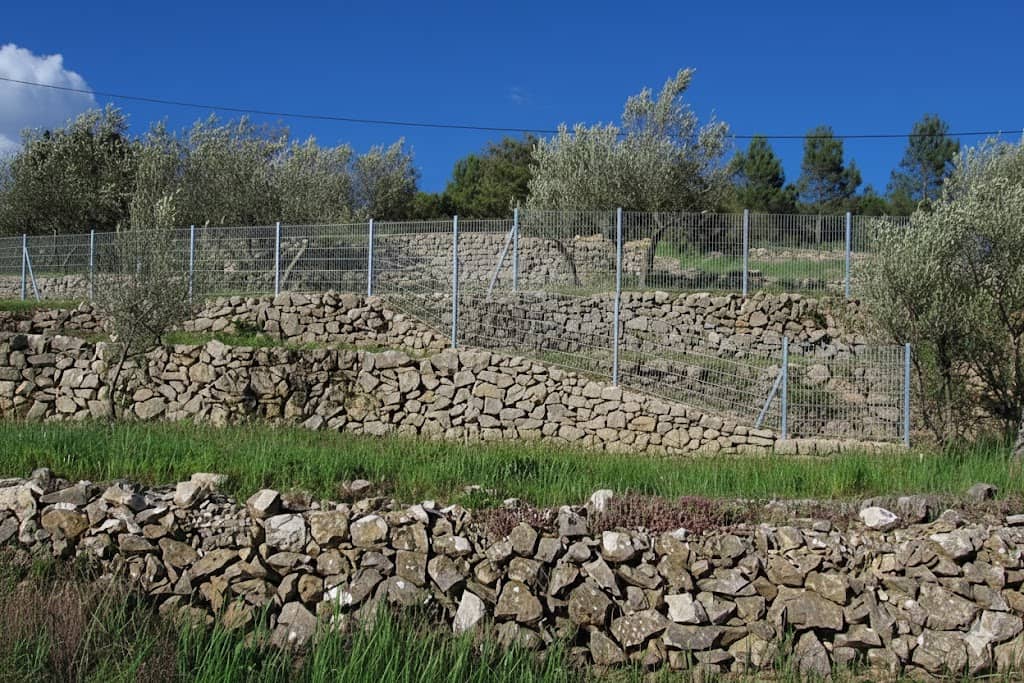
Is your land not perfectly flat and does it have a significant change in level? Rest assured, this is a very common situation. Installing a fence on sloping ground requires a certain technique, especially when there is a slope break, meaning a sudden change in gradient.
What is meant by a “slope break”?
A slope break is not a simple continuous incline, but a specific point where the ground changes angle, creating a “kink”.
This may be due to the natural topography of your garden or to landscaping, such as the edge of a terrace or a retaining wall.
Ignoring this feature is the best way to end up with a disappointing result: a fence that is not straight, large gaps under the panels, or a weakened structure.
The key is to anticipate this kink in your layout plan and choose the right installation method to manage it as a specific point in your project.
Which installation technique should you choose?
On sloping ground, two main techniques are available. The choice will depend primarily on the type of fence you want to install (flexible or rigid) and the aesthetic result you are looking for.
Stepped installation involves installing each fence panel perfectly level, offsetting their height to compensate for the change in level.
Installing along the slope (or “on the camber”) adapts the fence to the ground’s incline, which is easier with flexible mesh. For a clear slope break, stepped installation is often the most suitable and the most attractive.
Stepped installation
This method is ideal for rigid mesh panels. Each panel is installed level, creating a stepped effect that follows the overall line of the slope. This leaves a triangular gap under each panel, which can be filled if necessary with a chamfered base plate or concrete.
The key to this installation lies in managing the posts. You will need to plan for longer posts than for an installation on flat ground, because they must compensate for the height difference while being securely set into the ground. The finish is very clean and professional, and it ensures perfect rigidity for the whole structure.
Installing along the slope
If you choose flexible roll mesh, following the slope is the simplest solution. The mesh naturally follows the contours of the ground, limiting gaps at the bottom. This technique is quick and cost-effective.
However, on a very pronounced slope break, the mesh may tend to deform or “float” at the break point. It is then crucial to tension the mesh properly and ensure that the posts and struts are positioned perfectly to maintain tension on both slope sections.
Managing the break point
The best approach is to install two posts on either side of the slope break, very close to each other. Each post will serve as the starting point for the new slope line.
Attach the panel coming from the first slope to the first post, then start the new section with a new panel fixed to the second post, aligning it with the new incline. This guarantees a neat finish and rock-solid strength.
What type of fence should you choose for sloping ground?
Our recommendations for ground with one or more slope breaks are as follows:
- Rigid panels: This is the most recommended solution. Their non-deformable structure is perfect for a stepped installation. They offer a modern look and excellent robustness.
- Flexible mesh: More economical, it is best reserved for gentle slopes and less pronounced breaks. Its flexibility can become a drawback if the change in level is too abrupt, as it will be difficult to maintain even tension.

Expert in fencing, gates, and outdoor landscaping since 2019.
Holds a Master’s degree in Digital Marketing – SEO, UX/UI.
View LinkedIn profile


