
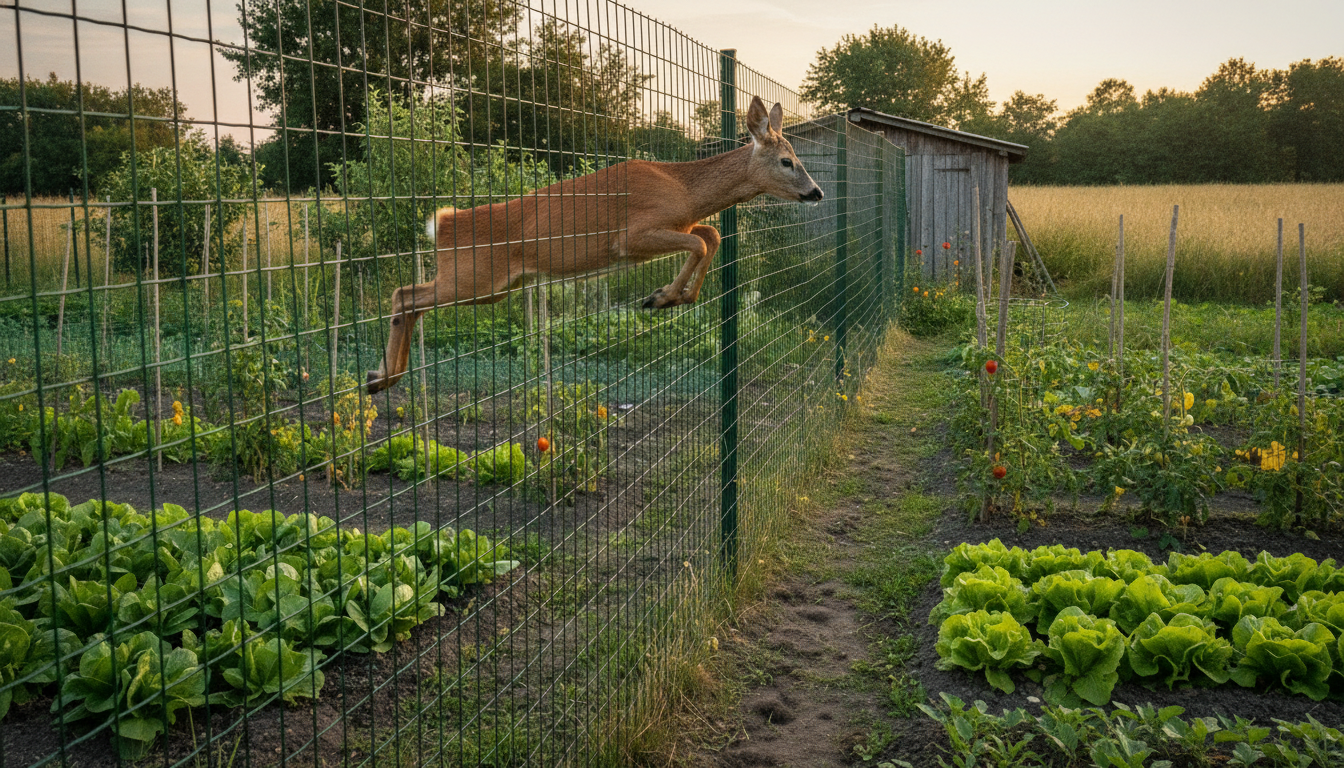
A deer jumping into your vegetable garden can cause significant damage in a single night. Nibbled young shoots, barked fruit trees, trampled plantations… these graceful animals quickly become a problem when they invite themselves into your garden. To keep them at a distance, everything depends on two criteria: height and mesh size. We explain how to make the right choice.
Why do deer get past conventional fencing?
Deer are excellent jumpers. An adult can clear an obstacle of 1.50 m without a running start, and even more if they pick up speed. A simple 1-meter garden fence therefore represents no barrier at all. They leap over it almost effortlessly, especially at night when they come to feed.
Another often overlooked point: deer can also squeeze under or through mesh that is too wide. If your fencing has large gaps or if there is a space at ground level, the animal will find a way through. A good deer-proof fence must block jumping over as much as passing underneath.
What height should you choose for total peace of mind?
This is the number one criterion. To effectively stop a deer, count on a minimum height of 1.80 m, and ideally 2 meters. Below 1.80 m, you run the risk of a motivated animal clearing the obstacle, particularly during the rutting season or when food is scarce.
If your terrain is sloped, adapt the height accordingly: a deer approaching the fence from higher ground gains jumping height. In this case, increase the height by 20 to 30 cm in the affected areas. It is better to plan for extra height than to have to redo everything after a first breach.
Recommended mesh size to block passage
Height is not enough if the mesh size allows the animal to pass through. For deer-proof fencing, two solutions have proven effective:
- Knotted wire mesh (such as deer fencing or knotted mesh) with narrower gaps toward the bottom, and a maximum of 15 x 15 cm at the top. This type of fencing follows irregular terrain well.
- Welded wire mesh in rolls or rigid panels, with a mesh size of 10 x 10 cm or less, which is more robust and durable over time.
The essential thing is that the bottom mesh gaps are the tightest to prevent animals from passing through at ground level, whether they are deer, wild boar, or small game.
Securing the fence to the ground
A deer does not dig, but it easily spots a weak point to slip under if the mesh is not taut at the ground. Therefore, remember to bury the bottom of the mesh by about ten centimeters, or fix it securely using closely spaced stakes and a lower tension wire pressed firmly against the ground.
On uneven terrain, check every dip and bump. A simple 20 cm gap under the fence can be enough for a young deer to squeeze through. Regular spacing of posts, every 2.5 to 3 meters, ensures uniform tension and prevents sagging.
Rigid or flexible mesh: which should you prefer?
The choice depends on your terrain and your budget. Flexible mesh (knotted wire) remains the most economical solution for large areas, such as an orchard or a wooded plot. It is quick to install and adapts to the landscape, but requires good tension to remain effective over time.
The rigid panel, on the other hand, offers superior strength and a more polished look. It is perfectly suited for a landscaped garden or the surroundings of a house, where aesthetics matter as much as protection. More expensive to purchase, it does not move or deform, even after several years.
Enhancing effectiveness with a few additions
If deer are particularly numerous in your area, a few additions can make the difference. An electric wire placed at the top of the fence quickly discourages animals attempting to jump. This is a formidable solution, often used by professionals to protect young plantations.
You can also use inclination: a fence slightly tilted outwards confuses the deer at the moment of the jump and encourages it to give up. These tips do not replace a good base height, but they reinforce an already well-designed installation.
At Districlos, you will find all the equipment necessary to set up an effective deer-proof fence: mesh, rigid panels, posts, and fixing accessories, available online or in our network of stores. Unsure about the height or mesh size suited to your terrain? Our team is here to support you with your project.

Expert in fencing, gates, and outdoor landscaping since 2019.
Holds a Master’s degree in Digital Marketing – SEO, UX/UI.
View LinkedIn profile


