
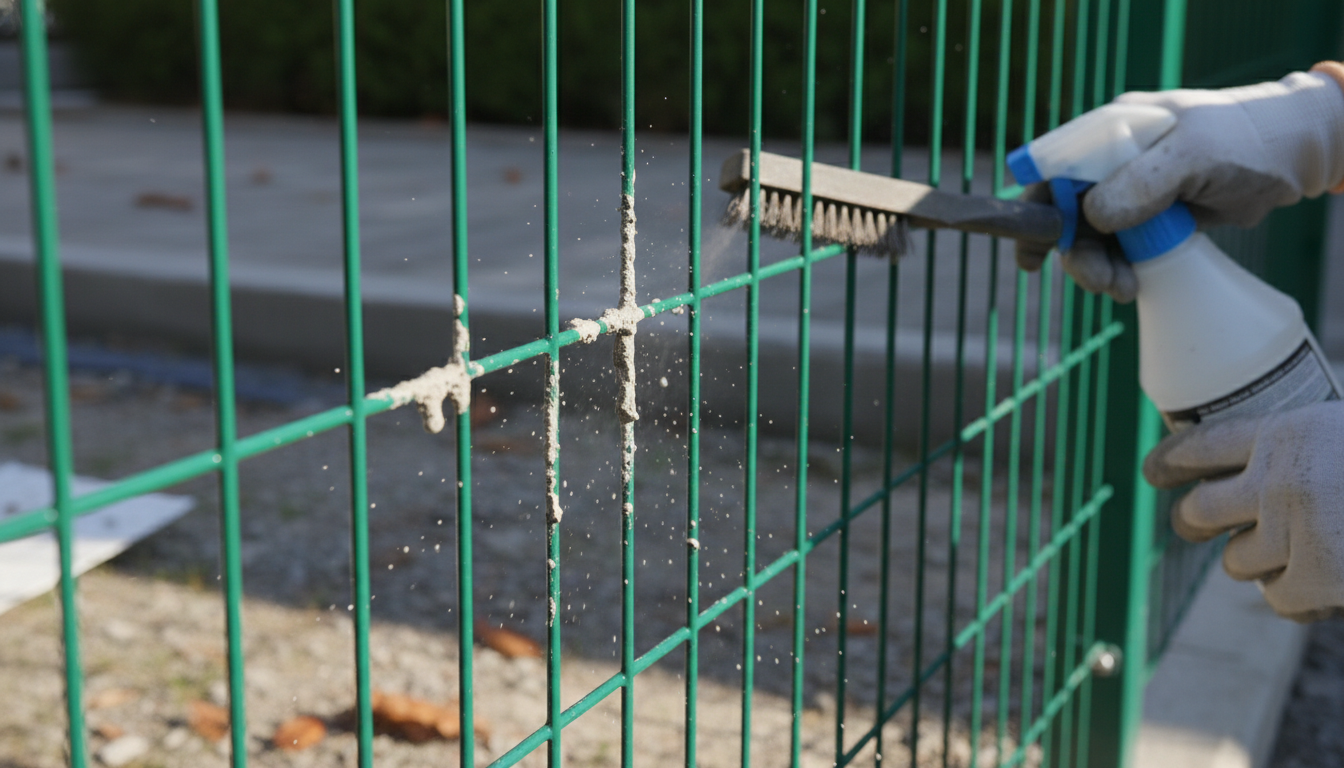
You’ve just installed your fence, and the mason (or you yourself) has left cement splashes on the mesh. Cement dries quickly, adheres strongly, and the longer you wait, the harder it is to remove. There are several methods to get your fence clean again without damaging it, but you need to use the right products and techniques.
Why Cement Adheres So Strongly to Fencing
Once dry, cement forms a hard mineral crust that chemically binds to the surfaces it contacts. On a galvanized or plastic-coated fence, it adheres to the rough spots of the wire and lodges at the mesh intersections. The longer it remains, the more resistant it becomes due to carbonation. Addressing it within the first few days is always simpler than after several weeks of complete drying.
On a new fence, the challenge is twofold: removing the cement without scratching the protective coating (galvanization or plastic coating). A surface-damaged fence will rust prematurely. Therefore, it is best to avoid overly aggressive methods.
Start with Dry Mechanical Cleaning
Before resorting to chemical products, first attempt mechanical removal. For fine splashes or isolated drops, this is often sufficient. Take a stiff nylon brush (not metallic, to avoid scratching the coating) and scrub the cement deposits. Thicker pieces can be gently detached with a plastic spatula or an old putty knife.
For larger clumps, a light tapping with a rubber mallet may be enough to break up the crust. Since the fence is flexible, vibrations help dislodge residues. Work mesh by mesh, without forcing, especially on a plastic-coated fence, as the PVC coating is more fragile than it seems.
Use an Appropriate Cement Remover
When scraping is not enough, you must move on to chemical methods. Cement removers (also called laitance removers) are acidic solutions designed to dissolve calcareous residues. They can be found in large DIY stores, generally based on phosphoric acid or diluted hydrochloric acid.
Here’s how to proceed:
- Dampen the fence with clean water before applying the product, to prevent the acid from directly attacking the coating.
- Apply the remover with a brush or sprayer to the affected areas, let it act for the time indicated by the manufacturer (often 5 to 15 minutes), then rinse thoroughly with water.
On a galvanized fence, test on a small, inconspicuous area. Hydrochloric acid can attack the zinc if the concentration is too strong or the application time too long. Opt for a product with a moderate pH and adhere to the indicated application times.
White Vinegar for Small Stains
For light splashes, white vinegar can do the job safely. It is a mild acid (acetic acid) that gradually dissolves the limestone contained in cement. Soak a cloth or sponge in pure white vinegar, apply to the stains, and let it act for about thirty minutes. Repeat if necessary, then scrub with a soft brush and rinse.
It is slower than a chemical remover, but it will not risk attacking the fence’s protective coating. On a green or anthracite plastic-coated fence, where the slightest stripping mark would be visible, this is the safest choice.
What to Avoid
Some seemingly logical reflexes can ruin your new fence. A wire brush, for example, effectively removes cement but also strips away the zinc or PVC layer. The result: rust in a few weeks. Pure (undiluted) hydrochloric acid is also a bad idea. It attacks the zinc galvanization and can weaken the welds of rigid fencing.
A high-pressure cleaner should be handled with caution. At too high a power, the jet can detach the plastic coating or project cement fragments that scratch adjacent mesh. If you use it, set it to a moderate pressure (less than 100 bars) and keep the nozzle at least 30 cm from the fence.
Protecting Your Fence During Masonry Work
The best cleaning is the one you don’t have to do. If you are pouring foundations, low walls, or posts near your fence, take five minutes to protect the fence. A simple plastic tarp secured with clamps or adhesive tape is enough to prevent splashes. It’s quick, costs almost nothing, and saves you hours of cleaning.
At Districlos, our teams advise installing the fence after masonry work when possible. When it’s not, protection with tarpaulins remains the most reliable method. And if, despite everything, cement has dried on your fence, you now know how to get rid of it.

Expert in fencing, gates, and outdoor landscaping since 2019.
Holds a Master’s degree in Digital Marketing – SEO, UX/UI.
View LinkedIn profile


