
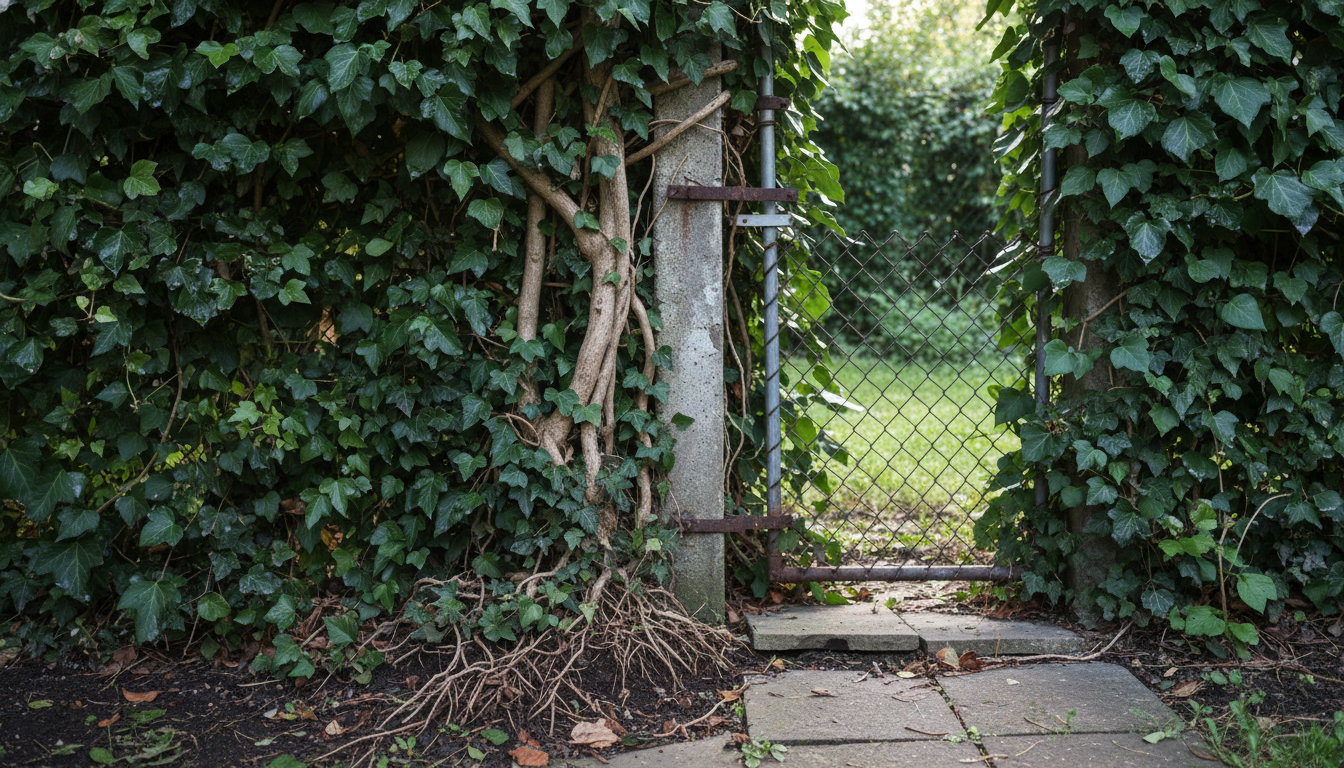
Ivy makes an excellent natural privacy screen for hiding a wire fence. However, this plant grows quickly and vigorously. While it does not directly “eat” concrete, ivy often ends up causing fence posts to shift. Its weight, roots, and the moisture it retains put significant strain on the fixings.
Root infiltration into micro-cracks
Ivy does not wrap itself around its support like wisteria would. It clings to it. It develops tiny aerial roots capable of sticking to even the smoothest surfaces.
On a fence post, these suckers look for the smallest flaw. If the concrete or wood has micro-cracks, the ivy forces its way in. As the root grows, it thickens and acts like a wooden wedge, widening the crack. This is particularly visible on old cement or wooden posts, where the structure eventually splits.
Moisture trapped at the base of the post
Its foliage is dense—so dense that it prevents the structure from drying after rain. This permanent moisture stagnates at the base of the fence, right at the level of the sealing.
On metal, water accelerates rust, especially if the branches have scratched the paint by rubbing against it in the wind. For posts set in concrete, the real danger occurs in winter. Water seeps between the post and the foundation block. When it freezes, this water expands and causes the base to crack. The post then begins to loosen.
The sail effect and the weight of the branches
People rarely realize the weight of old ivy, especially when it is waterlogged. This volume constantly pulls the post downwards.
Even worse is the wind resistance. In gusts, this wall of leaves behaves like a boat’s sail. All the force of the wind is transferred to the weakest point of the structure: its anchoring in the ground.
A standard wire fence post is simply not designed to handle this. If the post hole is not deep enough, the leverage effect will inevitably cause the fence to lean.
Wood, metal, and concrete versus ivy
The impact varies greatly depending on what supports your fence:
- Wood: This is the biggest loser. Ivy keeps the fibers permanently damp, which accelerates the rotting of the post just above ground level.
- Metal: Whether steel or aluminum, it handles the mechanical pressure of the plant well. The risk is limited to oxidation if the protective coating is damaged.
- Concrete: It is solid but sensitive to cracks. Roots exploit the smallest flaws, and frost causes the sealing blocks to burst.
Keeping your ivy without sacrificing your fence
You don’t have to tear everything out. But you will need to prune.
Cut the ivy back severely at least once a year. The goal is twofold: to lighten the structure and reduce its wind resistance. Also, take the time to clear the base of the posts with pruning shears for about ten centimeters. Air must be able to circulate there to dry the concrete and prevent the suckers from growing directly into the sealing joint.
If a post starts to move, cut the plant at its base immediately. There may still be time to add more concrete or install a brace.
What equipment should you plan for if you want to add greenery?
If your fencing project includes an ivy hedge from the start, forget about low-end flexible wire fence stakes. The installation will eventually bend.
At Districlos, we consistently recommend switching to rigid panels with notched posts. Steel is more robust, and the assembly resists lateral loads created by wind and plant weight much better.
Do not skimp on the foundations either. Plan for holes at least 50 centimeters deep and use a generous amount of concrete. If you have any doubts about the wind resistance of your future installation, come and talk to us in-store or call our customer service. It is better to size the posts correctly today than to have to straighten a fence blown over by the wind in three years.

Expert in fencing, gates, and outdoor landscaping since 2019.
Holds a Master’s degree in Digital Marketing – SEO, UX/UI.
View LinkedIn profile


