
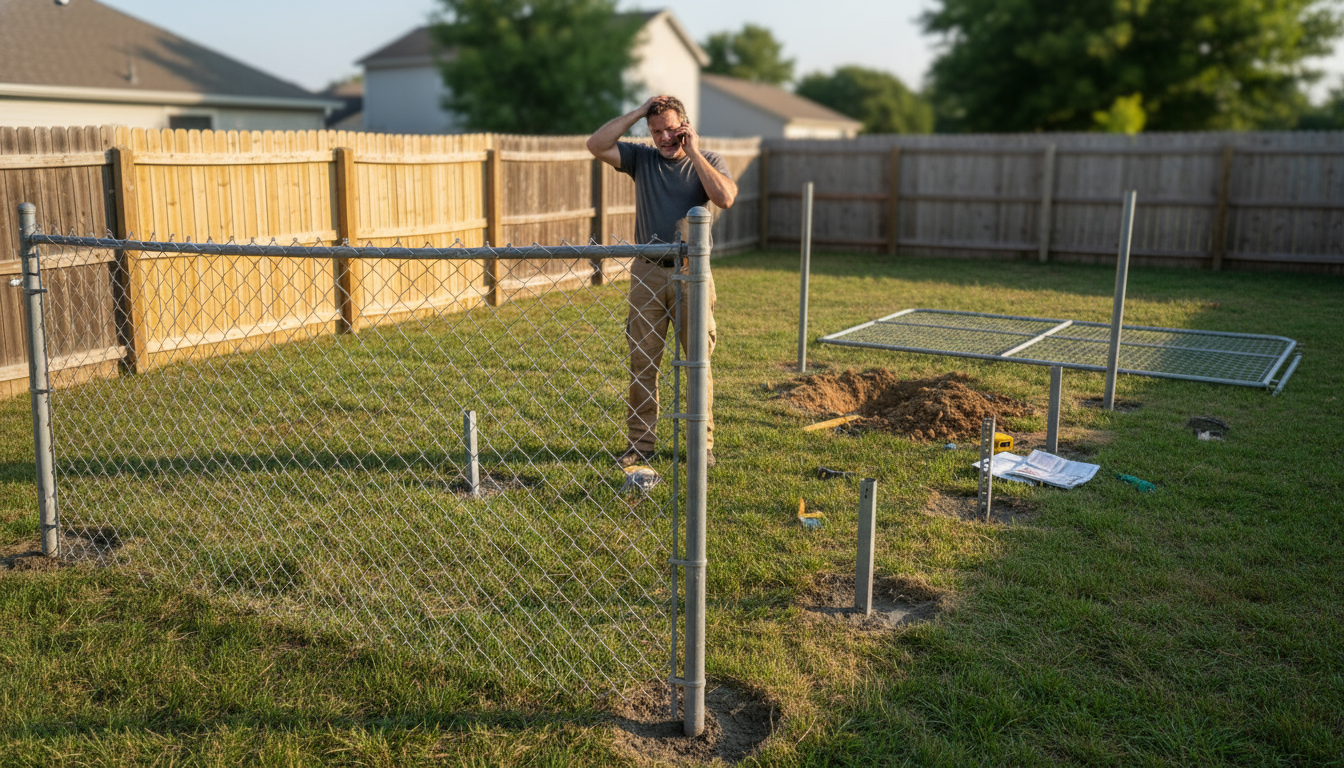
Installing a fence, mesh fencing, or a gate yourself is tempting. You save on labour, do it over a weekend, and that is that. Except that in reality, it is rarely that simple. At Districlos, our customer service team regularly receives calls from private individuals who started their installation… and then find themselves stuck because of avoidable mistakes.
Here are the three we see most often, and how to avoid them.
Not checking property boundaries before you start
This is probably the most costly mistake, and it has nothing to do with DIY. Many homeowners set their posts without having precisely checked the boundaries of their land. The result: the fence encroaches on the neighbour’s property, or it is set back 30 cm from the actual boundary. In the first case, a neighbour dispute is almost guaranteed, and you may even be required to dismantle everything. In the second, you simply lose land for no good reason.
Before anything else, consult your cadastral plan and, if possible, use a surveyor. Also check your municipality’s planning rules: maximum permitted height, required materials, distance from the public road. It takes half a day, but it saves you weeks of hassle.
Underestimating post depth and concrete setting
The classic mistake. The homeowner digs a 20–25 cm hole, props the post with a bit of compacted soil or a handful of concrete, and considers that sufficient. Except that a rigid fence or mesh fencing catches the wind like a sail. At the first storm, the posts lean, work loose, and the whole line ends up out of true.
The basic rule: the anchoring depth must be at least one third of the post’s total height. For a post that is 1.50 m above ground, you therefore need to dig at least 50 cm. Concrete setting is essential in most cases, with a drying time of at least 48 hours before fixing the panels or the mesh. Two points not to overlook:
- Use a spirit level on each post to check it is plumb
- Stretch a string line between the corner posts to keep a straight alignment along the entire length
Choosing the wrong mesh fencing, or not tensioning it properly
Third recurring mistake: buying mesh fencing that is under-specified for its intended use, or installing it without tensioning it properly. Flexible mesh simply hooked to the posts without a tension wire will deform within a few months. It warps, sags, and makes the whole fence look neglected.
The tension wire, installed at the top, at the bottom, and possibly in the middle for greater heights, is what gives flexible mesh its rigidity. Without it, your fence is not really a fence. As for choosing the mesh, it depends on your actual need: a rigid welded mesh in panels will be far more resistant and easier to install than a roll of flexible mesh, especially if you are not used to this type of work.
Not sure? It is better to ask before drilling
These three mistakes have one thing in common: they can be resolved before you take out the drill and the cement mixer. Taking 15 minutes to call an adviser, check a measurement, or reread the installation instructions is what makes the difference between a fence that lasts 20 years and an installation you have to redo the following year. At Districlos, our in-store teams and our customer service are there for that: to support you with your project, whether you are installing everything yourself or simply want technical advice before you get started.

Expert in fencing, gates, and outdoor landscaping since 2019.
Holds a Master’s degree in Digital Marketing – SEO, UX/UI.
View LinkedIn profile


