
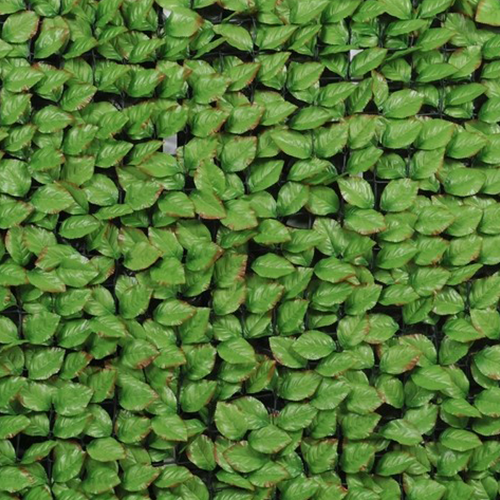
You would like to install an artificial hedge in your garden, but you are unsure about the legal constraints? It is true that between co-ownership rules, the local urban plan (PLU) and neighbour relations, it can be hard to find your way! At Districlos, we support private individuals and professionals every day with their outdoor landscaping projects. Discover all the regulations to know before installing your synthetic hedge, so you can enjoy your outdoor space with peace of mind, without risking disputes or fines.
The legal height of an artificial hedge depending on your municipality
The first thing to check is the permitted height for your plant-style fence. These rules vary depending on where you live and mainly depend on your municipality’s Local Urban Plan (PLU). In most cases, the maximum height allowed without prior authorisation is 2 metres. However, this limit may drop to 1.80 m or even less in certain areas.
We strongly recommend checking your municipality’s PLU before making any purchase. Do not hesitate to contact your town hall to obtain precise information on the restrictions in force in your area. A simple check can save you a lot of administrative steps later on!
Specific rules in co-ownerships and housing estates
Do you live in a co-ownership or a housing estate? Be careful: additional rules may apply. The co-ownership regulations or the housing estate specifications may impose specific constraints regarding:
- The permitted maximum height (often lower than municipal rules)
- The permitted materials (some co-ownerships prohibit synthetic hedges)
- The aesthetic appearance (colour, density, model)
- The exact location of your boundary
We recommend that you review these documents carefully before starting your project. A written request to the property manager or the co-owners’ association may be required to obtain authorisation to install your artificial hedge.
Administrative steps to complete
In some cases, installing an artificial hedge requires prior administrative authorisations. If your property is located in a protected area (historic monument, listed site) or if your hedge exceeds certain dimensions, a prior works declaration may be mandatory.
To avoid complications, we recommend that you check with the planning department at your town hall. As outdoor landscaping experts, we can also guide you through these sometimes complex administrative procedures to secure your installation project.
Aesthetic constraints to consider
Beyond purely regulatory aspects, some municipalities impose aesthetic criteria to preserve the area’s visual harmony. These constraints may relate to the colour of your artificial hedge, its density, or even the type of foliage being replicated.
Our range of artificial hedges at Districlos is designed to meet all these requirements. We offer a variety of models, from the most natural to the most decorative, so you can comply with local standards while creating an outdoor space that reflects you.
Regulations related to maintaining artificial hedges
Contrary to popular belief, an artificial hedge requires minimal maintenance to remain compliant with regulations. Most municipalities require owners to keep their plant-style fences, even synthetic ones, in good overall condition.
A neglected, faded or damaged artificial hedge can not only reduce your property’s value, but also expose you to penalties. We offer professional-quality products that are resistant to UV rays and bad weather, as well as maintenance advice to extend the lifespan of your installation and meet your legal obligations.

Expert in fencing, gates, and outdoor landscaping since 2019.
Holds a Master’s degree in Digital Marketing – SEO, UX/UI.
View LinkedIn profile


