
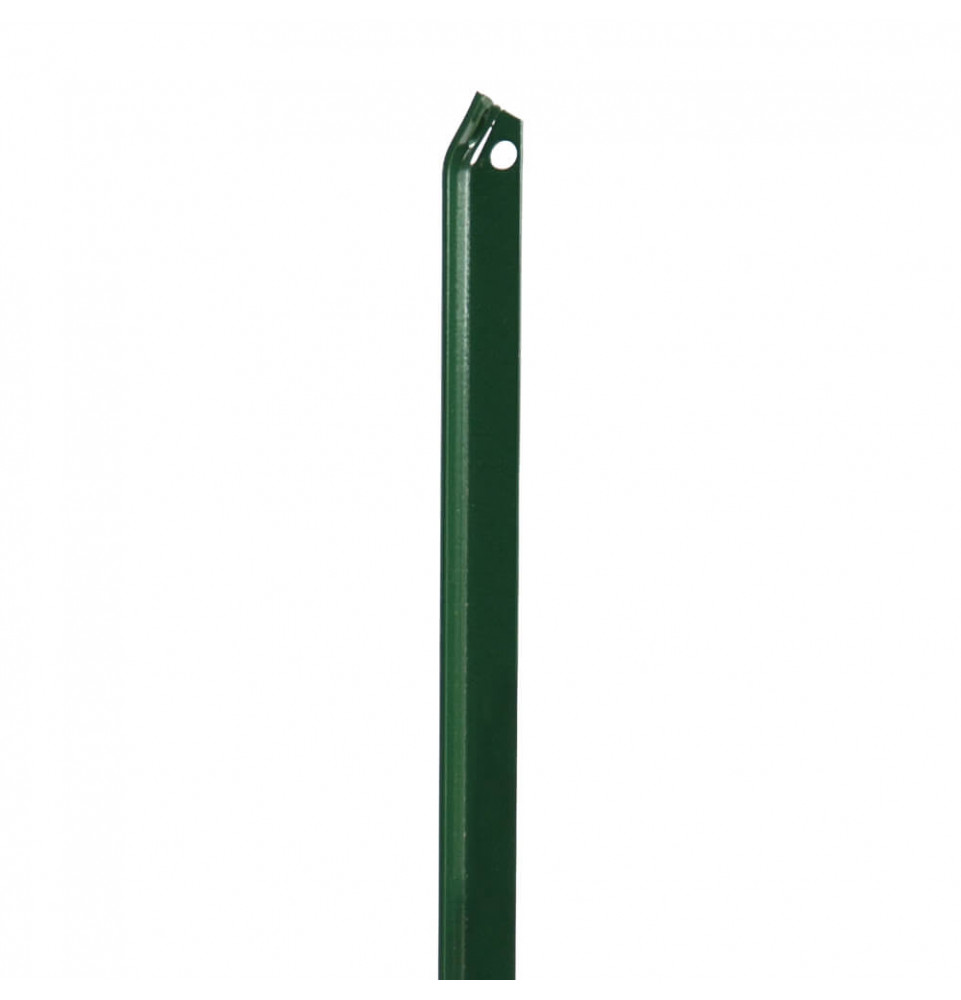
What is a bracing strut?
Are you looking to reinforce your garden fence, create a barrier, or simply equip yourself for outdoor renovation work? If you are planning to use bracing struts, these easy-to-install supports strengthen your installations and provide enhanced security. Discover with Clôture Discount everything you need to know about bracing struts.
Why do you need a bracing strut?
In France, several suppliers offer you a wide range of equipment for your fences, barriers, and other protective or access installations. Aware of the importance of your security, they complement these installations with reinforcement elements to safeguard your investment and support your structures. Among these elements are bracing struts.
These components transfer the load from the barrier or fence to the posts (typically at corners) to increase their stability. Essential security reinforcements, they improve your barriers’ resistance to wind and stresses involving significant pressure (violent pushing, impacts, etc.).

Find the Ideal Bracing Strut
Choose the ideal bracing strut for your frontage according to your needs. There are indeed several variations that take into account standard dimensions and current regulations. Additionally, bracing struts are generally offered with complementary equipment, such as posts, to facilitate their installation. Considering the importance of choosing the elements that make up your façade, do not overlook any detail. You must therefore take into account the various protective elements offered that benefit from the best materials. This way, you will enjoy uncompromising robustness.
To this practicality, add the variety of colors you can select according to your preferences to design a frontage of your dreams. Bracing struts often adapt to all types of fences: from welded mesh to rigid mesh and flexible mesh, everything is compatible.
Easy to handle, they combine aesthetics and versatility. You can therefore use them for both privacy screens and other devices. With our bracing struts, you also benefit from excellent value for money. Clôture Discount offers you struts meeting European standards at reduced prices. Choose durable, more affordable materials according to your preferences.
Want to Know More? Consult an Expert
Do you have a project to build, reinforce, or renovate your fence? Beyond considerations of taste, prioritize security: this essential factor will affect the choice of materials, as well as the elements to acquire. Keeping selection criteria in mind, find among Clôture Discount’s bracing struts solid barriers to create a safer frontage.
In addition to the tailored services we offer you through our advice and quotation preparation, our sales area remains accessible to you. Since investing in frontage development or redevelopment is of considerable importance, do not hesitate to call upon Clôture Discount’s expertise to advise you and help you succeed in your project.
What is the Ideal Bracing Strut Size for Installing Mesh Fencing?
In principle, the bracing strut to choose must have the same size as the post. To help you determine the appropriate dimension, here are a few example cases.
1.50 m high mesh fencing
For this fencing height, the post to use must have a minimum height of 2 m and only 50 cm should be set in the ground. The ideal bracing strut size is therefore also 2 m.
1.20 m mesh fencing
Are you planning to install mesh fencing approximately 1.20 m high? Then, the posts to install must measure 1.75 m. In this case, the size of your bracing strut must be equivalent to that of the post, i.e., 1.75 m. Note that the principle remains the same for all other posts.

How Many Bracing Struts Should You Plan for Installing Mesh Fencing?
Bracing struts primarily serve to reinforce three types of posts:
corner posts;
end posts;
posts intended to support the gate or main gate during installation.
The number of bracing struts required for installing your flexible mesh fencing therefore depends on the posts to be installed. Generally, you should plan for two bracing struts for each corner post and one per end post, depending on the layout and distance between posts. If you plan to install a post every 2 m, then you should place a bracing strut every 25 m. Depending on the configuration, you should also plan for a bracing strut for the gate or main gate to keep them straight.
How is the Bracing Strut Attached to a Post?
Certain rules must be taken into account, regardless of the bracing strut model chosen. Thus, during installation, it is essential to follow these various recommendations: place the bracing strut in alignment with the fence and opposite to the wire tension; attach the bracing strut at two-thirds of the visible height of the post, ensuring a 45° angle to the ground; wait for the post’s setting concrete to dry before taking any action.
To hold the bracing strut at the surface, place a stone in the ground to block the end. This remains essential to ensure proper positioning of the bracing struts. This way, they can properly fulfill their role.
Installation method according to the chosen bracing strut
The installation method varies depending on the bracing strut chosen. Indeed, a few details must be considered during installation.
Metal bracing strut
Primarily suitable for installing mesh fencing rolls, they are flat and pre-drilled. For their installation, you only need to align the drill hole of the bracing strut and that of the post together. Then, secure them with a screw or bolt.
Round bracing strut
Used for round posts, it requires a clamp and an end cap to install them properly. You must then bolt everything together to make the assembly solid.
Bracing strut for wooden post
For a wooden installation, it is recommended to place stakes 8 to 10 cm in diameter every 1.5 m. A bracing strut should therefore be added every 15 m against the stakes at two-thirds of their height. To then secure the bracing strut to the post, you can proceed with assembly using mortise and tenon joints. Alternatively, you also have the option of using timber bolts.
Dans le même thème

Expert in fencing, gates, and outdoor landscaping since 2019.
Holds a Master’s degree in Digital Marketing – SEO, UX/UI.
View LinkedIn profile


