
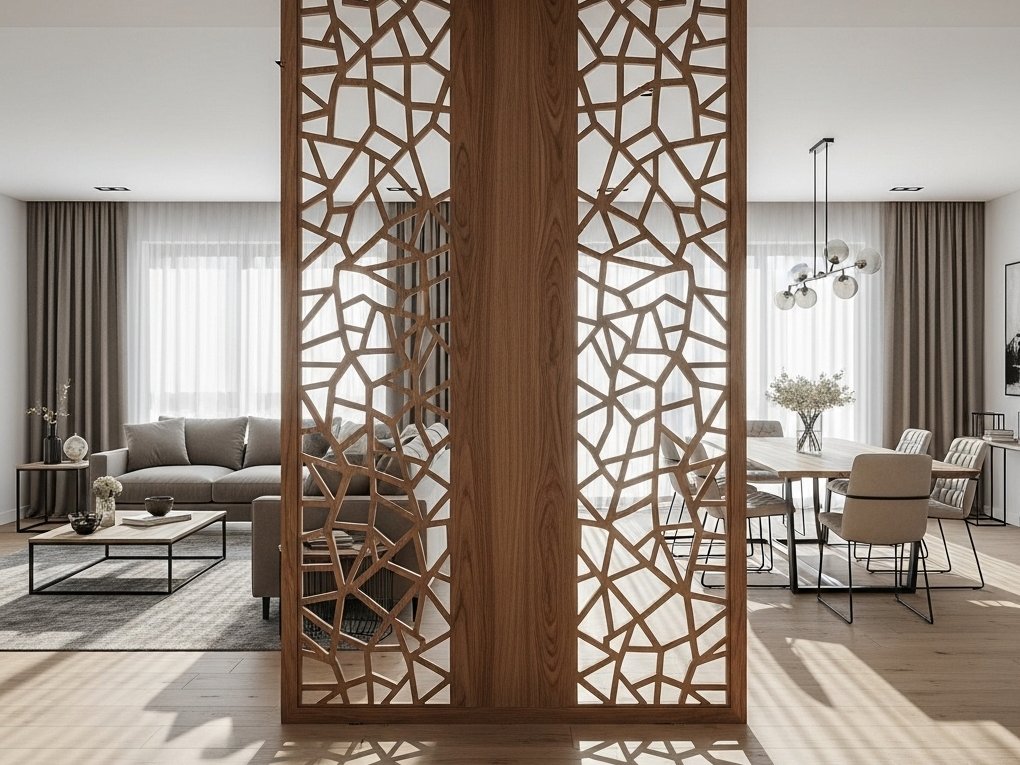
A decorative screen is an openwork partition, both useful and decorative. It allows you to define spaces without completely enclosing them, whether indoors to structure a room or outdoors to preserve privacy. Fixed or mobile, in wood or metal, the choice is vast. Here are the key points to consider to find the perfect model for your project.
Fixed or Mobile Decorative Screen: Which to Choose?
The choice will primarily depend on its intended use. Indoors, a decorative screen can serve as a fixed partition to separate an entrance from a living room, or as a mobile screen to modulate space or conceal an office as needed.
Outdoors, the decorative screen primarily acts as a privacy screen for a balcony, terrace, or pool area. For safety reasons and wind resistance, it is almost always fixed. Mobile models are rare, as they would need to be brought in at the slightest gust of wind. An interesting alternative is a planter topped with a panel, where the weight of the soil ensures stability while allowing for occasional relocation.
What Material Should You Choose for Your Decorative Screen?
While wood remains a classic, decorative screens are available in many other materials: aluminum, steel, composite, PVC, terracotta, plaster, and even textile. The choice will depend on its location (indoor/outdoor), your budget, and the desired style.
A mobile decorative screen made of stone or terracotta is obviously impractical due to its weight. For tighter budgets, wood (often pine) is an economical solution, easy to paint or leave natural for a rustic style. However, it will require regular maintenance (varnish, paint), especially outdoors.
If you lack time for maintenance, opt for aluminum or composite, which require virtually no care. For interior partitions with highly decorative patterns, plaster or MDF (medium-density fiberboard) cut with a laser offer infinite possibilities. Textile, on the other hand, allows for creating light and sometimes colorful partitions.
Decorative Screen Fixings
Installation varies greatly in complexity. A mobile decorative screen requires no work: you simply place it.
Installing a fixed decorative screen is more technical. It involves securely attaching it to the floor, wall, or ceiling using jacks (without drilling), battens, or rails. For outdoor decorative screens or heavy masonry models (terracotta), more significant work may be required. For an impeccable and secure result, professional intervention is often recommended.
What Pattern Should You Choose for Your Decorative Screen?
The pattern is the soul of the decorative screen. Models with vertical or horizontal slats are timeless classics. You can often choose the spacing of the slats to adjust the level of privacy and the graphic effect. Simple wooden battens, placed at regular intervals, are a very trendy and economical solution for creating a graphic separation indoors.
Beyond slats, there is an infinite variety of openwork patterns: geometric, floral, Moucharabieh style… The choice will depend on the style you wish to infuse into your space.

Expert in fencing, gates, and outdoor landscaping since 2019.
Holds a Master’s degree in Digital Marketing – SEO, UX/UI.
View LinkedIn profile


