
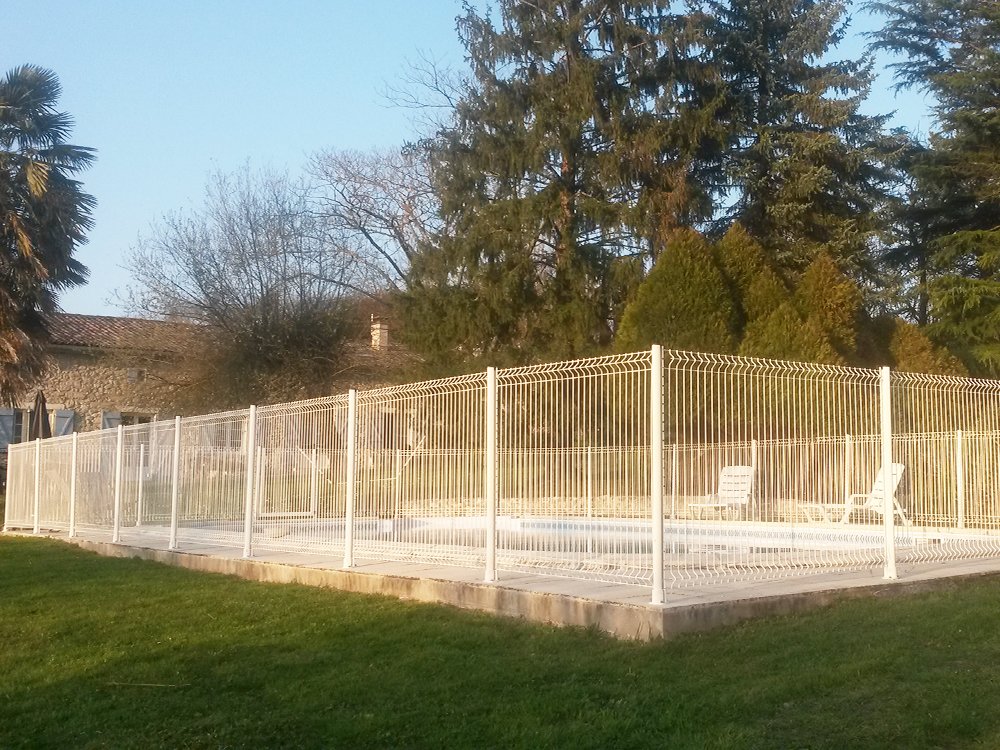
Delimiting your property provides privacy and secures your outdoor areas. However, be careful not to confuse boundary marking and fencing. The former is a legal act establishing the limits of your plot. The latter is a physical barrier. It is essential to understand the distinction before beginning work, otherwise you risk having to demolish a wall by court order.
Boundary Marking: Establishing the Legal Limit
Boundary marking establishes the exact dividing line between two adjoining properties. Only a licensed surveyor can carry out this operation by placing physical markers in the ground (the boundary markers).
This document has genuine legal value. Once the official report is signed by both neighbors, your property boundary becomes indisputable. It is mandatory if the land comes from a subdivision, and always recommended in other cases. Installing a fence by guesswork based on an old cadastral plan or an existing hedge is risky: an error in judgment can prove costly if neighbors contest it.
Fencing: Enclosing the Space
Fencing comes after boundary marking. It is the physical installation that blocks access to your plot. Article 647 of the Civil Code grants every owner the right to enclose their land. Unlike boundary marking, you do not need your neighbor’s consent if the installation is located entirely on your property and you finance it alone.
Districlos supplies the materials for most configurations:
- Chain-link or welded wire mesh in rolls
- Rigid panels with or without screening kits
- Wood, composite, or aluminum fences
- Masonry walls or planted hedges
Why Mark Boundaries Before Fencing?
Erecting a wall or installing a fence without certainty about your property boundaries is a dangerous gamble. In France, the courts are uncompromising regarding encroachment. If your new fence extends even one centimeter onto your neighbor’s land, they are entitled to demand its demolition. They will not even need to prove that the encroachment causes them inconvenience.
With a marked boundary, you know the limit to the millimeter. You can then choose to position the fence set back on your plot (it belongs to you entirely) or precisely on the dividing line (it becomes shared, which requires the neighbor’s agreement and cost-sharing).
Local Planning Regulations
Being a property owner does not grant complete freedom in choosing your fence. Before purchasing your materials, consult the planning department at your town hall to review the PLU (Local Urban Plan).
Municipalities often impose maximum heights, specific color palettes, or prohibit certain materials. Also verify that your land is not subject to an easement, such as a right of way granted to a landlocked neighbor. Finally, depending on your location, installing a fence may require filing a Prior Declaration of Works (DP) with the town hall.
Choosing Materials
Once the surveyor has placed the boundary markers and the town hall has approved your project, the next step is selecting the equipment. A fence is exposed to wind, rain, and temperature fluctuations year-round, which is why it is advisable to avoid the cheapest options.
Depending on the level of privacy required and your soil type, Districlos guides you toward suitable products. From aluminum gates to reinforced rigid mesh, working with a specialist ensures you install a fence designed to last.

Expert in fencing, gates, and outdoor landscaping since 2019.
Holds a Master’s degree in Digital Marketing – SEO, UX/UI.
View LinkedIn profile


