
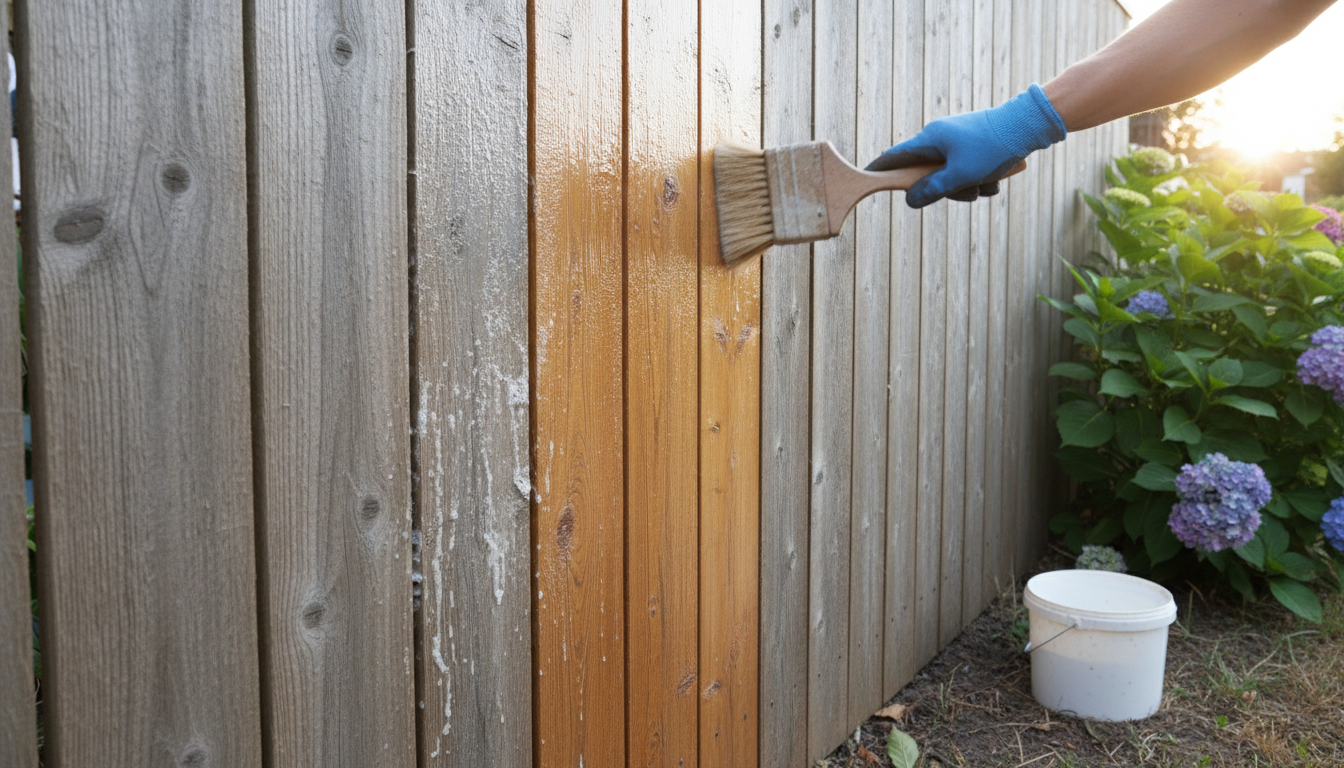
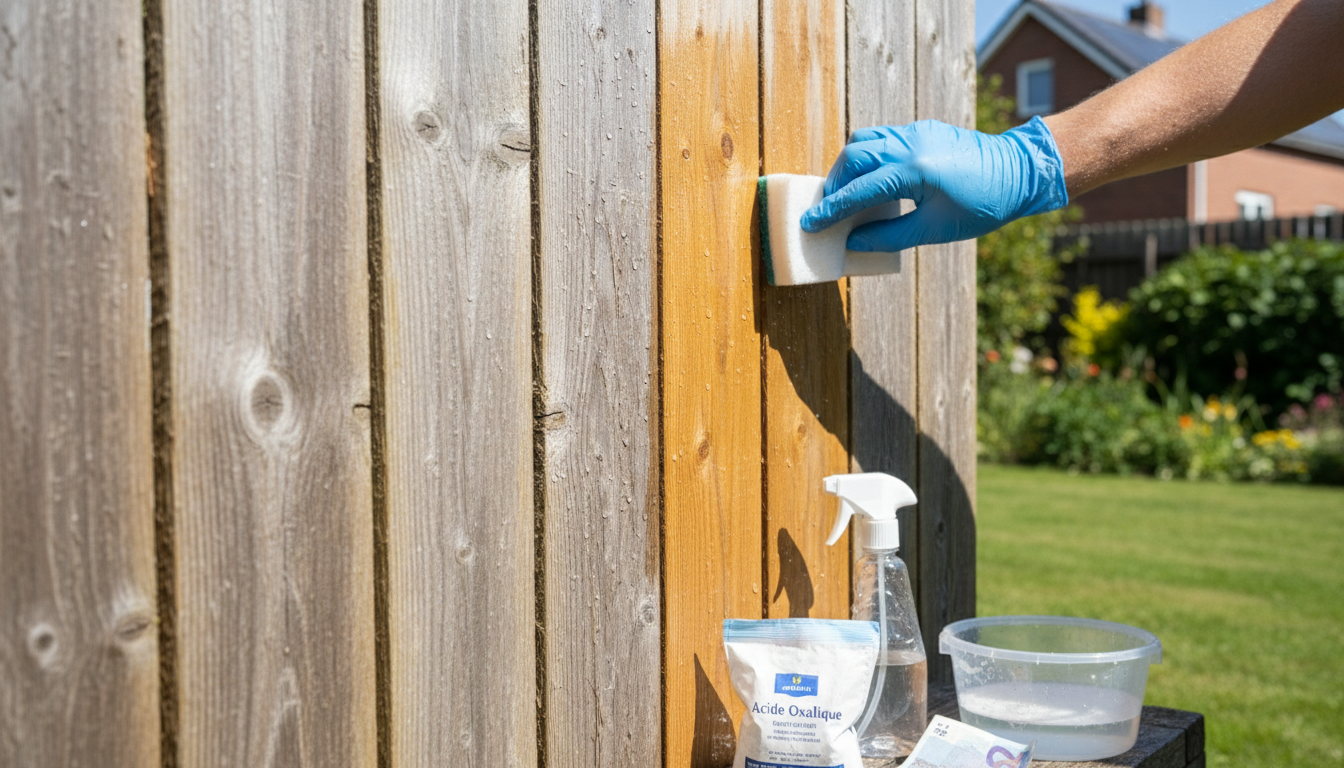
Has your wooden fence lost its golden tone and turned a dull grey? This is a natural phenomenon that affects all fences exposed to the elements. Before considering replacing everything, there is a simple solution to restore colour to greyed wood—and it costs only a few euros.
Why the wood in your fence turns grey
Wood greying is neither a manufacturing defect nor a sign that your fence is beyond saving. It is a common chemical reaction. Under the effect of UV rays and moisture, lignin—the component that gives wood its natural colour—breaks down on the surface. The wood loses its warm tone and takes on the greyish patina you know well.
The phenomenon affects treated pine as well as Douglas fir, larch, or chestnut. A few months are generally enough, especially on faces exposed due south or to driving rain. But grey does not mean damaged: in most cases, the wood’s structure remains sound beneath this superficial layer.
The €2 tip: sodium percarbonate
Forget industrial wood brighteners at €30 per litre. Sodium percarbonate, also known as solid hydrogen peroxide, does the same job for a fraction of the price. You can find it in hardware stores, organic shops, or the household aisle of any supermarket, at around €2 for 500 g. And 500 g is more than enough to treat an entire fence.
Percarbonate lifts the greyed layer without attacking the wood fibres. Unlike bleach (to be avoided at all costs on wood), it does not damage the structure and breaks down into oxygen and sodium carbonate. Effective, inexpensive, and with no impact on the plants at the base of the fence.
How to proceed
The method is simple and requires no particular skills:
- Dilute 2 to 3 tablespoons of sodium percarbonate per litre of hot water (around 40–50°C, not boiling, to activate the product properly).
- Apply generously with a sprayer or brush to dry wood. Leave for 15 to 30 minutes, scrub with a stiff-bristle brush, then rinse with a hose.
Work in dry weather, preferably on a cloudy day to prevent the product from drying too quickly in the sun. Wear gloves: percarbonate is still an oxidiser that can irritate the skin. The result is often visible after the first application. If the fence is very dirty, a second treatment a few days later may be necessary.
Protecting the wood after brightening
Restoring the original colour is good. Keeping it is better. Once the fence has been brightened and is dry (allow at least 48 hours), apply a protective finish. Two options: a saturator, which nourishes the wood deep down and filters UV without forming a film, or a stain, which creates a more covering barrier against the elements.
A saturator is often the best choice for a fence because it does not peel over time. One coat every 1 to 2 years is enough to maintain protection. Without this step, the wood will grey again within a few months.
When brightening is no longer enough
If your fence shows signs of rot, split boards, loose posts, or wood that feels spongy to the touch, brightening will not solve the problem. It is then better to consider partially or fully replacing the fence rather than persisting with wood that is structurally compromised.
At Districlos, we offer a range of wooden fences and panels, available in-store or delivered throughout France. Our advisers can help you choose the right product for your ground conditions, your budget, and the level of maintenance you are prepared to take on. Sometimes, starting again with a sound base costs less than patching things up indefinitely.
How often should you maintain your fence?
Regular maintenance avoids having to bring out the heavy artillery. Ideally: brush and hose-clean once or twice a year, in spring and autumn. Percarbonate brightening is done every 2 to 3 years depending on exposure. Combined with a coat of saturator, this schedule helps keep a fence attractive and functional for 15 to 20 years without difficulty.

Expert in fencing, gates, and outdoor landscaping since 2019.
Holds a Master’s degree in Digital Marketing – SEO, UX/UI.
View LinkedIn profile


