

Choosing the passage width for your gate is one of the steps to follow when developing your property. Whether for a main entrance or vehicle access, the dimensions of your gate must meet criteria of practicality, security, and aesthetics. An unsuitable width can not only complicate maneuvers but also impact the visual harmony of your exterior. In this article, our experts guide you through the various elements to consider when determining the ideal width for your gate.
Criteria to Consider When Choosing Your Gate’s Width
When it comes to choosing the passage width for your gate, several criteria must be taken into account to ensure practical and secure use. First, consider the main function of your gate: is it intended for light vehicles, or for trucks and utility vehicles?
The minimum recommended width varies depending on these uses. A gate intended for vehicles should generally measure between 3 and 4 meters. Next, consider the available space on your property to allow for maneuvering without hitting your gate.
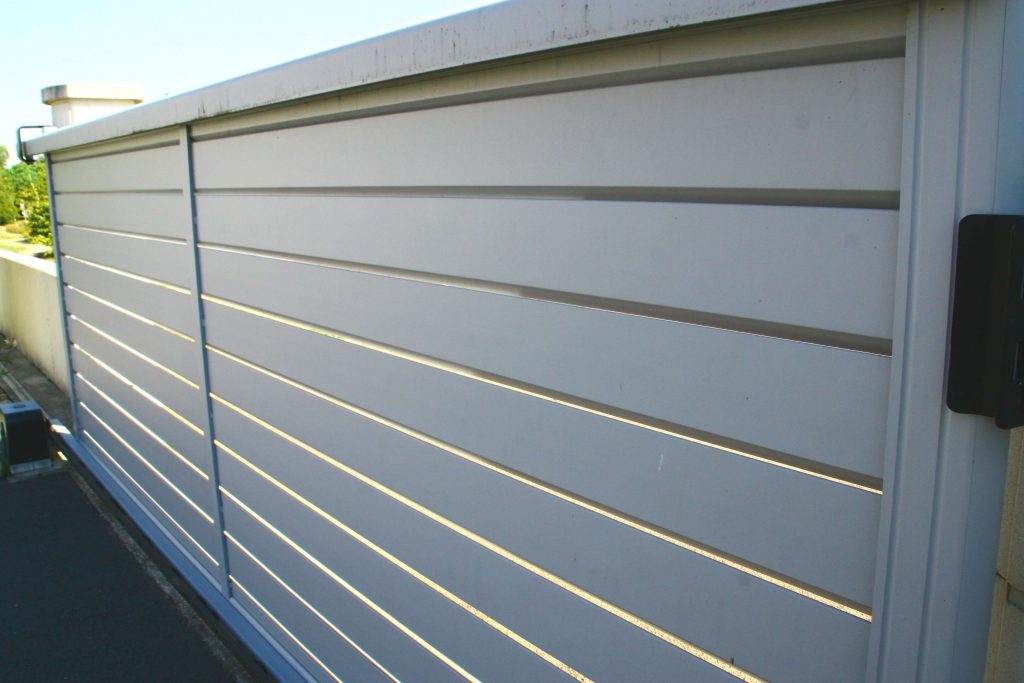
The terrain configuration is also essential: a sloped entrance or a sharp turn may require a greater width to facilitate maneuvers. Once practicality is achieved, be sure not to forget aesthetics; the gate must harmonize with the rest of your fence and exterior elements, while meeting your personal design preferences.
Standards and Regulations to Observe
First, check your municipality’s Local Urbanism Plan (PLU), which may impose restrictions on the dimensions and types of gates permitted, especially in classified or protected areas. For gates intended for vehicles, a minimum width of 3 meters is recommended to facilitate access, but this measurement may vary depending on the specific configuration of your entrance and local recommendations.
Regarding safety, it is important to comply with manufacturing and installation standards, such as NF EN 13241-1, which stipulates requirements for motorized and manual gates in terms of resistance, durability, and operational safety. It is also crucial not to forget regulations concerning encroachment on public roads: a gate must not open outwards onto public property, under penalty of infringement.
How to Take Accurate Measurements?
Determine the available space using a tape measure or laser to measure the distance between the two points where you plan to install your gate (the two support posts). Be sure to measure at several heights to verify that the opening is uniform and free of obstacles (and to confirm that your posts are straight).
Next, consider the necessary clearances by adding a few centimeters on each side; this will ensure the proper functioning of the leaves or the guide rail for sliding gates. This prevents friction and guarantees smooth opening.
You also need to consider maneuvering space: if the gate is intended for vehicles, check that the width is sufficient to allow for easy maneuvers. Measure while taking into account potential obstacles, noting the presence of posts, walls, your hedge, or other obstacles that could hinder the opening or closing of the gate.
Plan the placement of accessories: if your gate will be equipped with accessories such as hinges, or motorized systems, take their dimensions into account during measurement to ensure everything fits perfectly.
Discover Our Range of Gates
Dans le même thème

Expert in fencing, gates, and outdoor landscaping since 2019.
Holds a Master’s degree in Digital Marketing – SEO, UX/UI.
View LinkedIn profile


