
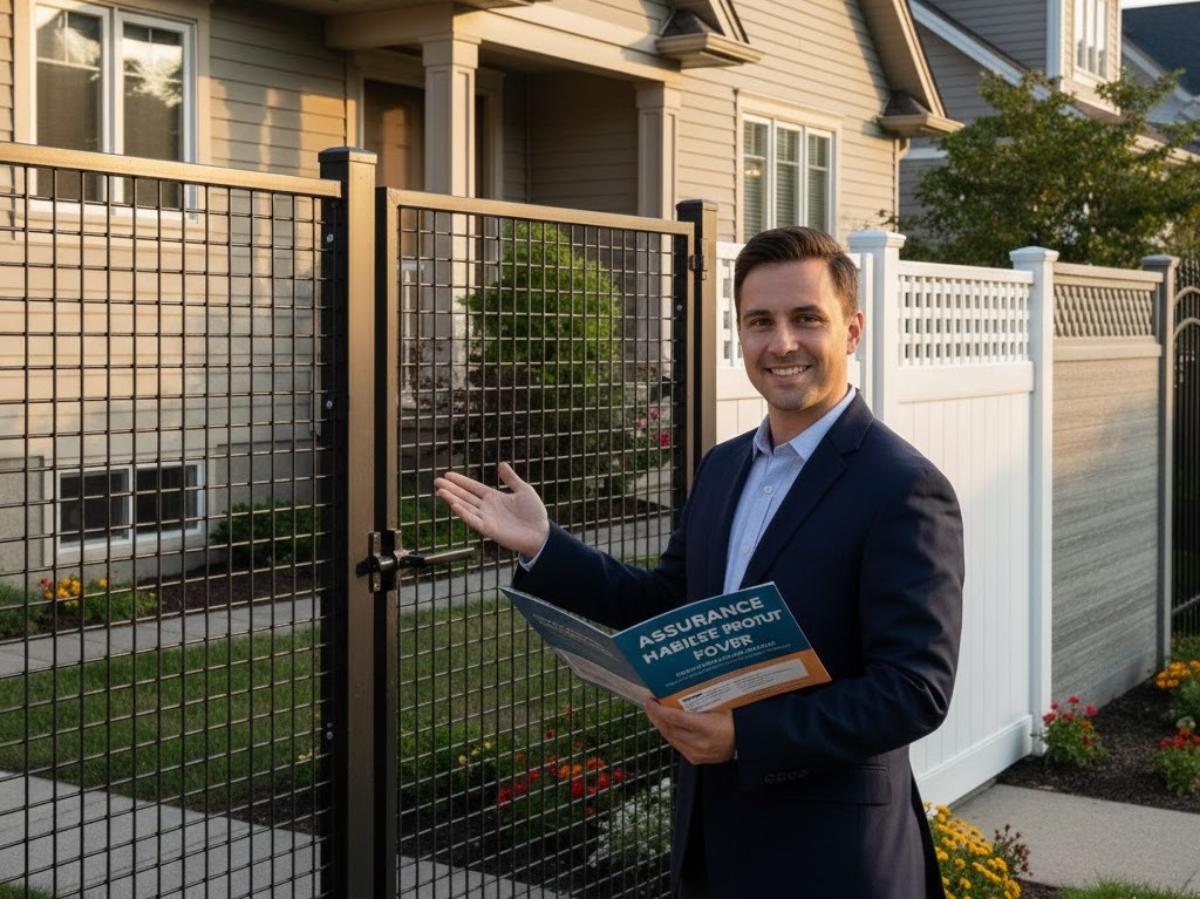
Securing one’s home is often the primary motivation for installing a fence, well before aesthetics or property demarcation. However, few homeowners take the time to read the fine print of their home insurance policy before starting work. The choice of your equipment can have a direct impact on your compensation in the event of a burglary. An installation that does not comply with your insurer’s requirements risks leading to a forfeiture of guarantee or a drastic reduction in the indemnities paid.
Why Does Your Insurer Impose Fence Standards?
For insurance companies, a fence constitutes the first physical barrier against intrusion. It materializes private property and deters opportunistic break-in attempts. This is why the “Theft and Vandalism” guarantee is often conditional on the presence of specific security devices. If your property is open to all winds, the insurer may consider that there is negligence on your part, facilitating access for criminals.
It is therefore crucial to check the general terms and conditions of your multi-risk home insurance (MRH) policy. Some policies simply require the property to be enclosed, while others impose precise technical criteria to validate protection. Failure to comply with these clauses means paying for insurance that will not fully cover you when you need it.
Minimum Height and Material Solidity
The most frequently mentioned criterion in contracts concerns the height of the installation. Generally, a fence must measure at least 1.50 meters to 1.80 meters high to be considered a serious obstacle. A decorative border or a low wall will not be sufficient to activate certain theft guarantees.
Beyond height, the resistance of materials is scrutinized. A fence that is easy to climb over, cut, or crush does not offer the expected security. This is where professional quality makes the difference: robust equipment demonstrates your commitment to protecting the premises.
Opt for Rigid Panels for Optimal Security
Between flexible mesh and a rigid panel, the choice is quickly made from an insurance perspective. Rigid mesh fencing is largely preferable because it is much more difficult to vandalize or breach than a simple roll of flexible mesh. Its galvanized steel structure and posts sealed in concrete offer superior mechanical resistance.
Opting for rigid panels, such as those offered by Districlos, sends a strong signal: your home is protected by solid material. This is the type of fence that best meets the perimeter protection requirements of most insurers, unlike lightweight privacy screens or single-twist mesh fences that primarily serve for visual demarcation.
The Essential Role of a Lockable Gate
Your insurer will systematically require that the property be enclosed by a locked gate in your absence and during the night. The presence of a certified lock or a self-locking motorization system is often required to validate the theft guarantee.
If a burglar enters your home without forced entry, simply by pushing an unlocked gate, the insurance may refuse compensation. Ensure that your gate, whether swing or sliding, is of the same quality as your fence and has a reliable and robust locking system.
Insuring the Fence Itself Against Damage
Up to now, we have discussed the fence as a means of protecting the house. But what if the fence itself is destroyed by a storm, hail, or a falling tree? Basic contracts do not always cover outdoor amenities.
To be compensated for damage to your installation, you often need to subscribe to a specific option such as a “Garden Pack” or “Outdoor Property Enhancements.” Here are the points to check for this coverage:
- Coverage for climatic damage (storm, weight of snow).
- Coverage against vandalism (graffiti, willful damage).
- The compensation limit (often restricted for outdoor areas).
- The depreciation rate applied to older materials.
Consequences of Non-Compliant Installation
If you suffer a claim and the appointed expert finds that your fence does not comply with the standards defined in the contract (too low, no lock, poor state of maintenance), the financial consequences are immediate. The insurer may apply a very high additional deductible, considering that you did not implement the necessary protective measures.
In the most severe cases, particularly if a causal link between the absence of an appropriate fence and the theft is proven, the insurer may declare the guarantee void. Investing from the outset in quality, available, and standardized materials is therefore a winning economic calculation to secure your assets and ensure your peace of mind.

Expert in fencing, gates, and outdoor landscaping since 2019.
Holds a Master’s degree in Digital Marketing – SEO, UX/UI.
View LinkedIn profile


