
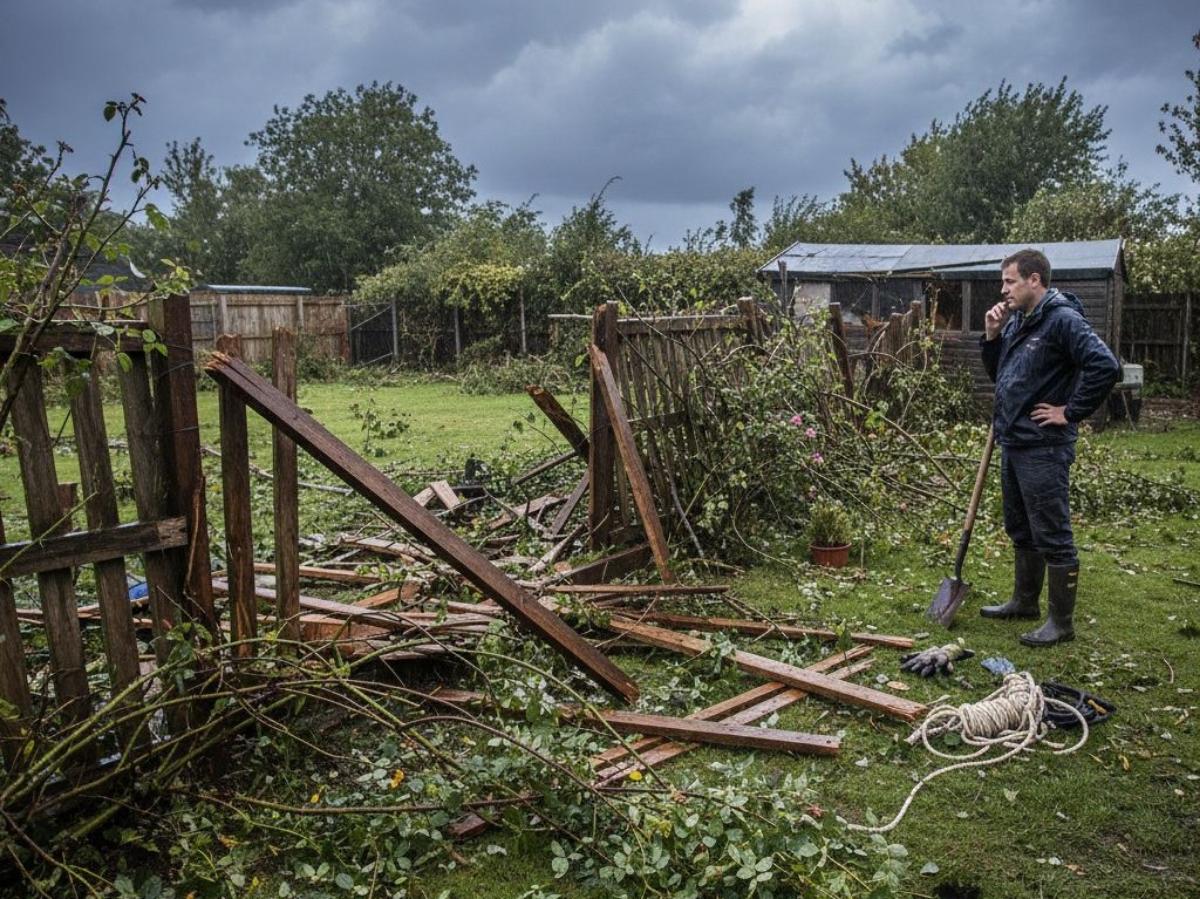
Has a storm just passed through and left your garden in disarray? Finding your fence torn out or your panels twisted is a real blow, but you need to respond methodically to avoid losing money. Before starting any renovation work, several administrative and safety steps are essential to secure your compensation and prepare the site.
Secure the area immediately
The absolute priority is not appearance, but the safety of your family and passers-by. A damaged fence can have sharp edges, exposed metal spikes, or unstable posts that could fall. If your installation borders a public road, you are liable for any damage it could cause to a third party or a vehicle.
Act quickly to cordon off the area or dismantle parts that are at risk of collapsing, without throwing everything away. It is crucial to keep the damaged elements on your property: they will serve as tangible evidence when the insurance adjuster visits.
Check the terms of your home insurance
As soon as things have calmed down, review your multi-risk home insurance policy. Most policies include storm cover, but it is often subject to strict conditions, particularly wind strength. Insurers generally require the wind to have reached a certain speed (often over 100 km/h) to trigger compensation.
If the damage was caused by a neighbouring tree falling onto your mesh fence, the tree owner’s third-party liability comes into play. In any case, do not delay: by law, you have a 5-business-day deadline after the incident to file your claim with your insurer.
Put together a strong evidence file
To be properly reimbursed, your file must be flawless. Take clear photos of the damaged fence from every angle: wide shots to show the extent of the damage and close-ups of bent posts or broken panels. These photos will allow the insurer to assess the loss without necessarily sending an adjuster on site if the amounts are low.
Also gather all documents proving the value of your installation:
- The purchase invoices for the materials (mesh, panels, posts).
- Installation invoices if you used a professional.
- Photos of the fence before the storm, if you have any, to prove its initial good condition.
Assess the extent of the repairs
Once the insurer has given approval, you need to determine whether a partial repair is sufficient or whether a full replacement is required. If only a few rigid panels are bent but the posts have remained straight and set, you can simply replace the defective modules. This is the advantage of modular systems sold by specialists such as Districlos.
However, if the posts have shifted or if the concrete footing has cracked at the base, the structure is compromised. Trying to straighten a bent metal post is often pointless because it has lost its mechanical strength: it will bend again in the next gust of wind. In that case, you need to remove the concrete footing and start again on a sound base.
Choose a fence suited to windy areas
If you have to replace everything, take the opportunity to choose a model that can withstand future bad weather. The classic mistake is installing privacy screening (slats, fabric) on a fence that was not designed to withstand that level of pressure. Screening creates a “sail” effect that multiplies the force the wind exerts on the posts.
In exposed areas, opt for robust notched posts and reduce wind resistance. If screening is essential for your privacy, make sure you choose posts with a larger cross-section and reduce the spacing between them to stiffen the whole assembly.
Get the installation right to ensure long-term durability
A fence’s resistance to storms depends 80% on the quality of its ground anchoring. A base-plate installation is quick, but it is strongly discouraged in windy regions or if you plan to add privacy screening, because the ground hold is too weak.
The most durable solution remains concrete setting directly in the ground. You need to dig holes at least 50 cm deep so the post is held firmly. Deep, properly proportioned concrete setting will allow your fence to absorb weather impacts without flinching, protecting your investment for years to come.

Expert in fencing, gates, and outdoor landscaping since 2019.
Holds a Master’s degree in Digital Marketing – SEO, UX/UI.
View LinkedIn profile


