
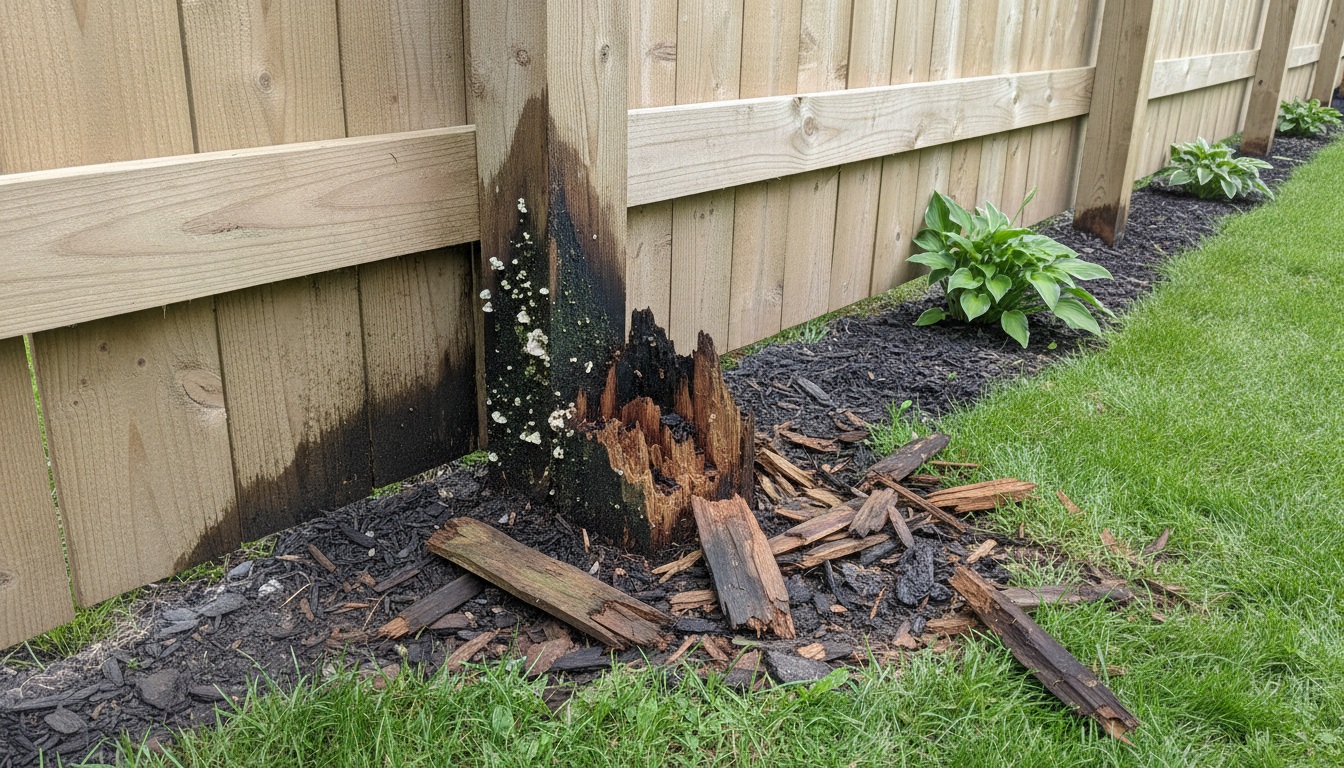
Your wooden fence looks great… until the day you notice the posts turning black at the bottom. The wood softens, crumbles, and you have to redo everything after only a few years. The problem is neither the quality of the wood nor the weather. It almost always comes from an installation flaw where the wood meets the ground. A simple technical detail, often overlooked, that turns your investment into a job you have to start over.
Why wood always rots from the bottom
Wood is a living material. When it remains in direct contact with damp soil, it absorbs water by capillary action. Moisture rises through the fibres, lingers, and creates the perfect conditions for wood-decaying fungi. This is what happens when a fence post is driven straight into the ground or set in concrete without precautions.
Concrete, contrary to what many people think, is not watertight. It holds rainwater around the post and prevents the wood from drying. Rot sets in within a few seasons at the wood-to-concrete junction, where nobody looks. By the time you notice it, the post is already weakened deep down.
The overlooked detail: isolating the base of the post from the ground
The principle is simple: wood must never touch the ground directly or remain in constant contact with moisture. This is rule number one, and it is the one many DIY installers—and even some rushed professionals—ignore.
In practical terms, you need to create a capillary break between the post and the ground. Several methods work:
- A metal post support (base plate or galvanised steel anchor) that raises the wood a few centimetres above the ground or the concrete
- A draining gravel bed at the bottom of the hole to carry water away and prevent it from pooling around the base
- A bituminous waterproofing product applied to the buried part of the post before setting
Without at least one of these precautions, you are dooming your fence from the day it is installed.
Poorly done concrete setting: a classic mistake
Many people pour concrete around the post, forming a basin. Rainwater collects there, runs down the wood, and stagnates at the base. It is the opposite of what you should do.
If you set your posts in concrete, the top of the footing should form a slight slope outward to direct water away from the post. Better still: leave a gap of a few millimetres between the concrete and the wood, filled with a flexible sealant such as exterior-grade silicone. Concrete protects the structure, but drainage protects the wood.
Which wood best withstands ground moisture?
Even with flawless installation, the species matters. Class 4 pressure-treated pine is treated to withstand prolonged contact with water and soil; it is the minimum for fence posts. Exotic woods such as ipé or cumaru perform very well naturally, but their price is significantly higher.
By contrast, untreated pine or basic fir, even when well installed, will eventually suffer outdoors. Pressure treatment does not replace correct installation, but it provides a safety margin against residual moisture.
Repair or replace: when the damage is done
If your posts are already affected at the base, there is no point patching with sealant or resin. Structurally rotten wood does not regain its strength. The only lasting solution is to replace the damaged posts, correcting the installation method this time.
On some fences, you can cut off the rotten section and fix the shortened post onto a metal base plate bolted into a concrete block. It is an acceptable compromise if the rest of the post is sound. But in most cases, when you can see rot on the surface, it has already progressed far beyond that.
Invest in installation, not just the material
A properly installed wooden fence can last 15 to 20 years without issues. Poorly installed, it lasts 3 to 5 years. The extra cost at installation is negligible: a few euros for metal base plates, a bag of gravel, a bit more care when setting. Compared with the cost of a full replacement, the calculation is quickly made.
At Districlos, our teams support both private individuals and professionals in choosing materials and following best installation practices. All our products—posts, panels, fixing accessories—are available in stock for in-store pickup or fast delivery to site. It is better to install it properly once than to redo it every five years.

Expert in fencing, gates, and outdoor landscaping since 2019.
Holds a Master’s degree in Digital Marketing – SEO, UX/UI.
View LinkedIn profile


