
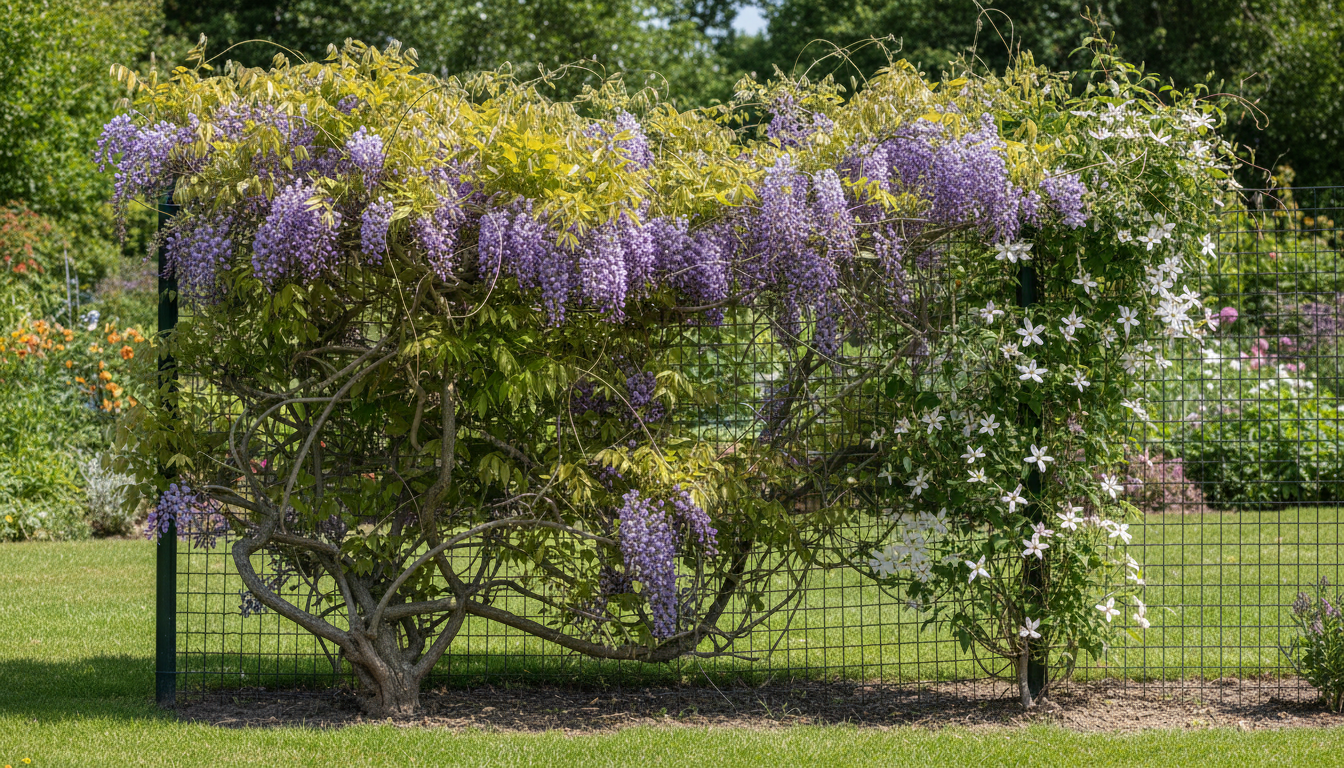
Roll fencing (simple twist or welded) is economical and easy to install. However, care must be taken when adding vegetation. The classic mistake? Planting a species that is too vigorous.
Flexible wire fencing does not have the strength of a rigid wall. Under the weight of overly dense vegetation, it deforms and eventually sags. At Districlos, we often see fences damaged by poor plant selection. The key is to focus entirely on lightweight options.
Watch Out for Weight and Wind Resistance
Roll fencing holds thanks to the tension of its wires. If you install wisteria or old ivy on it, the wood becomes heavy and the foliage acts as a sail at the slightest gust of wind. Faced with this mechanical stress, the fencing buckles, the wires slacken, and the posts may even bend.
Forget thick hedges, then. Instead, look for an airy visual screen with tendril climbers that wind around the mesh without smothering it or straining the structure.
Annuals: The Risk-Free Option
For quick results without long-term strain on your fence, annual plants are ideal. They grow rapidly in spring, bloom in summer, and disappear in winter. This leaves you with a clean fence each year, with no accumulation of dead wood.
A few lightweight and effective varieties:
- Sweet pea: delicate, fragrant, and exerts no pressure on the wires.
- Morning glory (or ipomoea): it covers large areas very quickly with fine foliage.
- Climbing nasturtium: it provides bright color without ever forming woody stems.
- Black-eyed Susan: ideal if your fencing is low in height.
Clematis: The Ideal Perennial
If you prefer a plant that regrows year after year, clematis is probably the best choice. Its stems remain slender. It attaches itself using its leaves, without creating thick trunks that would spread the mesh of your fencing.
Choose small-flowered clematis (such as viticella varieties). They are hardy, not very susceptible to disease, and above all, their foliage allows wind to pass through easily.
Star Jasmine and Honeysuckle: Yes, but Under Supervision
Want screening even in winter? Star jasmine (with evergreen foliage) and honeysuckle are tempting. It is possible, but you will need to use pruning shears regularly, as these plants become very vigorous over time.
Under no circumstances should branches be allowed to pile up. Severe pruning once a year is essential. Also consider guiding young shoots horizontally, along the tension wires. This distributes the weight over the entire length of the fence instead of creating a large pressure point in the same spot.
How to Plant Without Damaging Your Fence
The golden rule: never plant right against the fencing. Leave 20 to 30 centimeters of distance so that the roots do not lift the concrete footings of your posts.
A few good practices when planting:
- Guide the young plant with an angled stake up to the fencing, to prevent it from pulling on the fence as it grows.
- Space your plants approximately 1.5 m to 2 m apart to avoid concentrating all the weight on the same panel.
- Tie the first stems with raffia or very flexible ties. Never use rigid wire.
A Bit of Pruning from Time to Time
There is no miracle: vegetated fencing requires some maintenance. To keep your installation properly tensioned, plan for light pruning twice a year. The aim is not only to keep it looking neat, but to lighten the structure and limit wind resistance.
At the end of the season, cut back dead wood and clear smothered mesh. With this regular effort and the right choice of plants, your fence will fulfill its purpose for years without sagging.

Expert in fencing, gates, and outdoor landscaping since 2019.
Holds a Master’s degree in Digital Marketing – SEO, UX/UI.
View LinkedIn profile


