
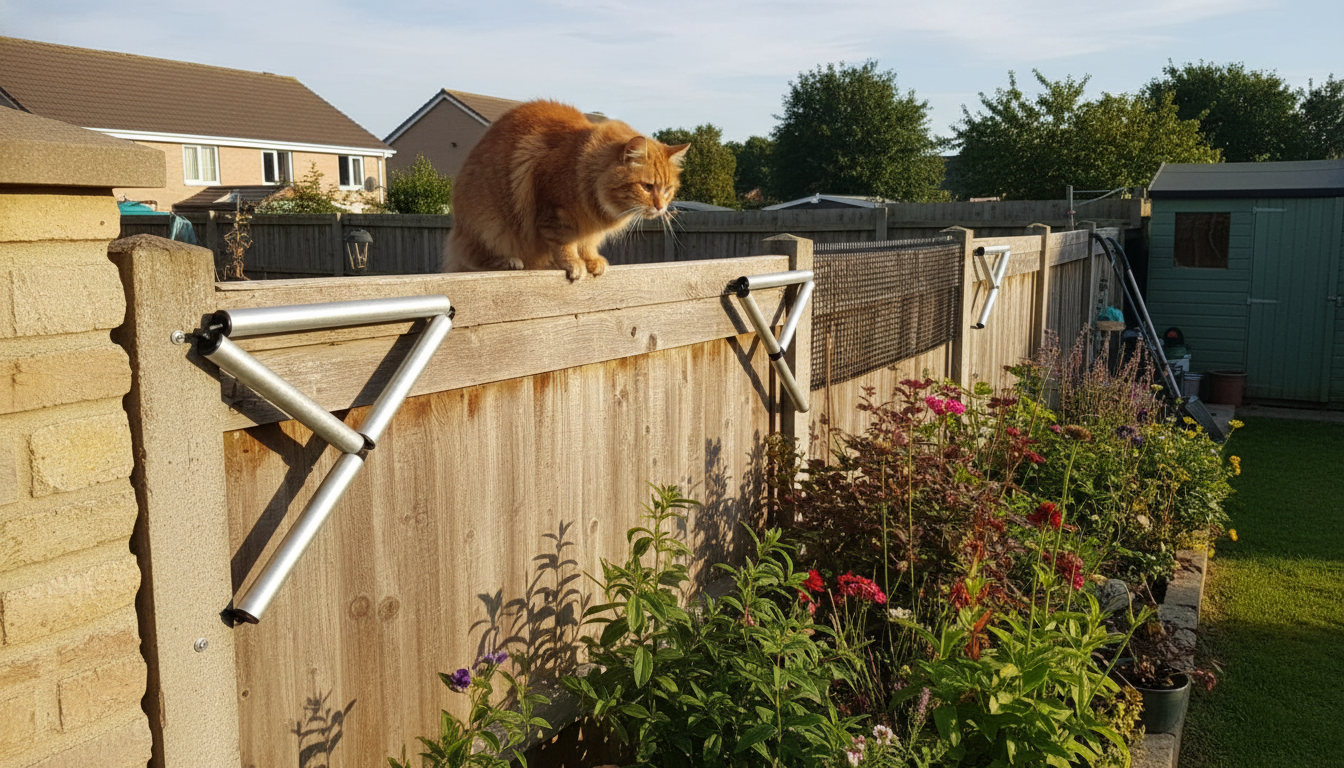
Cats love to explore. A standard fence is rarely enough to contain them, whether you want to protect your pet from road hazards or simply prevent neighborhood cats from invading your flowerbeds.
At Districlos, we are often asked how to secure a garden without turning it into a prison. The trick is simply to remove footholds or create an unstable obstacle that will deter the animal from climbing.
The Inward-Sloping Extension (or Cat Flap)
This is a classic method. You install a flexible mesh extension at the top of your fence, angled inwards at about 45 degrees. When the cat climbs and reaches the top, it encounters this “ceiling” and cannot tip over to the other side.
Installation is simple: brackets are fixed to existing posts, and then a net or fine mesh is stretched over them. The effectiveness of the device relies precisely on the flexible nature of the net. A cat dislikes moving surfaces. If it senses that the support is unstable, it will refuse to lean on it and will climb back down.
Rotary Rollers
If you have walls or rigid panels, you can attach a tube (plastic or aluminum) on a rotating axle along the top edge. As soon as the cat latches onto it to hoist itself up, the cylinder spins. The animal loses its balance and gently lands back on its paws.
This method is a little more expensive but remains one of the most reliable, especially for owners near busy roads. However, be careful: you must ensure that the mechanism continues to rotate freely after several months in rain and dust.
Remove Footholds
A cat needs to dig its claws in or find a ledge. Attaching smooth polycarbonate or plexiglass sheets to the upper part of a wooden fence will immediately block its ascent.
Also check the structure of your installation. A palisade with horizontal crossbars on the inside acts as a veritable ladder for a feline. If you need to install or change your equipment, we at Districlos advise avoiding these crossbars. Opt for rigid panels with very narrow mesh, where the animal cannot get its paw through. You can also insert PVC privacy slats, which smooth the surface and completely block claws.
Plant Deterrent Vegetation
Sometimes, simply preventing the cat from accessing the base of the fence is enough to curb its momentum. A dense hedge or prickly plants (such as holly, hawthorn, or barberry) placed in strategic locations will force it to seek another passage.
Certain odors also repel them. Rue, lavender, or the famous Coleus canina (which emits a faint skunk-like odor when brushed against) are often used around fences. Citrus peels scattered on the ground also work temporarily, but they need to be renewed after rain.
Block the View
A cat often climbs because it has spotted something on the other side: another cat, prey, or simply a new territory.
An open mesh fence is a real invitation. Installing a solid privacy screen breaks this dynamic. If the animal cannot see outside, its desire to go there drastically decreases. This is where dense screens or privacy kits prove useful. Without a clear visual target, most cats abandon the idea of climbing a blind obstacle and return to napping.
What Makes an Anti-Cat Device Fail
- An overly rigid extension: the cat leans on it and tips over. The flexibility of the net is the deterrent mechanism, not the height.
- A seized roller: after several months of rain and dust, an axle that no longer rotates becomes a simple handrail.
- Internal horizontal crossbars: these turn a palisade into a ladder, regardless of any device added at the top.
- Wide mesh: the cat gets its paw through and hoists itself up. Rigid panels with very narrow mesh, or fitted with PVC privacy slats, eliminate this grip.
- Unrenewed repellents: citrus peels lose their effect after the first rain.
Which Device for Which Type of Fence
| Device | Principle | Suitable Support | Point of Vigilance |
|---|---|---|---|
| Inward-Sloping Extension (Cat Flap) | Net or fine mesh stretched on brackets, angled inwards at about 45 degrees | Fence with existing posts | The net must remain flexible: instability is what deters |
| Rotary Roller | Plastic or aluminum tube on an axle that rotates under the cat’s weight | Walls and rigid panels | Higher cost; check that the axle still rotates after months of rain and dust |
| Smooth Sheets | Polycarbonate or plexiglass fixed at the top, with no grip for claws | Wooden fence | Also remove internal horizontal crossbars, which act as a ladder |
| Deterrent Vegetation | Prickly or odorous plants that block access to the base of the fence | Any type of fence with ground space | Citrus peels need to be renewed after rain |
| Solid Privacy Screen | Dense screen or privacy kit that removes the visual target | Open mesh fence | The screening must be total to break the desire to pass |
Frequently Asked Questions About Anti-Cat Fences
Should the inward-sloping extension be rigid or flexible?
Flexible. The effectiveness of the extension relies on the net or fine mesh stretched on brackets, angled inwards at about 45 degrees. A cat dislikes moving surfaces: if it senses that the support is unstable, it will refuse to lean on it and will climb back down.
Which method is most reliable near a road?
The rotary roller. The plastic or aluminum tube mounted on an axle rotates as soon as the cat latches onto it; the animal loses its balance and lands back on its paws. This is the most reliable solution for owners near busy roads, even if it costs a little more.
Why avoid horizontal crossbars on a palisade?
A palisade with horizontal crossbars placed on the inside acts as a ladder for a feline. It is better to use rigid panels with very narrow mesh, where the animal cannot get its paw through, possibly supplemented with PVC privacy slats that smooth the surface.
What plants deter cats from a fence?
Prickly plants like holly, hawthorn, or barberry block access to the base of the fence. For odors, rue, lavender, and Coleus canina, which emits a skunk-like odor when brushed against, are commonly used. Citrus peels on the ground also work, but they need to be renewed after rain.
Is a privacy screen enough to discourage a cat?
Often yes, because a cat climbs because it has spotted something on the other side: another cat, prey, or a new territory. A dense screen or privacy kit removes the visual target. With nothing to see, most cats abandon climbing a blind obstacle.
In brief: to prevent a cat from crossing a fence, remove footholds or create an unstable obstacle. Five solutions: a flexible inward-sloping extension at about 45 degrees, a rotary roller fixed to the top of the wall, smooth polycarbonate sheets or PVC slats, prickly or odorous plants at the base, and a solid privacy screen that removes the visual target.

Expert in fencing, gates, and outdoor landscaping since 2019.
Holds a Master’s degree in Digital Marketing – SEO, UX/UI.
View LinkedIn profile


