
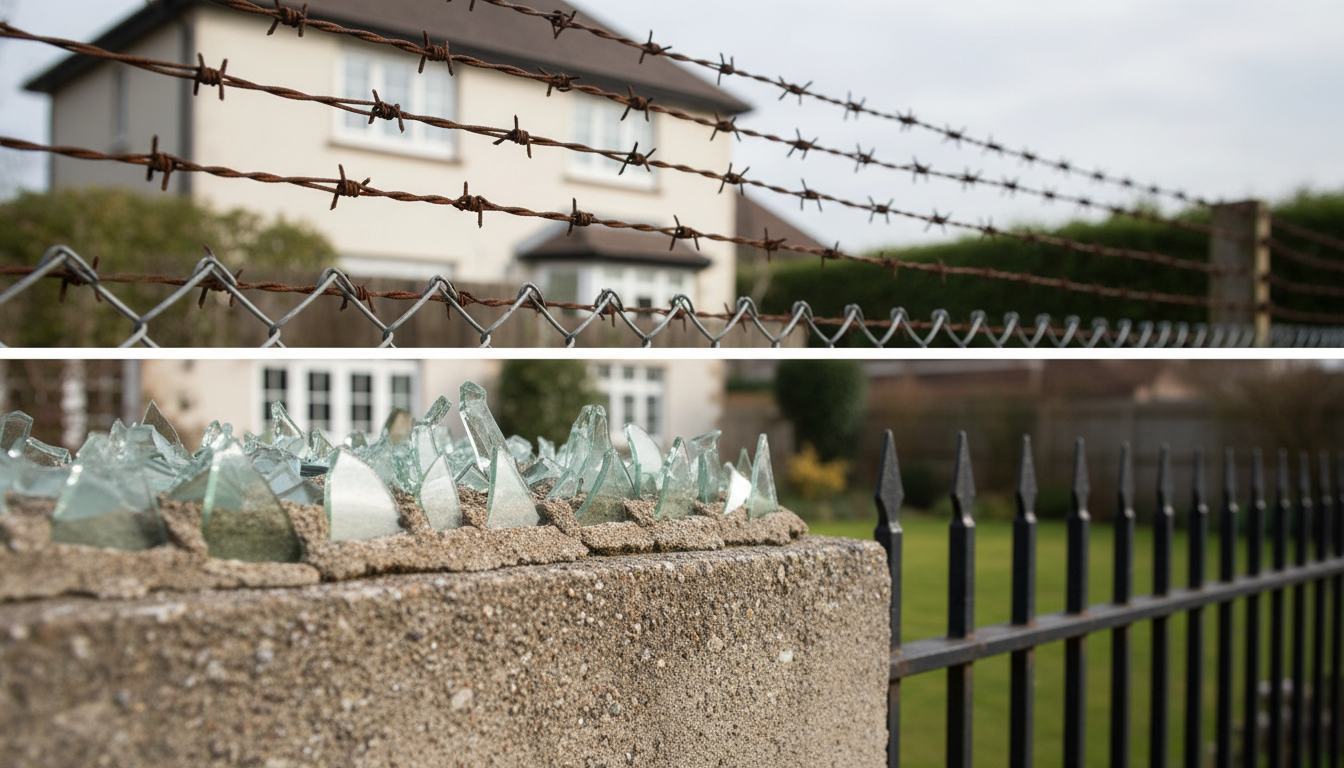
Barbed wire on top of a mesh fence, bottle shards sealed onto a low wall, metal spikes along a fence… Wanting to protect your property from intrusions is understandable. However, installing a defensive fence is not something you can do just any way you like. The law strictly regulates these devices, and if a third party is injured—even a burglar—you may be held liable. Here is what you need to know before installing this type of fence.
What is meant by a defensive fence
A defensive fence is any type of enclosure designed to deter or physically prevent someone from climbing over: barbed wire, concertina wire (coils of sharp blades), metal spikes, anti-intrusion spikes, crushed glass sealed along the top of a wall.
They are often seen in industrial or agricultural settings, or on certain sensitive sites. But as soon as you move into an urban or residential area, the rules change radically. French law clearly distinguishes the legitimate need to fence off your land from installing a device likely to injure someone.
The legal framework: what the law says
The right to enclose your property is guaranteed by Article 647 of the French Civil Code. Every owner may surround their plot with a fence. However, this right is not absolute. Article 1240 of the Civil Code (formerly 1382) sets out the principle of civil liability: anyone who causes harm to another through their fault must make reparation. Article 1242 extends this liability to things under one’s control, including a fence.
In practice, if a passer-by, a local child, or even an intruder is injured on your defensive fence, you may be held civilly and criminally liable. The courts consider the owner to be the person responsible for the fence and that they must control the risks it presents. The argument “they should not have come onto my property” is not enough to absolve you.
Barbed wire in town: a false good idea
In urban areas, municipal by-laws and local urban planning schemes (PLU) very often prohibit the use of barbed wire or sharp devices on fences facing the public highway or neighbouring properties. Some municipalities ban them entirely below a height of 2.50 metres.
Even without an explicit ban in the PLU, case law is strict. A judge may order the fence to be removed and order the owner to pay damages if the device is deemed disproportionate to the real risk of intrusion. The reasoning is simple: in a built-up area, the danger to local residents (children, pedestrians, animals) outweighs your right to security.
Criminal risks in the event of injury
Beyond civil liability, the consequences may be criminal. If someone is seriously injured on your fence, you may face prosecution for:
- Unintentional injury (Article 222-19 of the French Penal Code), with penalties of up to 3 years’ imprisonment and a €45,000 fine if the victim is unable to work for more than 3 months
- Endangering the life of others (Article 223-1 of the French Penal Code), if the device is clearly dangerous and you have taken no measures to provide warning signs or protection
The fact that the victim is a burglar does not automatically protect you. Self-defence does not apply to passive traps. Barbed wire does not distinguish between an intruder and a child retrieving a ball.
In rural or industrial areas: different rules
Context changes everything. On a farm, barbed wire remains common and is often tolerated to contain livestock or mark out plots far from homes. In industrial settings, high-security fences with concertina wire are permitted, provided local regulations are complied with and clearly visible warning signs are installed.
However, even in these cases, the owner’s liability remains. Poorly maintained barbed wire that injures a walker on a rural path, or unmarked concertina wire near a public trail—courts penalise the lack of precautions and the absence of warning signs.
What alternatives can secure your fence without legal risk?
There are effective solutions to deter intrusions without turning your land into a risk zone. A rigid fence of sufficient height (1.80 m to 2 m) is already a serious obstacle. Add a privacy screen or infill to remove visibility from the outside, and you significantly reduce your property’s appeal to a burglar.
Devices such as rounded fence spikes (standards-compliant), rigid panels with tight mesh, or lockable gates provide a good level of security while remaining legally sound. At Districlos, our teams can guide you towards deterrent, compliant fencing solutions suited to your land and your municipality’s regulations.
Check before installing: the right habits
Before installing anything, take the time to consult your municipality’s PLU (available at the town hall or online) and check any municipal by-laws. If your land is in a housing estate or a condominium, the internal rules may also impose restrictions. If in doubt, asking your town hall’s planning department will save you a lot of trouble.
Installing a fence, even a defensive one, means taking on long-term responsibility. It is therefore best to do things properly from the outset and choose a device that protects your property without exposing you legally.

Expert in fencing, gates, and outdoor landscaping since 2019.
Holds a Master’s degree in Digital Marketing – SEO, UX/UI.
View LinkedIn profile


