
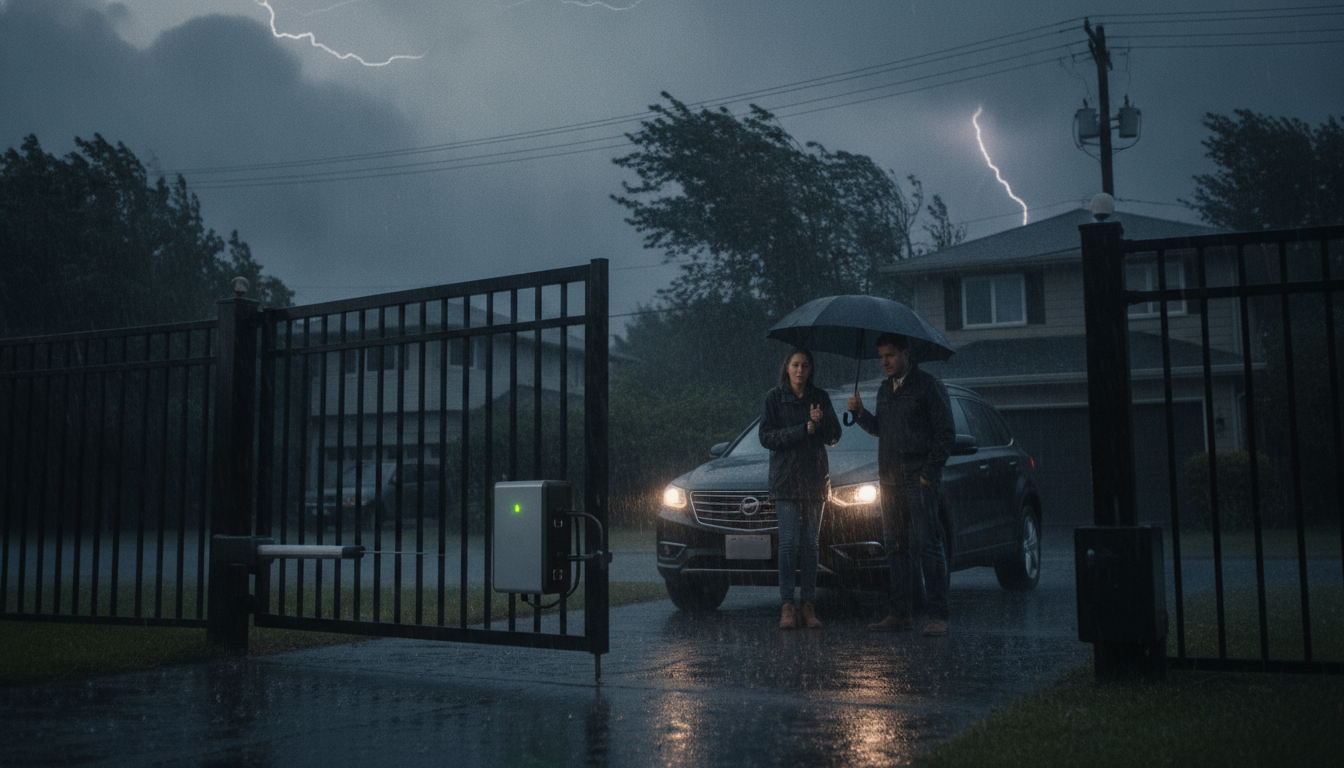
Power outage, electrical failure, storm that knocks everything out… and there’s your motorized gate stuck, with your car trapped outside or inside. Frustrating, isn’t it? That’s precisely where the backup battery comes in. But is it really an accessory you can’t do without, or just another marketing add-on? Let’s take a closer look.
What Does a Backup Battery Actually Do?
A backup battery, also called a standby battery, takes over as soon as your gate’s power supply is cut. It connects directly to the motor’s control board and recharges automatically when power is present. Result: even without electricity, your gate continues to open and close normally.
Depending on the model, a charged battery allows between 5 and 20 opening/closing cycles before running flat. That’s more than enough to cover an outage of several hours, until power is restored. For a swing or sliding gate, it’s the same principle: the battery ensures continuous operation without you having to lift a finger.
Isn’t Manual Release Enough?
Good question. All motorized gates are equipped with a manual release system, usually operated with a key. In the event of a failure, you can therefore disengage the motor and open the gate by hand. So why pay for a battery?
Because manual release has its limits. First, you have to get out of your vehicle, find the key, operate the mechanism sometimes positioned at ground level or in an awkward location. In the rain or at night, the exercise quickly becomes tedious. Second, a heavy sliding gate can be difficult to push manually, especially for someone alone or with reduced mobility. The backup battery spares you all this hassle: the ease of use remains identical, outage or not.
When the Battery Becomes Genuinely Useful
The relevance of a battery depends mainly on your situation and your region. It won’t have the same value for everyone.
- You live in an area regularly affected by power outages (rural areas, aging infrastructure)
- Your gate is your only access to the property, with no alternative pedestrian entrance
- You have a heavy sliding gate that’s difficult to maneuver by hand
- An elderly person or someone with reduced mobility uses the gate daily
- You’re often away and want to guarantee reliable access in all circumstances
Conversely, if you have an independent pedestrian gate for walking in and outages are rare in your area, the battery is more a matter of convenience than absolute necessity.
Backup Battery and Security: A Point Not to Overlook
Beyond simple convenience, the battery also plays a role in your security. A gate stuck in the open position during an outage is an open door to your property. With a battery, the gate closes as usual, which maintains your level of protection against intrusions.
This also applies to homes equipped with connected systems or home automation. The battery ensures that your installation remains operational continuously, without interruption. A detail that takes on its full meaning when the motorization is integrated into a broader security setup (video intercom, alarm, automatic lighting).
Compatibility and Installation: What to Check
Not all backup batteries suit all motors. You must choose a model compatible with the brand and reference of your motorization. Most major brands (Nice, Somfy, BFT, Came…) offer their own dedicated battery, designed to fit directly into the motor housing.
As for installation, the good news is that fitting remains straightforward on most recent models: the battery clips into a designated slot and connects to the circuit board. If you’re reasonably handy, it’s doable on your own. If in doubt, it’s better to verify compatibility before purchase to avoid an unpleasant surprise. At Districlos, our customer service team helps you find the battery suited to your installation.
How Much Does It Cost and What Lifespan to Expect?
The price of a backup battery for a gate generally ranges between €40 and €150, depending on the brand, capacity, and type of motorization. A measured investment given the convenience provided, especially compared to the overall cost of a complete motorization system.
In terms of longevity, a battery lasts on average 3 to 5 years before losing efficiency. It’s a wear item: like any battery, it eventually stops holding a charge and will need replacing. Nothing alarming—just keep this in mind to anticipate replacement when the time comes, rather than discovering it during an outage.
So, Essential or Not?
It all depends on your usage. The backup battery is not technically mandatory since manual release exists. But as soon as you’re looking for genuine everyday convenience, you live in an area prone to outages, or your gate is your only access, it becomes an accessory that’s hard to overlook. For a modest budget, it transforms a potential inconvenience into a simple non-event: the power goes out, and you keep going through without even thinking about it.

Expert in fencing, gates, and outdoor landscaping since 2019.
Holds a Master’s degree in Digital Marketing – SEO, UX/UI.
View LinkedIn profile


