
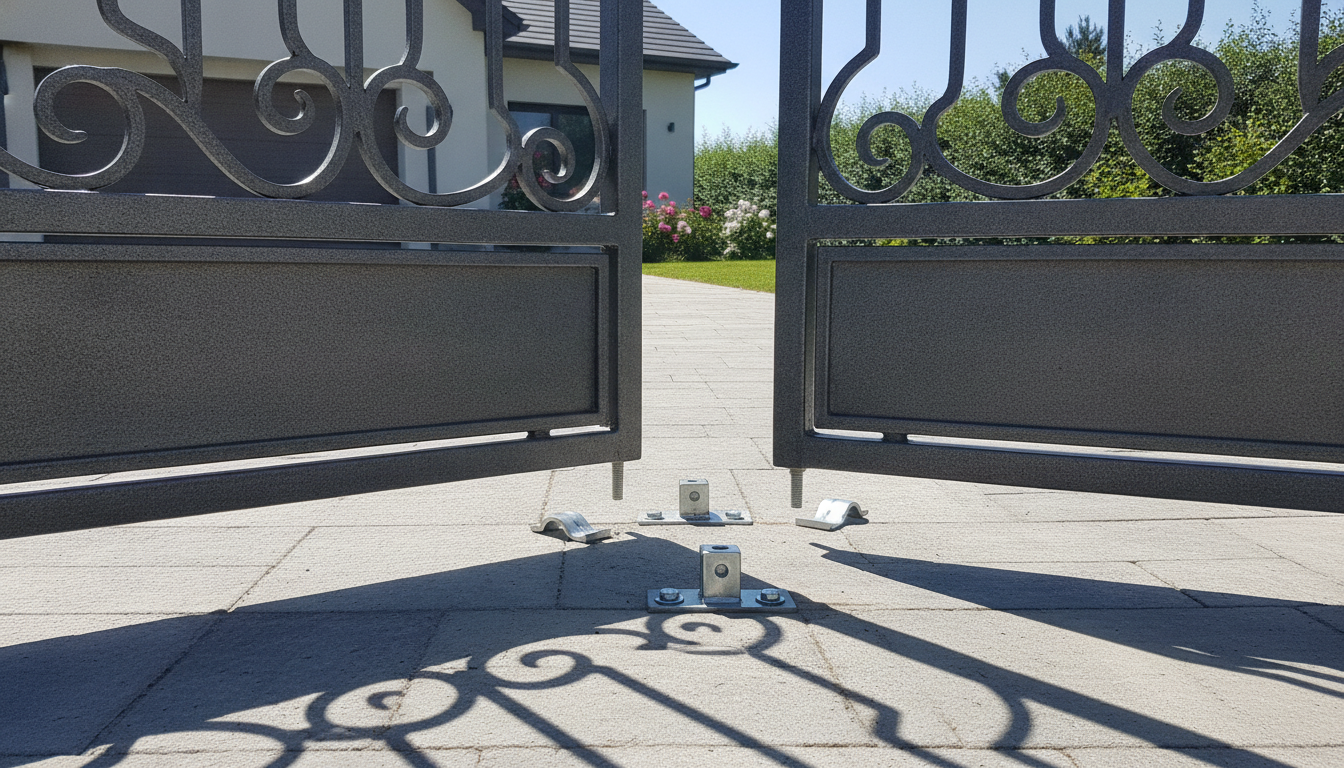
You have just installed a beautiful swing gate, and one detail is bothering you: those small metal parts you are advised to set into the ground. Stop, centre stop, opening stop… What are these accessories, which people tend to overlook, really for? Spoiler: they protect your gate, extend its service life, and prevent a lot of hassles. We explain everything.
What a gate stop is actually for
The gate stop has a simple but essential role: it stops the leaf at a precise point to prevent it from going too far. Without it, your gate keeps moving until something stops it—a wall, a post, or worse, the mechanism itself. Over time, this damages the hinges, strains the structure, and can even warp the gate.
In practical terms, the stop absorbs the impact and limits the opening or closing travel. This is especially true for motorised gates: the motor always pushes with the same force, and without a reliable stopping point, it would strain the fixings with every operation. The stop is therefore the safeguard that protects everything else.
Stop, ground stop, centre stop: are we talking about the same thing?
Not exactly. These terms refer to parts that look similar but do not have exactly the same function. Here is how to tell them apart:
- The ground-mounted centre stop: placed in the middle of the opening, it holds both leaves in the closed position. It prevents the gate from swinging inward beyond the desired alignment.
- The opening stop: positioned on the sides, it stops each leaf when fully open, so it does not hit the wall or the fence.
In everyday language, people often use stop to refer to either one. The principle remains the same: providing a clear, solid stopping point for the leaf, in one direction as well as the other.
Why it is essential on a swing gate
A swing gate works with leaves that pivot. This movement inevitably creates stress on the hinges with every opening and closing. If the leaf has no stopping point, all that force is transferred directly to the hinges and the anchoring point. After a few months, the result is play, squeaking, and a gate that starts to sag.
The centre stop also plays a role in the gate’s perfect closure. Without it, the two leaves can overlap or fail to align correctly, which prevents the lock from engaging properly. With a well-positioned stop, the leaves stop exactly where they should and the gate closes without forcing.
The key role for motorised gates
It is on automatic gates that the stop becomes truly important. A motor, unlike a human hand, does not feel resistance. It pushes until its programmed travel is complete. If a reliable physical stop is not in place in the right spot, the motor may push against the leaf or miscalibrate its stopping position.
Most gate operators also require a mechanical stop in the closed position to work properly. This hard stop serves as the reference point the motor uses to set its travel. Neglecting this element means risking premature wear of your operator, which costs far more to replace than a simple stop set into concrete.
How to choose the right ground stop
The choice depends first on the weight and material of your gate. A lightweight aluminium gate will not have the same needs as a heavy wrought-iron gate. The heavier the leaf, the more the stop must be robust and securely anchored to withstand repeated impacts.
Also consider these criteria before buying:
- Stop height: it must match your gate’s ground clearance, without risking blocking the passage or being too low to stop the leaf.
- Fixing type: to be set into concrete for maximum hold, or screwed onto an existing slab.
- Finish: choose a galvanised or anti-corrosion-treated model, since it remains permanently exposed to the weather.
Installation: a few points not to miss
Installing a ground stop is not complicated, but positioning makes all the difference. You need to open or close the gate to the desired position, mark the exact spot where the leaf makes contact, then set the stop there. A shift of just a few centimetres and the stop will no longer do its job.
For setting into concrete, allow sufficient drying time before putting the stop under load; otherwise it will move at the first impact. If you are installing on an existing slab, use anchors suitable for the load and check that the base is thick enough to hold over time. A poorly fixed stop that comes loose means the gate goes back to its bad habits.
A small accessory to prevent big problems
It is easy to see the ground stop as a minor detail. Yet this low-cost part protects your entire installation: hinges, structure, lock and, above all, the operator. It is exactly the kind of accessory that, when properly chosen and installed, saves you from costly repairs several years later.
At Districlos, you will find stops, centre stops and accessories suited to all types of swing gates, in stock and available in-store or for delivery. Our customer service team will help you choose the model that matches your gate. Entrust your project to us!

Expert in fencing, gates, and outdoor landscaping since 2019.
Holds a Master’s degree in Digital Marketing – SEO, UX/UI.
View LinkedIn profile


