
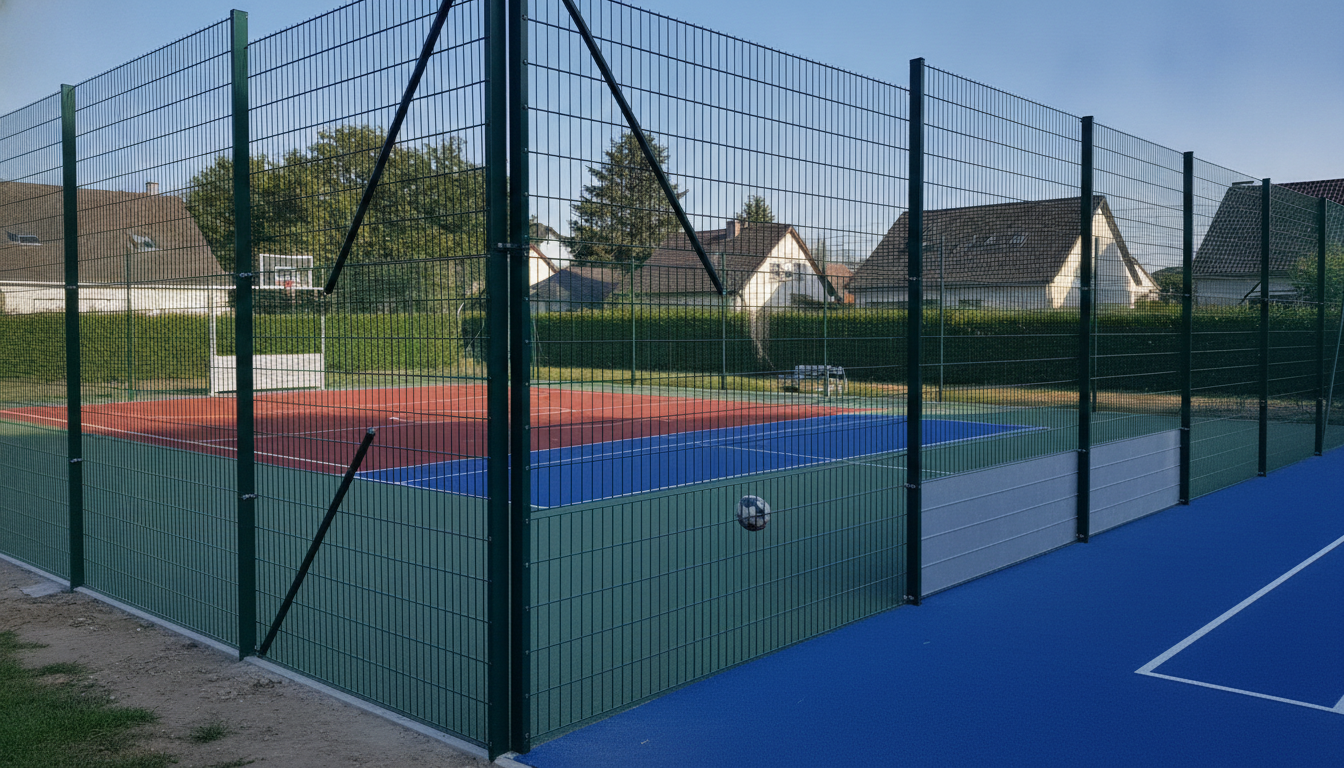
Installing fencing around a tennis court or multi-sports field requires careful planning. Between regulatory height, resistance to ball impacts, and safety requirements, every detail counts. Poorly designed equipment means balls flying into the neighbor’s yard, fencing bending with the first powerful shot, and frustrated users. Here’s what you need to know before you start.
Why Fencing for a Sports Field Is Not Ordinary Fencing
A tennis court or multi-sports field generates repeated and sometimes violent impacts. A tennis ball hit with a forehand can exceed 150 km/h, and a football slammed against the fence exerts enormous pressure. A classic garden fence would not last the season.
The fence must therefore contain balls within the court, protect players and passers-by, and withstand impacts and bad weather over time. We are talking here about equipment sized for intensive use, with reinforced posts and mesh adapted to the sport being played.
What Height for a Tennis Court?
The reference standard in France is NF P90-110 for tennis sports equipment. It recommends a minimum fence height of 3 meters around the entire perimeter, and sometimes 4 meters behind the baseline, where balls travel the furthest.
This height difference is not a minor detail. It is at the baseline that balls rise and escape most easily. Providing additional height at the back prevents constant trips to retrieve balls and secures external areas. On the sides, 3 meters is generally sufficient for recreational or club use.
Standards for a Multi-Sports Field
The multi-sports field, or multi-sport area, complies with standard NF EN 15312, which governs freely accessible sports equipment. This standard concerns both the structure and user safety: no sharp angles, no risk of entrapment, secure fastenings.
The fence height generally varies between 3 and 4 meters, with solid or mesh panels at the bottom to keep the ball in play. Goals and baskets integrated into the structure must also meet stability and resistance requirements. As a multi-sports field is often installed in a public space, robustness and resistance to vandalism are paramount.
What Type of Mesh to Choose
The choice of mesh and material depends directly on the intended use. For a sports field, robust and durable solutions are preferred:
- Galvanized and plastic-coated chain-link fence: economical, flexible, it absorbs tennis ball impacts well. Ideal for courts and recreational use.
- Rigid double-wire panels: more resistant and aesthetic, perfect for multi-sports fields subject to intensive use and potential damage.
The mesh must be tight enough to retain tennis balls (generally 45 x 45 mm or less for chain-link) while allowing light and air to pass through. For a multi-sports field accommodating larger balls, the mesh constraint is less strict, but the solidity of the panels is paramount.
Posts and Foundations: The Basis of a Durable Fence
A sports fence is only as good as its posts and anchors. At 3 or 4 meters high, wind resistance is significant, and repeated impacts place considerable stress on the structure. Therefore, reinforced galvanized steel posts, sealed in concrete blocks, are used.
The post spacing is generally between 2.50 and 3 meters to ensure the overall rigidity. Braces at corners and ends reinforce stability. Neglecting this step risks the fence sagging or deforming after only a few months.
Safety and Accessibility: What Not to Forget
Beyond height and resistance, user safety remains a priority, especially for public facilities. Wire ends must be protected, access gates must open easily without creating a danger zone, and no protruding elements should extend onto the playing area.
Also consider PRM accessibility for facilities open to the public: sufficient passage width at gates, adapted thresholds. A well-executed project anticipates these constraints from the design stage rather than correcting them afterward.
Making the Right Choice with Districlos
Choosing the right fence for a tennis court or multi-sports field requires considering several criteria: height, mesh, robustness, standards, and budget. At Districlos, our teams assist individuals, clubs, and communities in selecting equipment adapted to their sport and use.
Chain-link fencing, rigid panels, reinforced posts: our professional products are in stock, available in stores throughout France or delivered directly to your site. Unsure about the best solution for your project? Our customer service is here to advise you.

Expert in fencing, gates, and outdoor landscaping since 2019.
Holds a Master’s degree in Digital Marketing – SEO, UX/UI.
View LinkedIn profile


