
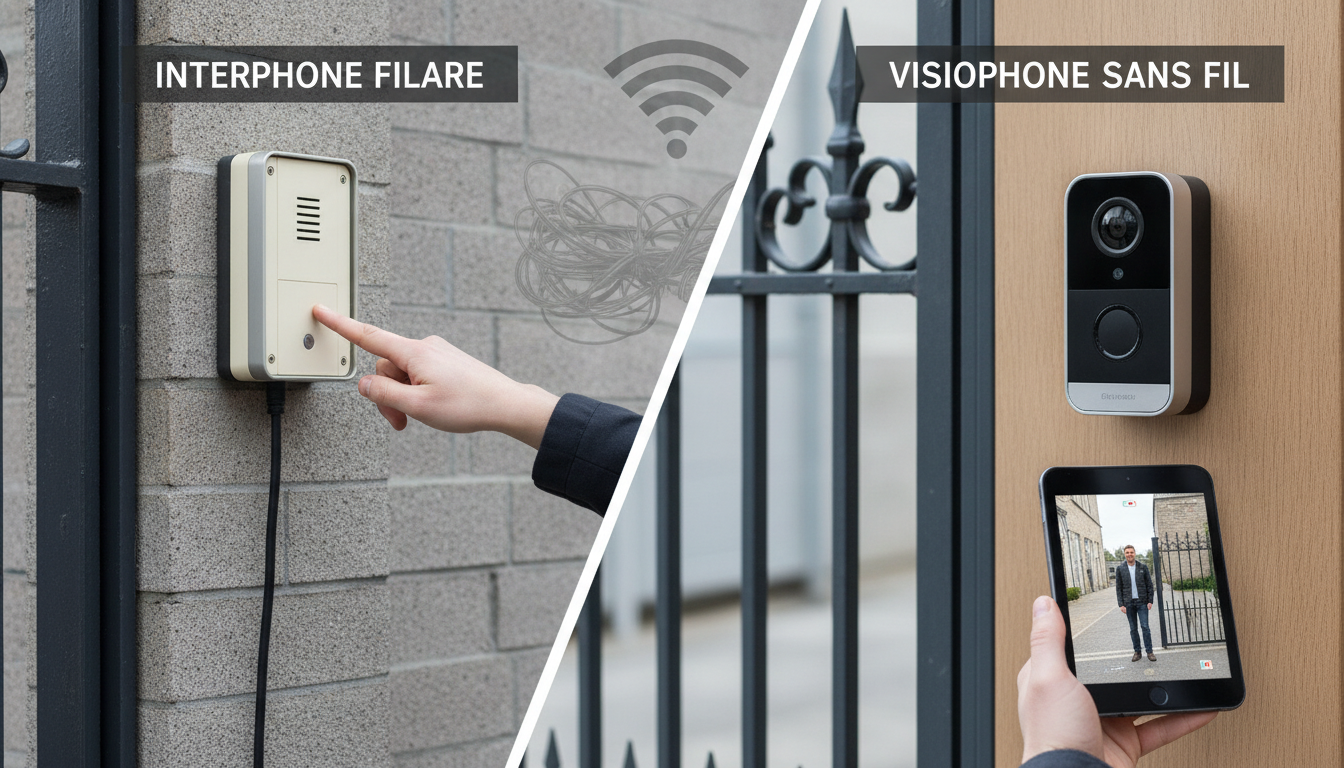
Want to know who is ringing at your gate before opening? Two main solutions are available: the intercom (audio only) or the video intercom (audio + video). And for each, you need to choose between wired and wireless. Each option has its advantages, installation constraints, and budget. We break it down to help you choose the right equipment based on your property, the distance to cover, and your DIY skills.
Intercom or Video Intercom: What’s the Difference?
The intercom is the simplest system: when a visitor rings, you communicate by voice and decide whether to open or not. It’s effective and economical, but you cannot see who is at the gate.
The video intercom adds a camera to the outdoor panel. On the indoor screen, you see your visitor in real time. This is a real plus for security, especially if you live alone, have children, or want to screen door-to-door salespeople. Today, most new installations use video intercoms, as prices have dropped significantly in recent years.
Wired: Reliable but More Demanding to Install
A wired system connects the outdoor panel to the indoor monitor via cable. This is the most stable solution: no risk of interruption from interference or a dead battery, and the image remains clear even at a distance.
The downside is the installation. You need to run a cable between the gate and the house, which sometimes means digging a trench, running conduit under a driveway, or along a fence wall. If you are building new or doing major renovations, this is the ideal time to plan for this run. On an already finished house, the work can quickly become extensive.
Wired is the right choice in several cases:
- Significant distance between the gate and the house
- Desire for maximum reliability with no maintenance
- New construction where conduits are already in place
Wireless: Quick to Install, but with Limitations
The wireless system communicates via radio waves between the panel and the monitor. Its main advantage: no cable to run, so installation takes just a few hours with no trenching work. It’s the perfect solution for equipping an existing home or a rental property.
Be aware, however: the range advertised by manufacturers corresponds to open space. As soon as the signal must pass through a thick wall, a solid sheet-metal gate, or several partitions, the actual distance drops sharply. Models often run on battery power on the panel side, requiring regular recharging or a small solar power supply. Finally, image quality and responsiveness generally remain below that of a good wired system.
What Distance and Gate Type Do You Have?
Before choosing, measure the actual distance between the panel location and the monitor location. Under 100 meters with no major obstacles, a quality wireless system will work. Beyond that, or if the signal must pass through several walls, wired remains more reliable.
The type of gate also matters. A solid aluminum or steel gate creates a real barrier to radio waves. In this case, it’s better to position the panel on a masonry pillar or go directly with wired. Also consider opening control: most video intercoms can operate an electric strike or gate automation system, provided you verify compatibility before purchase.
Budget to Plan For
Price-wise, the intercom remains the most affordable option, starting at a few dozen euros for a basic model. The wireless video intercom falls in the mid-range, with the advantage of no installation costs if you install it yourself.
The wired video intercom is often more expensive to purchase, and especially to install if you need to hire a professional for cable runs. But over time, it saves you from replacing batteries and signal loss. It’s an investment that pays off if you’re looking for durable equipment with no surprises.
How to Choose Your Model Properly?
The right choice depends on a balance between your existing installation, the distance to cover, and your budget. For a new home or renovation with access to conduits, go with wired: you gain reliability for years. To quickly equip an already built house, wireless saves you major work, provided you verify the actual range with your walls and gate.
Also look at additional features: color screen, night vision, visitor recording, remote opening from a smartphone, compatibility with your gate automation. These options make a real difference in daily use. At Districlos, our advisors help you choose the equipment suited to your fence and gate project, with products in stock, available in-store or delivered directly to you.

Expert in fencing, gates, and outdoor landscaping since 2019.
Holds a Master’s degree in Digital Marketing – SEO, UX/UI.
View LinkedIn profile


