
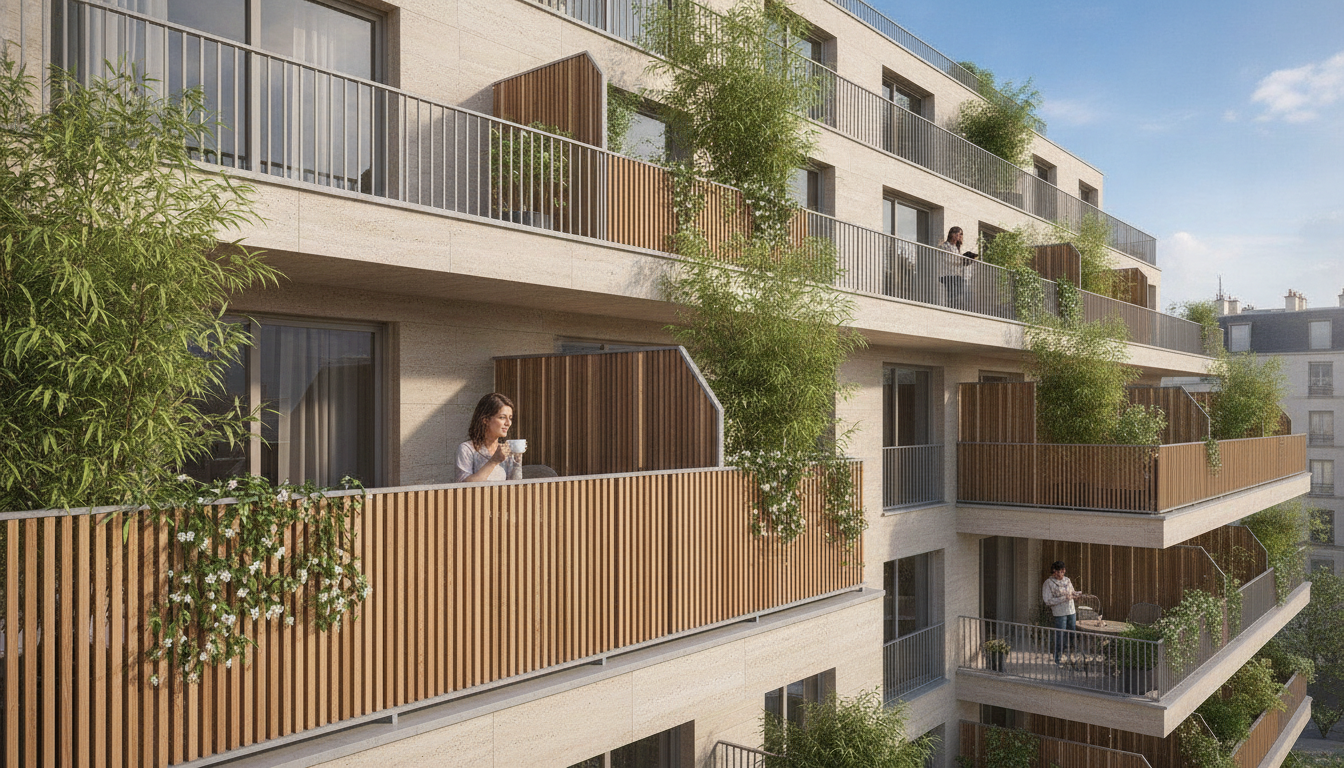
Do you want a bit of privacy on your terrace without the whole building watching? In a co-owned building, it is not as simple as putting up a privacy screen and enjoying your coffee in peace. Between the co-ownership rules, the building’s exterior appearance and your neighbours’ agreement, screening off a fence takes a minimum of preparation. Here is how to go about installing compliant screening, without drawing the managing agent’s ire.
Check the co-ownership rules first
Before you get the drill out, open your co-ownership rules. This document governs anything that affects the building’s exterior appearance, and your terrace is part of that, even if you have exclusive use of it. Many co-owned buildings impose specific rules: privacy-screen colour, maximum height, permitted materials, or even an outright ban on any screening visible from the street.
The aim is to preserve the visual harmony of the façade. A balcony with green reed screening when all the others are bare will stand out. So read carefully the clauses concerning common areas for private use: that is often the status of a terrace or balcony in a co-owned building. If in doubt, a quick word with the managing agent will save you a lot of trouble.
Approval from the general meeting: essential or not?
It all depends on the nature of your work. Simple removable screening, such as a fabric privacy screen fixed to your own railing without drilling into the structure, is generally fine. However, as soon as you change the exterior appearance or fix something permanently, general meeting approval becomes mandatory.
In practical terms, you will need to add the item to the agenda of the next general meeting and have the co-owners vote. The vote is most often by simple majority, but for a change affecting the exterior appearance, a qualified majority may be required. So it is best to plan ahead: prepare a clear description of your project, including the product type, its colour and how it will be fixed. The more watertight your request is, the more likely it is to be approved.
Choose discreet, compliant screening
Ideally, opt for screening that blends into the surroundings. A neutral shade such as anthracite grey, dark green or beige is more likely to be accepted than a garish pattern. Also think about consistency with the other balconies: if all your neighbours have installed the same type of privacy screen, choose the same model—it makes approval easier.
Several solutions are available depending on your budget and constraints:
- Fabric privacy screen: lightweight, affordable and easy to attach with cable ties, without drilling.
- Composite or PVC screening panels, more rigid and durable, but often requiring a permanent fixing.
- Natural reed screening (bamboo, willow): attractive, but less durable over time and sometimes prohibited on the façade.
Prioritise no-drill fixings
In a co-owned building, anything that affects the building structure is sensitive. Drilling into a wall, a metal railing or a slab can make you liable if damage occurs, and weaken elements that often belong to the common parts. The safest solution is therefore no-drill fixing.
Grommeted privacy screens can be fixed perfectly with cable ties or tensioners directly onto your railing bars. It is reversible, neat, and it allows you to remove everything without leaving a trace if you move out or if the managing agent changes their decision. A good way to stay compliant while gaining your privacy.
Size your screening correctly
There is nothing worse than a poorly fitted privacy screen that flaps in the wind or leaves bare areas. Before buying, measure the length and height of your terrace fence precisely. Always allow a small margin for material tension and fixing.
Also watch out for the maximum permitted height. Some co-owned buildings limit screening to the height of the existing railing, with no overhang. Screening that is too high may be seen as a visual extension of the façade and be refused. Check this point before ordering—it will save you from having to cut everything down again.
Manage your relationship with neighbours
Screening protects you from prying eyes, but it can also block your neighbour’s light or view. In a co-owned building, neighbour relations matter as much as the rules. Before installing anything, inform the co-owners directly concerned, especially those whose balcony adjoins yours.
A neighbour who has been informed and reassured about how your installation will look will be your best ally on voting day at the general meeting. Conversely, a “sneak” installation can lead to tension, or even a legal request for removal. It is better to be transparent from the start: it costs one conversation and avoids months of conflict.
Seek expert advice
Between technical constraints, material choice and dimensions, it can be helpful to be supported with your project. At Districlos, our teams will guide you towards screening solutions suited to installation in a co-owned building: grommeted privacy screens, composite panels, reversible fixings. Everything is in stock, with in-store pickup or fast home delivery.
Whether you are a private individual or a professional, our customer service will advise you on the most discreet and most robust product for your terrace. Once the managing agent’s approval has been obtained, all that is left is to install your screening and finally enjoy your outdoor space, sheltered from view.

Experte clôture, portail et aménagement extérieur depuis 2019.
Diplômée en Master de Marketing digital – SEO, UX/UI
Voir le profil sur LinkedIn


